HappyDude88's Search

About Me

My photo
Hello, this is Siwri88, better known to some as Simon. Currently work as a picture researcher and product editor with a leading publishing company that works with trading cards and sticker albums on a variety of licenses in sport and entertainment. Freelance Journalist and writing a book in my spare time. Achieved a 2:1 studying BA Hons Journalism at the University of Northampton (2009-2012). Enjoy reading!
Showing posts with label BBC. Show all posts

Thursday, 24 November 2011

BBC F1 - Another broadcasting chapter ends

NOT only does the 2011 FIA Formula One world championship ends this weekend, but it will also feel like the end of an association for many Grand Prix petrol heads.  Television viewing changes next year and the BBC is taking a backseat from its coverage of one of the most colourful and glamorous sports in the world.  2011 has been the final season where you will be able to watch every single Grand Prix on free-to-air television.  From next season, Sky Sports becomes the home of Formula One racing.     
     Under the controversial new deal, signed at July’s Hungarian Grand Prix, Sky subscribers will get extensive previews to races, plus live coverage of every single practice, qualifying and race event from the currently 20 scheduled events in next year’s championship.  The deal runs until 2017.  The BBC has had to scale back its coverage, due to sweeping budget cuts.  It decided to do this, despite recently renewing deals for the Six Nations and the Wimbledon tennis championships.  However, they will still screen ten live weekends next year of all sessions, plus delayed highlights of the other ten events it will not show live.  Monaco, the season finale in Brazil and the British Grand Prix will be definitely covered in the agreement by the BBC, while there is still an announcement pending over the other seven races.  Pundit teams have also yet to be revealed, although we do know that Jake Humphrey will still be fronting BBC’s coverage, whilst Martin Brundle is debating over taking over as the lead commentator for Sky Sports, or staying on as the leading anchor for the BBC.
       The BBC has a prestigious history of screening Formula One, even if that is not so much in recent times.  They began showing live coverage of the entire Grand Prix season from 1978 onwards.  ‘Grand Prix,’ became the home of F1 for 18 years, until 1996.  They showed the drama of Alain Prost and Ayrton Senna's dramatic collisions in successive years at Suzuka, Nigel Mansell's spectacular tyre blowout that robbed him of the 1986 championship and Damon Hill's popular title success in 1996 which had Murray Walker literally with a lump in his throat.
    In 1997, ITV outbid the BBC to take the rights away for 12 seasons.  Although the levels of extensive coverage improved from BBC’s output, especially in the early days, its later years were seen as a massive letdown for fans.  Commercial breaks during some huge moments in events, including the embarrassing faux-pas at the 2005 San Marino Grand Prix added to the mounting frustration.  In March 2008, ITV announced their F1 exit for commercial pressures; three years before their current deal was due to expire.  The BBC took back the rights for 2009 on a new five year deal.  Formula One was coming home!
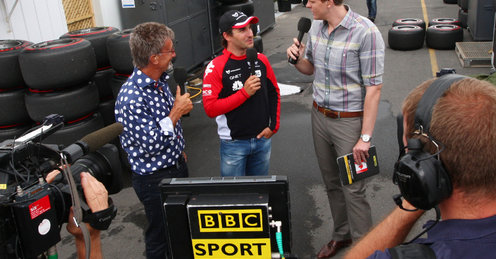
      Jake Humphrey was preferred to Steve Rider in taking over the hosting duties.  He was joined in the paddock by Eddie Jordan and newly retired David Coulthard, who have certainly added plenty to the coverage, especially Eddie’s horrific choice of shirts!  Jonathan Legard, who had previously covered F1 for BBC Radio 5 Live became lead commentator, whilst both Brundle and Ted Kravitz switched from the ITV team to the BBC crew.  Lee McKenzie, an experienced motorsport presenter from A1GP and GP2 joined Ted in reporting from the pitlane and the legendary voice of Formula One, Murray Walker, has been part of the team too, previewing, reviewing and answering burning questions from fans on a regular basis.
        The BBC era started brilliantly and in a way, they took over from where ITV left off, with a British world champion.  Jake and the team did magnificently to interview Jenson Button in a massive media scram only moments after he had clinched the championship in sensational style in Brazil.  They took coverage to a new level, with every session on the red button and all qualifying and race events on BBC One, with a prime time highlights package on freeview station BBC Three.  BBC built on this in 2010 and has also given plenty of time for analysis from the action, which has included the popular F1 Forum.  The forum lasts an hour online and on the red button after every race.  Blogs from the presenters on the BBC F1 website, Ted Kravitz’s behind the scenes report from the pitlane and features such as Classic F1 have only added to the experience. 
       There was a minor change to the team in 2011, when Legard was dropped from the team and Coulthard joined Brundle in the commentary box; Brundle moving into the lead role having been the expert provider since 1997.  TV ratings have always been very high, peaking regularly on raceday at between five and seven million viewers.  It won the BAFTA for Sport in 2011, thanks to its coverage of the season decider 2010 Abu Dhabi Grand Prix, which saw Sebastian Vettel take the title in the first four way showdown ever.  Its impeccable coverage of the sensational Canadian Grand Prix this season, which lasted nearly five hours, means it, will be a favourite for more awards in 2012.
       This isn’t the end for the BBC and the F1 partnership, as they will still be giving us unbeatable coverage in 2012 and for the next five seasons afterwards, but on a more reduced scale which is a big disappointment to the normal viewer.  Money talks in this business and it is clear that BSkyB has this in abundance.  I have no doubt that Sky Sports has the ability to take F1 coverage to another level, like they have with the Premiership since 1992, but they will never get the same audience appeal that the BBC has enjoyed in the last three seasons.  Enjoy the Brazilian Grand Prix weekend everyone, as another F1 broadcasting chapter reaches a conclusion.

Sunday, 20 November 2011

Children in Need 2011 - A record breaking night

By Jason Wright (Entertainment expert)


RECORDS: Children in Need was very popular again with the public

FAMOUS faces were out in force again at Television Centre for the 32nd staging of the popular BBC Children In Need telethon night.  BBC One, as ever, cleared its Friday night schedules for the seven and a half hour marathon of music and entertainment in the aid of giving disadvantaged children a helping hand.
     Sir Terry Wogan again oversaw the proceedings across the night and was joined by Alisha Dixon (7:30pm-8:30pm), Tess Daly (8:30pm-10:00pm) and finally Fearne Cotton (10:35pm-2:00am.)  With the financial times getting so tough, it was predicted that the appeal night total would be down again for the third year in a row.  They were wrong!
     X-Factor boyband One Direction were the headline act of performances, getting the girls screaming out more as usual.  JLS, Susan Boyle, the reunited Steps, Olly Murs and the Saturdays, which saw Frankie Sandford make a surprise return to the band after several months away due to illness, were among the other musical guests on the show.  For this year’s official single, Take That and new X-Factor head judge, Gary Barlow gathered some of the finest acts from the R&B and hip-hop scene, including Rizzle Kicks, Tinchy Stryder and Tulisa from N-Dubz to perform his self-penned song ‘Teardrop.’  The song however was blighted with a sound failure in the microphones during its performance on the show.
     BBC programmes once again got in on the act.  The cast of EastEnders paid tribute to rock legends Queen, Lord Sugar took on the terrifying Dragons in a special Dragons Den sketch.  There was a special edition of Never Mind the Buzzcocks shown on BBC Two during the interlude on BBC One for the Ten O’clock News and Doctor Who fans were treated to a special sneak preview of the upcoming Christmas episode.  BBC Radio 2 rose over £2 million through their popular ‘Money Can’t Buy’ auction and ‘Music Marathon’ events.
     Of course though, Children In Need wouldn’t be the same without something from the BBC News team.  This year, four of the presenting team – Emily Maitlis, Sophie Raworth, Susanna Reid and Sian Williams joined forces with four professionals from Strictly Come Dancing for a special group dance.  Strictly is one of a few programmes to raise interest in Children In Need, and this weekend’s show is being broadcast from Wembley Arena in front of an audience of 6,000.  In three weeks from now, 10,000 will be seated inside the same arena for the X-Factor final weekend.

     Outside of appeal night, other companies have been offering their support for good causes.  Some of the most highlighted were:
·         ASDA sold a wide variety of Children In Need kitchenware and Pudsey Bear gingerbread biscuits.
·         Greggs sold Children In Need themed cupcakes and doughnuts.
·         Boots sold Pudsey teddy bears along with key rings and wristbands.  Wristbands were also on sale in Post Offices.
·         Welcome Break motorway service stations and CostCo cash & carry stores displayed donation boxes.
·         Build-A-Bear Workshop had Pudsey teddy bears in a wide range of different outfits.
     All that, along with the rolling donations from the night, ensured that Children In Need against all odds broke the record for an on-the-night total, raising a massive £26,332,334.  This was over six million higher than the previous record set in 2008.  The final total is already projected to hit over £45 million.
     It proved that despite the doom and gloom on the financial market that for just that one night, Britain can afford to pick their phones and give some money in the aid of a good cause.

Thursday, 13 October 2011

The Finishing Straight - Japan (by HappyDude88)

SO, IT is now all officially over.  Sebastian Vettel is world champion and becomes only the ninth driver in history to become a back-to-back title winner.  It’s a prestigious list he joins, with the likes of Fangio, Schumacher, Senna, Prost and Alonso among those to have achieved an incredible feat.  The emotion on his face when the BBC played back the wonderful montage of back-to-back champions was genuine and he is such a nice bloke too.  Sometimes in Formula One, you have to appreciate greatness rather than moan about domination.  Vettel totally deserves the title this season; he has been in a class of his own.  I will be doing a special blog about the back-to-back champion at a later date.
      However, Sebastian had to share the honours on Sunday with Jenson Button, who drove flawlessly again to record his first dry win in a McLaren.  His win was another example of stunning driving and he has totally proved those critics, including myself, who said he made a severe error of judgement in leaving Brawn GP for McLaren in 2009.  Button is now the defunct no.1 at McLaren and I hope he hangs onto second place in the championship.  Again, this win means a lot for Button – with his Japanese girlfriend, Jessica at his side, plus the seven seasons he spent driving for BAR/Honda.  He has a close affinity with Japan and is effectively a second home race.  Jenson is driving out of his skin at the moment and has the ability now to go on and potentially win a second championship.
     The talking point of the race was Vettel’s move on Button at the start of the race.  Having been pipped by 0.009secs in qualifying, Button was keen to get the lead from the start.  He made a slightly better start, but Sebastian gradually squeezed him out of space.  He left Button with a rather brutal choice; back off or risk a crash and sensibly, Jenson chose the former.  However, I’ve seen far worse moves at the start of the race and gone unpunished.  It deserved a closer look with the race stewards, but no more action was taken thankfully.  At last, a decision I agree with this season from the stewards, who sadly have gone back to the inconsistency of 2008.
     As Button continues to blossom, Lewis Hamilton continues to look like a lonely, depressed soul and he has a lot of soul-searching to do over the winter.  Whilst his team-mate has finished on the rostrum in the last five races, Hamilton has managed just four rostrums in 15 races; a sobering statistic for a driver of the highest calibre.  He finished an uneventful fifth at Suzuka and his race also included another run-in with Felipe Massa, AGAIN!  This time, it was a minor clash, which saw Massa come off worse on this occasion.  This time, Felipe attempted to make the most of it and Hamilton is completely blameless.  However, I do find it hard to believe him complaining about vision in his mirrors being impaired.  Come on Lewis, this isn’t the third race of the season, it’s the 15th.  It is an issue that should have been dealt with by Shanghai at the latest, not at this late stage of the campaign.  These are the sort of issues that Sam Michael will need to address with his arrival next season.
     Having only scored four points in the last six races, Renault arrived in Japan under some sustained pressure from an ever-improving Force India outfit.  Vitaly Petrov stemmed their charge, with a fighting performance to ninth in Japan.  Bruno Senna wasn’t helped when he clipped Petrov in a scramble on the exit of turn two during the first lap.  With plenty of front downforce missing, his race was severely compromised.  It was interesting to see GP2 champion Romain Grosjean sitting on the pitwall, looking like a spare part.  Senna has done a good job in the four races he has competed so far for Renault, but Grosjean deserves a shot before the season’s conclusion, especially as there are continuing doubts about Robert Kubica’s pending return.  Renault’s strategy on tyres was dreadful; so it made Petrov’s drive even more impressive.  Fifth place now looks as good as secure for the team, who will want significant improvements next season.
     Force India now has some fresh investment in the team, from a major Indian company.  The future looks very rosy now for the Silverstone based outfit, but they will have to be disappointed with their Suzuka showing.  Adrian Sutil and Paul di Resta both missed out on points, finishing 11th and 12th respectively.  Sutil produced the move of the race; on Sauber’s Kamur Kobayashi, which showed a lot of courage and bravery in 130R.  However, they struggled with tyre troubles like Renault and the timing of an unnecessary Safety Car severely hurt their hopes of a double points finishes.  Paul di Resta’s performance was quite admirable, considering as he looked awful all weekend, suffering from a flu bug.
     Also suffering from being under weather was Sergio Perez.  The Mexican looked incredibly pale when speaking to BBC’s David Coulthard on Saturday morning, he might have keeled over.  His non-show in Q2 gave me the thought that he might not participate in the race.  However, the Mexican surprised me, his team and probably himself with a fighting drive to eighth place, his first points since the seventh place result he achieved at Silverstone back in July.  His four points move Sauber, who’ve had a rocky mid-season, back onto Force India’s coattails.  Although Perez’s form has fluctuated over the course of the season, especially since that Monaco crash in May, he has produced enough to hint that he is Ferrari material in the long-term.  Kamur Kobayashi had a poor race and finished down in 13th place, but qualified well and was supported stoutly by his home crowd.  Kobayashi has done so much to promote his country in the wake of the dreadful tsunami to have hit the country earlier this year and it was a shame he couldn’t bring his car home for points on Sunday.
     Having predicted that Toro Rosso might finish sixth in the constructors championship two races ago, it looks like I put a dark curse on the team.  They have failed to perform in the last two events and now look unlikely to improve on eighth in the championship.  Their cause will not be helped by their mechanics failing to tighten up their wheels in pitstops.  Jaime Alguesuari suffered in China from this and the same fates befall Sebastian Buemi at the weekend.  Had he not had this issue, Buemi might have been right in the mix for points when the chequered flag came out after 53 gruelling laps.    
      There is no doubt who was Driver of the Weekend and that was Jenson Button.  Fastest in every single session over the weekend, except the crucial Q3 session, he looked like he had a mission to accomplish over the three days in Suzuka and he achieved in with consummate ease.  However, Sergio Perez is my surprise nomination for Driver of the Day.  Considering that he looked barely 50 per cent fit, his performance on such a physical driver’s circuit such as Suzuka was very impressive.
      Although the constructor’s championship isn’t quite wrapped up, we can now go racing for fun in the final four races of the season.  Hopefully, F1 2011 can finish on a high and there are still plenty of questions to be asked.  Can Lewis Hamilton recapture his form?  Will Mercedes GP score a podium by the season’s end?  Has Mark Webber got the luck to win a Grand Prix this season?  However, we must salute Sebastian Vettel, a true modern racing legend.

Saturday, 8 October 2011

F1 classic races - Japan

1994
WINNER: Damon Hill (Williams Renault), 2nd: Michael Schumacher (Benetton Ford), 3rd: Jean Alesi (Ferrari)
SUZUKA 1994 began in truly awful conditions.  Michael Schumacher started on pole position, but nearly half the field fell off the road early on as aquaplaning took hold.  When Gianni Morbidelli and Martin Brundle went off heavily at the Degner complex; Brundle’s accident badly injuring a marshal, the race was eventually stopped.  Despite concern over a restart, the rain relented and the fans that stayed witnessed a battle of aggregate timing to decide the race between Schumacher and Damon Hill.  Hill’s one stop strategy gave him the time advantage, but on worn tyres, he was struggling against the fresher Benetton in fast diminishing light.  However, Damon held onto win by 3.3seconds and took the title showdown to that controversial finale in Adelaide.  Nigel Mansell had a similar exciting battle with Jean Alesi and passed the Frenchman into the chicane on the final lap.  However, on the timing rule, Alesi was the final driver on the podium.

1996
WINNER: Damon Hill (Williams Renault), 2nd: Michael Schumacher (Ferrari), 3rd: Mika Hakkinen (McLaren Mercedes)
WITH a nine point lead over rookie team-mate Jacques Villeneuve, Damon Hill could only throw away the 1996 championship.  He qualified second, behind Villeneuve and people thought it would be a cautious drive.  However, he stormed into the lead from the start and despite an early vicious attack from Gerhard Berger, which left the Austrian needing to pit for damage, Damon was largely untroubled.  Villeneuve had a horrible start and dropped to sixth, struggling to keep up with Mika Hakkinen and Eddie Irvine.  On lap 36, a rear wheel pitched off the Canadian’s car and sent him into the gravel trap.  Hill coasted home, ahead of outgoing champion Michael Schumacher and Hakkinen, leaving Murray Walker literally with a lump in his throat and the perfect way to end Grand Prix on the BBC chapter one!

1997
WINNER: Michael Schumacher (Ferrari), 2nd: Heinz-Harald Frentzen (Williams Renault), 3rd: Eddie Irvine (Ferrari)
HE WAS under pressure to deliver after some suspect performances in Austria and at the Nurburgring, but Michael Schumacher once again produced a stirring drive at Suzuka to win and take the title lead with one race to go.  His rival for the championship, Jacques Villeneuve, had to race under appeal after he had been initially excluded from the meeting following his fourth yellow flag infringement of the season during Saturday morning practice.  On Sunday, Villeneuve’s only intention was to destroy Schumacher’s race, but his plan backfired.  Ferrari’s plan was to get Eddie Irvine into the lead and pull enough of a lead out, so Villeneuve could not slow everyone down.  Better pit work from Ferrari got Schumacher ahead of the desperate Canadian, before Irvine slowed down and let his team leader through.  Damon Hill’s Arrows badly held Schumacher up in the closing stages, which gave Heinz-Harald Frentzen the chance to attack.  However, Schumi held on and with Williams dropping their appeal after the event, Villeneuve lost his two points for Suzuka and went to Jerez a point behind.  At least Frentzen’s ability to overhaul Irvine for second place in the race did secure the constructor’s championship for Williams.

2000
WINNER: Michael Schumacher (Ferrari), 2nd: Mika Hakkinen (McLaren Mercedes) 3rd: David Coulthard (McLaren Mercedes)
THIS was a true battle between the modern greats of the sport; Michael Schumacher and Mika Hakkinen.  Schumacher took pole position after a fierce scrap in qualifying, but like in 1999, Hakkinen made the better start.  They traded fastest laps throughout, as they left the rest standing.  David Coulthard, who came third, finished over a minute behind.  A sprinkling rain shower saw McLaren pit Hakkinen a bit earlier for his second stop.  He got held up badly behind Pedro de la Rosa’s Arrows and this allowed Schumacher to set the quick times required to get out ahead of his only title rival.  Mika kept pushing to the end, but Michael held his nerve to win the 2000 event and the world championship for the third time; Ferrari’s first driver’s title since 1979.  At last, the Schumacher/Ferrari combination had delivered and it started a new era of utter domination in F1.

2005
WINNER: Kimi Raikkonen (McLaren Mercedes), 2nd: Giancarlo Fisichella (Renault), 3rd: Fernando Alonso (Renault)
PASS: Raikkonen is about to complete his epic drive in 2005
KIMI Raikkonen produced the finest win of his Grand Prix career, in a titanic 2005 race, one of the best ever in the history of the championship.  After wet qualifying, the likes of Raikkonen, new world champion Fernando Alonso, Michael Schumacher and Juan Pablo Montoya started near the back of the grid.  Montoya was eliminated on the first lap, crashing heavily out of the final corner while attempting an ambitious move around the outside of Jacques Villeneuve.  Alonso showed his determination, as he drove flat out around the outside of Schumacher’s Ferrari at 130R on lap 16 in a stunning move.  Gradually, Raikkonen hauled himself upto second place, but Giancarlo Fisichella still had a healthy 20 second cushion infront.  Alonso used more bravery to pass Mark Webber’s Williams on the grass with five laps remaining to snatch third, but Fisichella switched off and was powerless against the relentless Raikkonen.  Kimi charged upto his gearbox and then drove past him into the first corner around the outside of the Renault as they started the last lap.  This was a day when man and class in driver tolled over the usual combination of driver/machinery and kept the constructors championship battle alive to the finale in China.

2007 (Fuji Speedway)
WINNER: Lewis Hamilton (McLaren Mercedes), 2nd: Heikki Kovalainen (Renault), 3rd: Kimi Raikkonen (Ferrari)
UNDER pressure from Fernando Alonso, Lewis Hamilton delivered a masterful performance to win in terrible weather conditions at Fuji Speedway.  With Suzuka’s facilities needing an urgent update, Fuji staged the event for two seasons (2007 & 2008).  The race began behind the Safety Car, with Ferrari’s curious decision to start on intermediate tyres sending their drivers to the back of the field.  Hamilton pitted later than Alonso when racing got underway and cleared some important traffic, which Fernando couldn’t.  Despite a collision with Robert Kubica, Lewis continued to pull away at the front whilst Alonso ended up crashing out of the event.  After another Safety Car, which saw youngster Sebastian Vettel blot his copybook and crash into the back of a furious Mark Webber, Hamilton drove away again as he pleased to earn a vital win.  Kimi Raikkonen produced a similarly great drive against adversity to finish third behind Heikki Kovalainen.  Kubica ended up with a drive-through penalty for his clash with Hamilton, before losing a ferocious last lap dice over sixth with Felipe Massa’s Ferrari, which had echoes of Gilles Villeneuve/Rene Arnoux at Dijon in 1979.

Sunday, 7 August 2011

Baby swap plot cleared by OFCOM


MEDIA regulator OFCOM has cleared BBC soap EastEnders of any wrongdoing over a controversial storyline last Christmas.  The baby swap plot, which ultimately led to the departure of actress Samantha Womack, received a record number of complaints, but the drama will not face any actions for the dramatic episodes which were screened around New Year.
     The storyline focused on two of the show’s most loved characters, Ronnie Branning, played by Womack and Kat Moon, played by Jessie Wallace giving birth to two beautiful babies almost at the same time.  Ronnie’s baby, James tragically passed away and in clear distress and not knowing where to turn, Ronnie sneaked into the Queen Vic and snatched Kat’s baby Tommy whilst the new mother was in hospital.   OFCOM received 1,044 complaints whilst 23,000 people complained about the episodes to the BBC.  In response, producer Bryan Kirkwood elected to end the storyline earlier than initally planned, with Ronnie giving the baby back to Kat and Alfie Moon in April.  Recently, Womack left EastEnders after Ronnie was sentenced to three years in jail for her actions.
SWAP: The baby plot has been cleared by OFCOM
     Many viewers were worried that these episodes had been shown in a pre-9pm watershed slot, but OFCOM said that the soap had “a record of tackling controversial and, at times, highly sensitive social issues.”  Another feature in the report was this;
“The storyline presented Kat’s grief, disbelief and anger and the temporary breakdown of her relationship as well as her gradual coming to terms with her loss and the efforts to rebuild her life following the tragedy.” 
     They concluded that the extensive research and meetings the BBC held with cast members and foundations before going ahead with the storyline, consequently “providing sufficient context overall to justify the potential offence.”
    Ultimately, although I admit that it wasn’t the right time of year to broadcast a storyline like that, some people took their criticisms way too far and need to accept that soaps like EastEnders, Hollyoaks and Coronation Street will broadcast controversial and perhaps, distasteful storylines in order to get a reaction.  Hopefully, EastEnders can now move on from this brave attempt, and under the guidance of Kirkwood, will almost certainly aim for more challenging scenarios and storylines in future.  

Friday, 29 July 2011

Sky and BBC to share Formula One


THE Formula One world has woken up to the shock news this morning of a broadcasting bombshell which will see the sport move to pay-per-view TV from the 2012 season onwards.  Current contract holders, the BBC will share the rights with sports powerhouse Sky Sports for the next six years.  However, fans who want to watch all 20 F1 events next year will have to pay for a Sky subscription, as only BSKYB will screen live coverage of all the events.  The BBC will screen half the races and qualifying live, including the jewel in the crown races of Monaco and the British Grand Prix at Silverstone. 
     Earlier this year, there was talk of a takeover of the sport by media mogul Rupert Murdoch and News Corp.  The BBC had been considering axing their service (due to run out in 2013) thanks to budget cuts, so for both broadcasters, the deal seems to fit well.  However, the deal has enraged fans and the F1 teams alike;
SHARE: EJ and Jake Humphrey will have to share the limelight with Sky
     Bernie Ecclestone told BBC Sport this morning; “It’s super for F1.  It will mean a lot more coverage for the sport.  There’ll be highlights as well as live coverage on two different networks now, so we get the best of both worlds.”  BBC’s lead commentator Martin Brundle is believed to be considering his future, as he used Twitter to express his frustrations; “BBC/Sky/F1 2012+.  Found out last night, no idea how it will work yet I’m out of contract, will calmly work through options.  Not impressed.”
     The new broadcasting partnership will include;
  • All races, qualifying and practice sessions live on Sky Sports across TV, Online, Mobile and Tablet devices.
  • Half the races and qualifying sessions remain live on BBC TV, Online and Mobile including key races such as the British Grand Prix, Monaco Grand Prix and the final race of the season.
  • Extensive BBC highlights on TV, Online and Mobile, of all races and qualifying sessions that the BBC  is not covering live.
  • Extensive multi-platform coverage including BBC Red Button, bbc.co.uk/sport and skysports.com.
  • Build-up coverage of each Grand Prix on BBC News, Sky News and Sky Sports News.

     Sky’s managing director Barney Francis is delighted with the deal; “This is fantastic news for F1 fans and Sky Sports will be the only place to follow every race live and in HD.  We will give F1 the full Sky Sports treatment with a commitment to each race never seen before on UK television.  As well as unrivalled build-up to each race on Sky Sports News, we will broadcast in-depth live coverage of every session.
     The teams are said to be shocked by this decision made by FOM boss Ecclestone.  Managing director of McLaren and head of FOTA, Martin Whitmarsh urges those upset to be calm before jumping to conclusions.  He told Autosport.com; “I don’t think anyone should be immediately reacting to say this is good, bad, or indifferent.  What we need to understand is whether the large audience we currently enjoy in Formula One will be maintained.  I think we also need to understand exactly how this is being done.”
     On his website, former ITV lead commentator James Allen sympathised with the fans, but felt the deal was on the cards.  “Many fans will be unhappy at the idea of having to pay Rupert Murdoch, one of the main shareholders in Sky and its driving force, in order to watch F1, especially in the current climate with the entire goings on at the News of the World.  This is a typically bold deal by Murdoch and a strong forward move in the teeth of adversity.  To me, it feels like’s it’s been coming for some time.  F1 fans will provide new cash flow to the Sky coffers, in a business which always needs to generate new lifeblood.”
     Ultimately, although some will see it as a sensible deal and both broadcasters happy, it seems to have left a gaping hole with many Grand Prix fanatics this morning.

MY VIEW
When I woke up this morning and saw the news on my phone via the BBC Sport website, I felt like throwing up.  Why has Bernie Ecclestone broken a promise he made!  In reality, it’s a simple answer, money.  Consequently, it makes Ecclestone and Rupert Murdoch perfect bedfellows.  All the pair care about is money, not the feelings of its viewers, readers or fans.
     We’ve been here before and Bernie should know that.  His F1 Digital+ platform on the pay-per-view Sky service for the 2002 season epically failed.  It was scrapped after one nightmare campaign, so I’m surprised he has decided to go back down an already failed experiment.  The general consensus from the teams is that they are unimpressed, with Martin Whitmarsh referring this morning to the complex Concorde Agreement and saying it could be seen as a breach in the regulations.  Consequently, I don’t see the dust settling on this one quickly.
     I understand that the BBC has to make license cuts.  They are scrapping the Football League, cutting back on Wimbledon coverage and might ditch Athletics coverage altogether, but why tamper with F1.  It might been expensive, but eight million tuned into last Sunday’s German Grand Prix, BBC’s highest viewing figures for an F1 event since 1996.  There was talk that Channel 4 was seriously interested in F1 and with ITV not wanting to bid for the rights again, why did Bernie not stick with the terrestrial route full-time, especially if the BBC wanted to ditch F1?
     For me, I can’t afford Sky Sports and even if I could, I wouldn’t pay Rupert Murdoch a penny, let alone his pathetic subscription fees!  I have to deal with Premiership Football being on pay-TV and I can’t believe my second sporting love is heading in the same direction.  What’s more, following the phone-hacking scandal, how the hell can News International bid for anything?  Is Bernie Ecclestone blind, stupid or both!  News Corp have been dragged through the mire, with further revelations set to come and Murdoch has screwed a lot of normal people for years, maybe even decades. 
     I am furious, upset, disgusted and bewildered by today’s events and I bet I’m not the only one.  Unfortunately, it is done and nothing can be done now.  Murdoch and Ecclestone haven’t made many friends down the years and they’ve made more enemies today.  If they want to annoy sponsors and reduce the viewing figures, be my guest!

Thanks for listening and thanks very much Rupert and Bernie!

Thursday, 28 July 2011

TV classics (or rejects!) - The Premiership

IN THE summer of 1999, smooth talking Des Lynam made the shock decision to leave the BBC, to take the role as lead football anchor for ITV Sport.  He would front live FA Cup and UEFA Champions League football, alongside shared coverage of major international tournaments.  Just over two years later, he was back in his traditional role of presenting Saturday evening Premier League highlights.  However, ‘The Premiership’ turned into one of the biggest flops in ITV’s distinguished history.
     There was big surprise when ITV outbid the BBC for Premiership highlights in the summer of 2000.  The three-year contract cost the commercial broadcaster £185million.  The BBC’s MOTD team was left devastated by the news and trundled through the remainder of their Euro 2000 coverage looking depressed and downcast.  In fact, when watching Gary Lineker that summer, it felt like we were about to watch a funeral procession, let alone a major football match!  Always critical of late starts, Des Lynam wanted the new programme to be an early Saturday evening show, rather than the traditional 10.30pm slot, feeling it would appeal to all audiences.  He aimed for 6pm at first, but this idea was scrapped due to Sky’s curfew time lock it had on Premier League rights.  9pm was too late, due to ITV’s compact Saturday evening entertainment line-up, so the decision was taken to screen ‘The Premiership,’ at 7pm every Saturday evening.  It would turn into one of the most horrendous timing misjudgements of all time!
     U2’s Grammy-award winning track ‘Beautiful Day’ was selected as the music theme and although it has no comparison on the Match of the Day theme tune, it was still a brilliant choice of music for football.  Major drinks giant Coca Cola was signed up to sponsor the programme, using ‘Leggsy,’ (its mascot) in some hilarious break bumper parodies.  Alongside lunchtime show On The Ball and the doomed afternoon results show, The Goal Rush – ITV was the new place for Saturday football entertainment.
     On Saturday August 18 2001, ‘The Premiership’ debuted with Middlesbrough v Arsenal, Liverpool v West Ham United and Sunderland v Ipswich Town being chosen as the three featured games.  ITV would send its four main commentators; Clive Tydlesey, Peter Drury, Jon Champion and Guy Mowbray out to featured matches, whilst reporters such as Ned Boulting, Russ Williams and Gabriel Clarke would cover the less featured matches.  Terry Venables and Ally McCoist would be the main pundits alongside Des in the studio, with Robbie Earle and Ron Atkinson also being used on occasion.  ITV decided to pioneer two new technology pieces which failed miserably.  The ProZone programme saw Venables hopelessly being able to keep up with technology and had to rush through key moments of games, struggling to explain what this new data meant.  Also, Andy Townsend, former Chelsea and Aston Villa midfielder would be at a key match from the weekend in a pathetic ‘Tactics Truck!’  If lucky, Andy might be joined by a Premiership player who had nothing else to do on their Saturday evenings to analyse a game in better depth, but this experiment was quickly abandoned.  It worked for Channel 4 with Test Cricket and Channel Five for their live UEFA Europa League coverage, but this format simply didn’t work for highlights.  Townsend’s Tactics Truck was torn to shreds by avid football fans and journalists, calling it “totally inept and excruciatingly painful.”
     Despite getting critical acclaim on the opening weekend from the News of the World, the viewing figures were disappointing.  Only five million watched the opening 7pm show, two million lower than The Weakest Link, which was BBC’s head-to-head competition.  The Daily Mirror was a strong critic of The Premiership’s lack of match action and ITV’s determination to show those annoying commercial breaks whenever they could.  A week later, viewing figures dropped to 3.1million; ITV’s worst Saturday night viewing figures for a decade and although the average slightly picked up, the 7pm experiment was a doomed failure.  Under pressure from the likes of Cilla Black, who was concerned about the later time for her show Blind Date and advertisers, ITV’s controller of sport, now FA chief executive Brian Barwick had little alternative but to shove the show back to a traditional 10.30pm slot from November 2001 onwards. 
    Afterwards, the show never really recovered and in 2003, the BBC won back the highlights rights from the 2004/05 season onwards.  The Goal Rush ended in December 2003, after spectacularly dismal ratings and in May 2004, both On the Ball and ‘The Premiership’ made a quiet and tame exit after three failed seasons.
     You have to give ITV some credit for attempting such a bold move, but this was a gamble that spectacularly backfired.  The Premiership will always be remembered as a ‘Desater!’  

Sunday, 10 July 2011

Pam hangs up her earrings


AFTER 25 years playing Pat Evans, or ‘Fat Pat,’ as she is referred to by Janine Malloy, Pam St. Clement has decided to leave EastEnders.  She had decided not to renew her contract, paving the way for a dramatic Christmas storyline exit on the BBC1 soap.  Pam, 69, is thought to have made the decision following the departure of some her closest friends from Albert Square, such as Barbara Windsor.  It is also thought that she wants to go and travel the world with more time on her hands.
     Pam St. Clement first appeared in Albert Square in 1986 and for the last 25 years, fans have been treated to 25 years of dodgy choices in men and also, in those famous earrings she wears.  She is the second longest serving character in the show currently, only behind Adam Woodyatt, who plays unpopular chip shop owner Ian Beale. 
LEAVING: Pam St. Clement is hanging up her earrings
     Pam’s character will be famously known for the on-off relationship she had with car dealer Frank Butcher, played by the amazing and sorely missed Mike Reid.  They got married on the show in 1989 and were happily married until 1992, when financial problems set into their marriage.  On Christmas Eve that year, Pat ran down a teenage girl outside The Queen Vic and was found over the drink-drive limit.  She was sentenced to six months in jail.  Frank and Pat’s marriage eventually crumbled when he left in 1994 and two years later, Pat married car dealer Roy Evans.  However, she couldn’t keep her hands off Frank and in 2000; they rekindled their romance whilst on holiday in Spain.  Peggy eventually found out and revealed all to the Square during the 2000 Bonfire Night celebrations.  Although Roy kicked her out, they reunited until his death in 2002 from a heart attack.
     Since then, Pat has had flings with several men, including Patrick Truman (Rudolph Walker).  In recent years, her character has faded out of the limelight, although her fraught relationship in recent times with Janine Malloy (Charlie Brooks) has always been interesting to watch. 
     On her departure, she said this on the BBC website; “I have enjoyed 25 and a half wonderful years in EastEnders, creating the character of Pat but I feel it’s time to hang up her earrings.  Leaving the EastEnders ‘family’ will be akin to bereavement.  However, I’m looking forward to the other work and life opportunities that I will have the time to pursue.”
     Pat Evans will be sorely missed by her fans in EastEnders and hopefully, she will get a brilliant exit that befits the character.  Another piece of Albert Square history will this Christmas be consigned to the history books.

Friday, 8 July 2011

TV classics - The National Lottery


By Jason Wright (Entertainment Expert)

IN 1993, the growingly-unpopular John Major Conservative government made one of their few successful moves in office by passing an act to commission Britain a lottery draw.  Camelot Group was awarded the license and The National Lottery was launched.
     Playing the lottery was dead easy, providing the player was 16 years or over.  They needed to select six numbers from a block of 49 for just £1 to be entered into the upcoming draw.  It could be played at virtually any retailer in the country like Tesco, ASDA, WHSmith, Woolworths as well as in post offices and selected petrol stations.  Matching all six numbers would make the player a chance to become a millionaire.
PLAY: 'It could be you!'
     On November 19, 1994, over 20 million people tuned in to BBC1 to see the first ever National Lottery draw with Noel Edmonds overseeing the proceedings.  A jackpot of £6 million was shared between seven people leaving Camelot red-faced that none of them got an exact million pound winning.  Following this spectacular launch, the coming weeks saw The National Lottery Live broadcast from a different location every week with Anthea Turner and Gordon Kennedy hosting.
     In April 1995, it made the permanent switch to broadcasting from the Television Centre with Turner still presenting, though often sharing the now solo role with Bob Monkhouse and Dale Winton amongst others.  It was also at this time when Alan Dedicoat would begin to describe the draw as it happens and the fortune teller Mystic Meg would give physiological predictions on the draw.  Perhaps the most infamous moment in the Lottery’s history came on November 30, 1996 when the draw machine Guinevere, failed to start.  The draw was delayed for around an hour to fix the fault and avoid leaving millions of people demanding refunds.
     1998 saw the start of the transition of the Lottery draw being morphed into a format with a typical Saturday gameshow.  First came Big Ticket with Patrick Kielty and Anthea Turner which although proved to be entertaining, it never really warmed to the public.  Next was Winning Lines with Simon Mayo and then Phillip Schofield in later years.  Other shows given the lottery treatment included Jet Set, In It to Win It, 1 vs. 100 and Who Dares Wins.  As more and more games were churned out, the main lottery became a twice weekly draw with a Wednesday draw and was also joined by sister draws to give viewers more chances to win.  Thunderball debuted in 1999 and the appalling Lottery Extra which got ditched in 2006 (about 6 years too late to be precise!) with the more pleasing Dream Number.
     In May 2006, a protest by the activist group Fathers 4 Justice resulted in the lottery draw being taken off air for several minutes and somehow, managing to finish in time before the Eurovision Song Contest, as that was being held on the same night at its traditional 8pm start time.  This resulted in the BBC taking the inept decision from September 2006 to move the lottery draws to a specially constructed studio inside Lottery HQ.  This was increase security whilst the quizzes were now all pre-recorded and intercut with the draws, still being broadcast live.
     Throughout the years, popularity within the game has declined significantly, resulting in the jackpot prize being much lower than its peak in the nineties.  It is expected because not much progress or improvement can be made in this game unlike many others.  However, the impact that The National Lottery has made on the nation has been quite spectacular and will continue to be played week after week for many more years to come.

Thursday, 30 June 2011

TV classics - Noel's House Party


By Jason Wright (Entertainment Expert)

THROUGHOUT the eighties, the BBC had discovered a great entertainer in Noel Edmonds.  First was the daring Late Late Breakfast Show before the more applauding Saturday Roadshow.  Then in November 1991, the Saturday Roadshow became Noel’s House Party, the BBC’s first live Saturday night show for a long time.
     Broadcast from ‘The Great House’ in Crinkley Bottom, a fictional Westcountry village, the idea behind the show was to have fun, play pranks, make famous people fools, embarrass members of the public and of course, some rewards.  This was in a period where all kinds of Saturday night entertainment were rolled into one.  A bitter ratings war was subsequently launched with ITV’s common Saturday offerings of Catchphrase, Gladiators, Family Fortunes and Blind Date up against BBC’s line-up of Big Break, The Generation Game, House Party and Casualty.
     The features of House Party usually featured Gotcha! where members of the public and sometimes celebrities were fooled with hidden cameras and had to endure a series of practical jokes.  To prove that the show was well and truly live, NTV placed a secret camera in a living room of someone watching the show, and again, celebrities were caught out in this segment on some occasions, most notably Chris Evans, the late Richard Whiteley and Dale Winton.
     The Gunge Tank was yet again no escape for anyone.  Starting off as a phone-in poll between two celebrities to decide who should get the gunging, it later evolved into a tour around the house whilst being soaked in the slimy mess.  The show did give away some prizes, with Grab-a-Grand.  A celebrity would spend up to 60 seconds, depending on the amount of questions a viewer answered correctly, collecting foreign banknotes in a fan booth.  The cash collected was converted into a prize total using the exchange rate rule.  People could also win money in Number Cruncher.  A special phone booth was placed somewhere in Britain and the first person to find it would play the game, a big cash prize if successful but failure resulted in…you guessed it…a gunging!
DUO: Trouble often followed Noel Edmonds and Mr. Blobby!
     However, the best known character of House Party was Mr Blobby, a spotted mascot who would so often or not get himself or Edmonds into trouble in one way or another.  His popularity spurned a large merchandise line and the Christmas Number One in 1993 with his own title song.  With the show pulling in usually around ten million per week, Crinkley Bottom was given its own park at Pleasurewood Hills in Lowestoft, Norfolk for people to experience it firsthand.
     As the show continued to screen throughout the years, drastic improvements were made to try and keep it up-to-date with the growth in other modern gameshows and newer programmes.  However, they didn’t have a great effect; people left disappointed as they believed House Party would be one of the shows that should never have had its format tampered with.  Viewers turned off in their droves and Edmonds went into a contractual dispute with the Beeb, claiming they were responsible to making the tweaks that sent the show downhill.  Eventually, he agreed to try one more series in 1998, with a raft of new features, but designed to try and make House Party look original again.  Sadly, only die-hard fans were watching and the BBC decided enough was enough and axed the show.  The final episode was broadcast on March 20, 1999.
     “It's an overworked expression when people say it's the end of an era but for BBC Television, the Entertainment Department, for me and possibly you, it really is the end of an era. I hope your memory will be very kind to us. After 169 . . . bye.”  Those were Noel Edmonds simple but effective final words on the show.  Following the show’s axing, the BBC has not attempted to launch another show that has similar borderlines to House Party whilst Edmonds vowed never to work for the BBC again.  He has kept that vow to this day, with the exception of presenting a one-off National Lottery special in 2006.  Noel can now be found every weekday presenting the Channel 4 show Deal Or No Deal.
     There can be no question that House Party changed the face of Saturday night television for the BBC but if it wanted to survive longer than eight years, it needed to follow the golden quotation of revamping shows, ‘if it ain’t broke, don’t fix it.’  Sadly, it seemed the BBC weren’t paying close attention.

Monday, 20 June 2011

BBC Television Centre up for sale


AFTER 50 years at its iconic London site on Wood Lane, BBC Television Centre was put up for sale last Monday.  The corporation, who gave their first indications of a possible sale for the site back in 2007, have decided to cash in as part of their budget restructuring plans.  Currently, BBC Television Centre is home to 5,000 employees, but by 2015, the site will be completely vacated.
     Relocation is already in the process of taking place.  BBC News will move its services to the modernised Broadcasting House near Oxford Circus.  Meanwhile, the children’s and sports departments will move to Salford.  Football Focus and Match of the Day will begin their new seasons at their new home, whilst BBC Breakfast is moving to Salford in January 2012.
SALE: BBC Television Centre is going under the hammer
     The BBC is looking for a buyer that will ‘maximise the value’ for itself.  They are hoping for a final sale figure of a price between £300million and £350million, though some property experts are expecting leading bids to only total £200million.  Interest has to be given by prospective bidders by July 1.  By selling the building, the BBC hopes to save £20million a year, which is enough to pay for 30 more hours of top-notch drama.  Reaction has been mixed to the news of the Beeb’s decision.  BBC F1 presenter Jake Humphrey used Twitter to express his fondness for Television Centre; “The place I call home is for sale.  I love BBC TV Centre.  It’s played a huge role in the history of British TV and my life.”  Comedian Charlie Brooker wasn’t so impressed with the news; “It’s like they’re going to saw up the Tardis and use it for firewood.”
     BBC Television Centre has a very distinguished history.  Classic programmes such as Doctor Who, Fawlty Towers, Allo Allo and Blue Peter are among the programmes that have been filmed at Television Centre.  The centre has also been home to controversy and embarrassment too.  The launch night of BBC Two in April 1964 had to be cancelled due to a massive powercut on the site.  In October 2009, protestors against the BNP stormed the reception of Television Centre when controversial BNP leader Nick Griffin appeared on Question Time. 
     Nevertheless, no-one can take any gloss over a sensational half century of programming and memories at BBC Television Centre.

Tuesday, 17 May 2011

Eurovision Song Contest 2011 - Azerbaijan pulls off a surprise triumph


By Jason Wright (Entertainment Expert)

THE most competitive and campest night of the year always delivers a talking point or two each time.  The 57th staging of the Eurovision Song Contest on Saturday night promised to be a spectacular occasion and it didn’t disappoint.
     For the first time since 1998, the contest did not take place in the capital city of the host nation.  Germany opted for the Esprit Arena in Dusseldorf over their capital Berlin.  In its day job, it’s a second division football stadium, but the tenants happily vacated their home for a few weeks to allow Europe’s greatest music competition to take centre stage.  43 countries, equalling the record, participated and the previous week’s semi-final heats whittled the field down to 25 countries in line for the showpiece prize.
IMPROVEMENT: However, Blue couldn't crack the top ten
     In recent years, the United Kingdom has plummeted from Eurovision contenders to no-hopers.  The BBC has had enough with the viewing public’s pathetic decisions of recent Eurovision performers, so decided that the only way it could win Eurovision again was to make the decision on the country’s act.  Step forward former boyband pin-ups Blue with the song ‘I Can.’ Confidence was high and the boys delivered a great performance.  However, it wasn’t their night and they finished a disappointing 11th, though it has been suggested that a sound fault in their dress rehearsal, which was marked by the juries, going towards 50 per cent of the final result was their downfall. Nevertheless, the UK will take this result as a step in the right direction.
     Like the UK, Ireland has also been in the doldrums in recent times.  It stepped up the game this year by sending in X-Factor rejects Jedward.  The quiff-haired twins were surprisingly so liked, a win looked to be on the cards.  Fortunately for those who despise them, that didn’t materialise but they still came ahead of Blue in 8th place.  Jedward got 12 points from the UK and even more shocking still, 12 from the majority of the Scandinavian countries.  Everyone now knows Jedward and so could this be the start of world domination?
GLORY: Azerbaijan celebrate a shock Eurovision success
     Ultimately, the night belonged to Azerbaijan with their powerful pop ballad ‘Running Scared,’ performed by duo Ell and Nikki, one half originating from London no less.  Tipped as a possible contender, not even bookies suggested it could win but they nailed the performance on the night and so deserved the plaudits.  The leaderboard and competition itself showed that at long last, Eurovision is finally returning to its glory days of the nineties when the competition was always close.  Azerbaijan might have runaway with the victory but behind them, margins with separated by just inches of points.  This has certainly been made possible by the EBU’s decision to bring back jury voting in 2009 to curb the political voting of the Noughties.  Yes, some of it is still evident, like high point exchanges between Scandinavians, near guarantee of maximum points for Eastern and Balkan countries and of course, the at least one exchange of 12 points between Greece and Cyprus.  Everyone agrees though, these powers have become less common in the result now.
     This was a night that many favoured failed to step up to the challenge.  France, the bookies favourite finished 15th whilst heavily backed entries from Hungary and Estonia ended up in the bottom four.  The only main liked contender, Sweden, looked at one stage to be winning but fell back the run-in to wind up third.  Host nation Germany, once again represented by last year’s winning act Lena, also had a disappointing night, ending in tenth.
     Meanwhile, the shock of the night came from Italy.  In their first contest since 1997, ironically the last time the UK won the damn thing, the Italians finished runner-up after polling as a rank outsider.  Eurovision of course wouldn’t be Eurovision without a selection of manic acts although only one made the final cut this time.  Moldova brought out six people who should belong in a mental institution rather than on a music stage, ridiculously finishing 12th!
     In overall, it was night full of excitement and suspense.  Congratulations to Azerbaijan on a brilliant success and for only the second time in Eurovision history, next year’s contest, to be held in the Azerbaijan capital of Baku as many expect, will be outside of Europe, as Azerbaijan is technically within the Asian border.  Hail Azerbaijan!  

Sunday, 1 May 2011

The Royal wedding on TV - The verdict


By Jason Wright (Entertainment Expert)

IT IS unsurprising to think that The Royal Wedding will go down as one of the biggest watched television events in history.  In Britain, the three major networks, BBC, ITV and Sky, all covered the prestigious day in their own unique way. But which of them emerged out on top?

Sky – Making the best of a bad situation
TEETHING: Technical problems hindered Sky's big day

It was Sky News in unprecedented territory.  Although it has covered major royal events down the years, it has never been something on a grand scale like this.  Eamonn Holmes, host of the ‘Sunrise’ breakfast programme was duly promoted to all-day anchor for the coverage, being assisted by several key figures within the team like Dermot Murnaghan, Adam Boulton and Kay Burley.  Sky produced accurate and well detailed reports on the day’s developments and Holmes did a rather reasonable job with the big task in hand.  However, its technical department wasn’t quite up to scratch, cutting out of interviews inappropriately, one being with prime minister David Cameron, cameras sometimes in the wrong position and even worse, its picture was blacked out just as the main service began.  Nevertheless, it was solid effort and they didn’t give up no matter the difficulties of the situation.

BBC – Strong line-up falls short
PREDICTABLE: Huw Edwards was seen by many as bland and boring
It was perhaps the BBC’s crucial hour.  As the official broadcaster to the wedding, they would be distributing the majority of the pictures, not just to the other main UK broadcasters, but to everyone else around the world.
     The decision on having its lead newscaster Huw Edwards as presenter, instead of special broadcasting veteran David Dimbelby in the end turned out to be a seething mistake.  Whereas he was very descriptive and did talked sense in the unfolding events, he seemed very dreary all day and when commentating on the ceremony; his voice sounded more like commentary of a funeral.  The only members of BBC’s team that were very captivating during the day were fellow newscasters Fiona Bruce and Sophie Raworth.  BBC Breakfast correspondent Chris Hollins blended in well with the crowds at The Mall and BBC F1 host Jake Humphrey proved to be very brave climbing aboard on one of the RAF planes used for the flyover at the end of the day.

     Back to the bad trend and Fearne Cotton seemingly struggled with her role as reporter outside Buckingham Palace.  Being rated as one of the highest acclaimed hosts in TV and radio today, this was bit of an embarrassment by her standards.  Another Radio 1 DJ that came under fire was Edith Bowman, who also had a disaster in her role as reporter at St. Andrews University, where Prince William and Kate Middleton, or Duke and Duchess of Cambridge as they are formally known now, first met.
     Although there were promises of a day to remember, the Beeb will kind of think that they well and truly shot themselves in the foot.

ITV – A surprising triumph
TRIUMPH: Etchingham and Schofield's chemistry was spot-on
Towards the build-up of the wedding, ITV had their fair share of critics who believed they would make very many comparisons to Charles and Diana’s wedding thirty years ago.  In truth, although of course mentioned much from time to time, it wasn’t that bad nor completely biased to the 1981 spectacular.

     In fact, it struck the right notes throughout much of the event.  The risk to employ Phillip Schofield as presenter instead of obvious candidate Alistair Stewart or even the possibility of coaxing legendary Sir Trevor McDonald out of retirement again turned out to be a success. Partnered by News at Ten presenter Julie Etchingham, they formed great chemistry and really introduced and injected a lot of humour into the day.
     With Stewart based outside the Goring Hotel, the Middleton’s base for the day, Mary Nightingale at Westminster Abbey and Nina Hossain with the crowds in Hyde Park, this was a simply basic approach by ITV in using their news team to cover the events.  Only two members of the crew were from outside their news operation.  Kate Garraway, who was live in the bride’s village of Bucklebury, and Matt Smith from ITV Sport who covered events in St. Andrews.  It was main newsreader Mark Austin however who stole the show as try as he might; he was often caught up in the thick of the crowds at The Mall.  The expert approach taken by Austin even saw him trending the most than anyone else on Twitter during the coverage.
     ITV themselves also achieved an unthinkable feat; they didn’t interrupt a single minute of the coverage for an advertisement break!  As soon as the main coverage started at 8:30am, that was it, they ran on continuously for the seven or so hours they were on the air for.
     This simple layout by ITV for once earned them great and deserved reconigition.  A clear winner as they knew what they were doing and importantly, had the right team for the job.

The viewer’s choice
No matter what the experts say, it comes down to who won the most viewers.  When the overnights were published, it was no surprises that the BBC came out on top.
     BBC earned an average of 13.4 million and a peak for the ceremony of 19.3 million.  Despite the glowing coverage, it sadly wasn’t enough to prevent ITV from getting the thrashing that many had initially predicted before the event.  Its coverage could only muster 4.4 million, rising to 5.5 million for the ceremony.
     If there is any consolation, ITV actually rated in more viewers in the afternoon’s section of coverage than BBC, considering they brought actual reaction and celebrations across the country whereas BBC just kept repeating the same footage again and again.  Meanwhile, Sky’s coverage took in 700,000 as their average figures and 1.2 million chose them for the ceremony despite the blackout.
     Although, as predicted, the BBC won the rating battle, it was ITV that won the broadcast war.  I hope it gets recognised at next year’s television BAFTA’s and Royal Television Society awards.