HappyDude88's Search

About Me

My photo
Hello, this is Siwri88, better known to some as Simon. Currently work as a picture researcher and product editor with a leading publishing company that works with trading cards and sticker albums on a variety of licenses in sport and entertainment. Freelance Journalist and writing a book in my spare time. Achieved a 2:1 studying BA Hons Journalism at the University of Northampton (2009-2012). Enjoy reading!
Showing posts with label Argentina. Show all posts

Thursday, 27 October 2011

Rugby World Cup 2011 review

THE seventh IRB Rugby World Cup concluded with the right result at the weekend; a victory for the tournament hosts.  New Zealand ended 24 years of hurt, misery and underachievement at rugby’s top level with an 8-7 triumph in the final against France on Sunday at Eden Park.  It was a successful campaign for the All Blacks, but just how good was the 2011 showpiece. . .

Good, but not great
ALTHOUGH there were some shock results and the second-rate teams did better in restricting the heavy landslide scores that are normally associated in the pool stages, the quality of rugby in 2011 had decreased on 2007.  The 07 tournament saw plenty of memorable matches, terrific tries and some sensational scalps.  It didn’t happen this time around, for a variety of reasons.  Teams seemed to focus more on defensive, rather than attacking rugby.  This meant a lack of try-scoring activity, especially in the knockout stages and aside from Tonga’s pool win over France and Ireland humbling Australia, the expected results took their course without too much distress.  There were close scrapes along the way; as Wales pushed the world champions South Africa all the way, Canada beat Tonga and gave France a match and both Romania and Georgia came within an inch of upsetting Scotland, but the 2011 edition will not be remembered for the underdog’s success.

A nation reborn
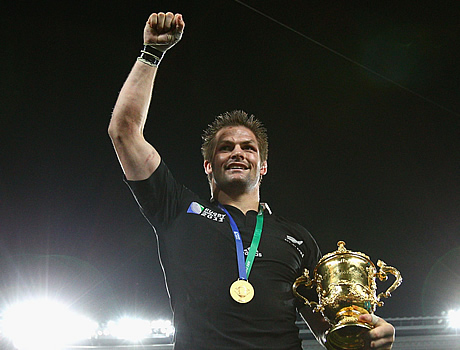
EXAMPLE: Captain McCaw led New Zealand's road to glory
NEW Zealand’s success in the final completes a proper story, at a time where depression is in the news a lot.  The country has had to deal with a horrible year, which has including a mining disaster and the devastating earthquake in Christchurch back in February.  Finally, the rugby team have managed to put smiles on the Kiwi public, which has had a lot of trauma to put up with this year.  By far, this isn’t the greatest All Blacks side ever put together, but what it does have is not just the abundance to turn on the style, but hold on when it needed to.  Consistently, they played the best rugby over the six weeks, delivered when it counted and got the ultimate prize at the end, a deserved reward for a nation that can feel reborn on its success.

What went wrong for England?
EVERYTHING pretty much went wrong for England; their time in New Zealand was a disaster.  The players have to take the blame for some average performances.  The first half nightmare in the quarter-final against France finally sealed their fate.  Martin Johnson will probably pay for the lack of performance, with his job.  The media didn’t help the team either, with some unsavoury headlines about late night antics involving Mike Tindall.  The team were allowed to enjoy themselves, but maybe they did it too much.  Words fail me with what Manu Tuliagi was thinking when he decided to jump off a ferry even after elimination.  Johnny Wilkinson looked well past his best, Matt Stevens is a liability and indiscipline cost the team on the pitch too, with both Courtney Laws and Dylan Armitage serving suspensions after being reported.  The RFU has to produce an urgent review into the failings of the side and on the evidence of this tournament; England will do well to retain the Six Nations title next spring.

Other disappointments
SCOTLAND had a challenging pool and didn’t get any luck against England and Argentina when they needed it the most.  However, they only scored four tries in four matches and didn’t make the quarter-finals for the first time in RWC history.  Another disappointment was Fiji, who laboured past Namibia, then were simply dreadful against Wales, South Africa and Samoa.  They were expected to challenge seriously for a quarter-final berth, but it never materialised.  Defending champions South Africa looked like a side that was past its best and Peter de Villers has quit off the back of failing to retain the trophy.  Finally, despite reaching the last four, Australia never looked convincing either.  The Aussies have a promising crop of young players and were also desperately unlucky with injuries throughout, but they didn’t hit the heights they looked capable of from the Tri Nations series.  Perhaps this tournament was a bit too soon for the current young generation.  However, the Aussies must continue to invest in this development, as it might make them favourites to regain the trophy in four years time.

Redemption for France
FRENCH rugby looked to be in yet another crisis, especially after that shocking defeat to Tonga in the pool stages.  They scraped into the quarter-finals, but while the rugby experts continue to write them off, I never did that.  They saved their best performance for the final and came within an inch of causing their own upset and clinching the golden prize for the first time.  Three weeks ago, the French deserved to fly home in standard class to a chorus of boos at Charles de Gaulle airport in Paris.  Now, they return to their homeland as heroes.  Rugby can be a fickle game at times!

Argentina perform at the highest level
AT LAST, Argentina has got into the Four Nations, formerly known as the Tri Nations next year.  I’m sure South Africa, Australia and New Zealand will appreciate the extra competition, if not the daunting trip to Buenos Aires.  Unfortunately, I do feel this decision has come four years too late.  The Pumas may have not looked at their best, as they did in 2007, but a run to the quarter-finals, giving the All Blacks their most challenging encounter until the final showed that progress has been sustained at least.  The story of the South Americans is once again, among the success stories of a Rugby World Cup.

Improvements from the ‘B’ teams
DELIRUM: Canada surprised Tonga in the pool stages
NAMIBIA aside, there was some great performances from the lower-ranked sides.  Canada beat Tonga and pushed France all the way, Samoa came within an inch of shocking South Africa and even though they didn’t win any matches, the flamboyant Japanese side won many fans in New Zealand.  So did debutants Russia, whose defending was pretty abysmal, but didn’t mind giving it a go and scored tries in all of their four pool matches, including 22 points against Australia.  There was the occasional thrashing, but the days of regular landslide scores in the pool stages of the Rugby World Cup is a thing of the past.

The Welsh journey
TURNED: The Welsh dream ended with this cruel red card for Warburton
NEW Zealand might be world champions, but the story of the Rugby World Cup is the rebirth of Welsh rugby.  Warren Gatland’s side returned with a fourth placed finish and had it not been for a diabolical decision to send off Captain Sam Warburton in the semi-final against France, it could have been even better.  The youngsters in the Welsh pack are incredibly talented and they showed that in abundance.  The likes of Faletau, Halfpenny and Warburton also brought the best out of the experienced players such as Shane Williams.  Wales have now given themselves a massive platform to build on and start February’s Six Nations as overwhelming favourites.  Previously the laughing stock of Northern Hemisphere rugby, they have to be taken seriously now as leading lights in world rugby.

So there you have it, six weeks of cracking rugby is over.  The atmosphere was electric and New Zealand lived up to the billing, being absolutely sensational hosts of the premier competition in world rugby.  The action might not have lived upto the standard of 2007, but there are still many fond memories for fans to take away, especially for the hosts, who can once again claim to be, world champions.

Friday, 14 October 2011

F1 classic races - Korea

IN A new series, I will be looking back at six classic races every weekend from the country about to stage an event in the 2011 FIA Formula One World Championship.  As Korea only made its bow onto the world championship stage last season, here is a varied selection of events that are no longer on the current F1 calendar, plus last year’s inaugural event in Korea.  The races are between 1991 and 2010, so enjoy the archive!

1991 – Portugal
WINNER: Riccardo Patrese (Williams Renault), 2nd: Ayrton Senna (McLaren Honda), 3rd: Jean Alesi (Ferrari)
WILLIAMS may have won the 1991 Portuguese Grand Prix, but it was the wrong driver as far as the championship battle was concerned.  Despite starting fourth, Nigel Mansell took the lead early on and looked set for a crucial victory.  Disaster then struck at his first pitstop, when chief mechanic Peter Windsor didn’t tighten up his right rear wheel.  The wheel rolled off down the pitlane, leaving a frustrated Mansell, beating his hands on the steering wheel in sheer despair.  The team then worked on the car in an illegal area and Nigel was black-flagged in Estoril for the second time in three years, having charged back to fifth.  Riccardo Patrese drove well to win, but second place took Ayrton Senna a massive step forward towards a third world championship.

1998 – Argentina
CONTROVERSY: Coulthard was furious with this contact in 1998
WINNER: Michael Schumacher (Ferrari), 2nd: Mika Hakkinen (McLaren Mercedes), 3rd: Eddie Irvine (Ferrari)
MCLAREN had dominated the first two races of 1998, but Ferrari and Michael Schumacher responded in superb fashion on F1’s last visit to Buenos Aires.  A new, wider tyre from Goodyear helped them close the gap.  The talking point of the race came on lap six, when Schumacher collided with David Coulthard, spinning the McLaren around and out of the lead.  Schumacher survived and despite a late trip into the gravel during a rain shower, beat Mika Hakkinen by over 20 seconds.  Eddie Irvine won out in a fierce scrap with youngster Alexander Wurz to secure a double podium finish for Ferrari.  Further run-ins with Jacques Villeneuve and Giancarlo Fisichella left Coulthard’s car looking like a battering ram by the finish.  However, he still earnt a point for his troubles.

1999 – France
WINNER: Heinz-Harald Frentzen (Jordan Mugen Honda), 2nd: Mika Hakkinen (McLaren Mercedes), 3rd: Rubens Barrichello (Stewart Ford)
THIS was a great Grand Prix, which Stewart, McLaren and Ferrari took turns in taking command, yet Jordan won the race.  An inspired decision on the pitwall saw the Irish team fuel Heinz-Harald Frentzen’s car to the brim during a heavy downpour on lap 22.  Frentzen didn’t have to pit again and claimed the lead when both Mika Hakkinen and Rubens Barrichello had to call in late on for a splash and dash.  Jordan’s second Grand Prix victory was memorable, but Damon Hill’s future in the sport came into serious question.  In a wet qualifying, he failed to make the 107% cut-off.  Given special dispensation to start, he tangled with Pedro de la Rosa and collected a puncture, before giving up at half-distance.  Afterwards, he cast doubts over whether he would get back into an F1 cockpit.  David Coulthard’s rotten season continued, when an alternator problem forced him out of a commanding lead on the ninth lap, whilst Michael Schumacher was restricted to fifth by gear selection issues.  Jean Alesi was on for a great result, but spun off in the downpour, as did Jacques Villeneuve and Alexander Wurz.  It was a crazy event, full of overtaking, but a magnificent day for Jordan’s new star in Magny-Cours.

2003 – Austria
WINNER: Michael Schumacher (Ferrari), 2nd: Kimi Raikkonen (McLaren Mercedes), 3rd: Rubens Barrichello (Ferrari)
AUSTRIA 2003 was one of Michael Schumacher’s greatest victories.  He had a big advantage infront, when he pitted for a routine pitstop on lap 20.  Seconds later, droplets of fuel from a faulty refuelling rig made contact with the engine cover and his Ferrari was on fire.  The mechanics quickly put out the barbeque, whilst Schumacher sat there, looking as cool as a cucumber.  Nine laps later, he hunted down Kimi Raikkonen’s ailing McLaren successfully and seconds later, was back infront when a water leak terminated Juan Pablo Montoya’s chance of victory for BMW Williams.  Raikkonen showed his championship might by protecting a sick engine and resolutely holding off Rubens Barrichello to prevent a Ferrari 1-2.  Jenson Button did well to finish fourth, his best result of the season whilst an engine failure ended a great comeback drive from Fernando Alonso, having risen from 19th on the grid to fifth.  However, this was the day when great escapes really do come true and a stunning way for Austria to end its Formula One relationship.

2004 – USA
WINNER: Michael Schumacher (Ferrari), 2nd: Rubens Barrichello (Ferrari), 3rd: Takuma Sato (BAR Honda)
MICHAEL Schumacher had to deal with mixed emotions at Indianapolis in 2004.  He managed to beat his team-mate Rubens Barrichello to record his eighth win from nine attempts in a runaway Ferrari season.  However, he had to drive past the scene of a nasty accident for his brother, Ralf.  11 laps into the event and a puncture on his Williams sent Schumacher Jnr careering backwards into the turn 13 concrete wall.  He suffered a cracked vertebra and would miss the majority of the season.  He wasn’t the only Michelin driver to collect a puncture, as debris on the track from a startline crash ended Fernando Alonso’s challenge two laps earlier.  Juan Pablo Montoya was black-flagged, after his engine died on the dummy grid.  He failed to switch to the spare car 15 seconds before the start of the formation lap, sealing his fate.  The biggest cheers in the paddock were for Takuma Sato, who recorded his one and only podium finish in F1 for BAR and for Zsvolt Baumgartner, who survived the mayhem to be the eighth and final finisher, hence scoring Minardi’s first championship point in over two years.

2010 – Korea
BLOW: Vettel extinguishes the charred remains of his engine in 2010
WINNER: Fernando Alonso (Ferrari), 2nd: Lewis Hamilton (McLaren Mercedes), 3rd: Felipe Massa (Ferrari)
F1’s maiden visit to Korea began with an 80-minute delay, due to heavy rain.  Four laps behind the Safety Car was criticised by the drivers, so the event was temporarily suspended.  Once they got going, Red Bull imploded.  Two laps after the Safety Car pitted, championship leader Mark Webber got onto the Astroturf and spun into the wall.  His car came back across the track, taking out the unfortunate Nico Rosberg in the process.  Having been the fastest driver all weekend, Sebastian Vettel looked set to win and take the championship lead.  However, he suffered a cruel engine failure with just ten laps to go, handing Fernando Alonso the victory and the drivers lead in the process.  Second place for Lewis Hamilton kept him in the championship challenge, but team-mate Jenson Button had a nightmare afternoon.  He struggled with grip all day, was one of the slowest cars on the track and finished a distant 12th; all but ending his hopes of retaining the world championship he had won in 2009.  Fourth place for Michael Schumacher equalled his best result of a tricky first season back in the sport after a three year lay-off.

Tuesday, 27 September 2011

Rugby World Cup 2011 - Favourites begin to show their class

WITH the pool stages at the 2011 Rugby World Cup coming to a close, the quarter-final line-up begins to take rapid shape.  In the last week, we’ve seen evidence that the cup favourites have taken their game up a notch and some more landslide results as a consequence.  Although to the neutral, this can be seen as disappointing in light to a true contest, the underdogs know that barring a disaster, it’s four games and then an early flight home, whilst the heavyweights play out the latter stages. 
RETURN: Cueto made a successful comeback, with a hat-trick
     Having scathingly criticised England for their opening two performances, Martin Johnson’s men finally arrived at this Rugby World Cup with a ten try whitewash of minnows Romania in Dunedin.  The 67-3 scoreline didn’t flatter the English either, with signs that their A game has now been brought to the pitch.  Mark Cueto marked his return to the test side, with a devastating hat-trick in the first 30 minutes.  The flamboyant Chris Ashton also crossed for his own hat-trick, as Romania simply couldn’t cope with the onslaught.  To not concede a try and only three points in total also underlines that the defensive work in training is beginning to pay off.  Let’s not forget that Romania is a lower-ranked side, but the performance was much better than the one witnessed in beating Georgia six days earlier.  Only against sterner opposition, like Saturday’s crunch encounter with Scotland in Auckland can we truly assess where England are at in comparison to the other favourites.
TORMENT: Scotland have to look on, as the Pumas celebrate
       Sadly for the Scots, it will now take a miracle to qualify for the quarter-finals.  In conditions more akin to rallycross, they were narrowly beaten 13-12 by Argentina in Wellington.  It was a game of few chances and that was always going to be the case between two well-matched sides.  The crucial, game breaking moment came with nine minutes remaining.  Dan Parks had come off the bench to kick Scotland 12-6 ahead.  The Pumas response was absolutely scintillating.  Lucas Gonzalo Amorosino weaved his way past three Scottish tackles, before diving over for the pivotal try; one of the best individual ones of the World Cup so far.  Stalwart Felipe Contepomi, playing in his last World Cup kicked over the conversion.  In the dying stages, Contepomi looked blatantly offside during the final Scottish attack.  Rather than wait for the certain penalty, Parks attempted the drop goal which wasn’t even close.  The advantage went and with it, so did Scotland’s hopes in cruel fashion.  They now must beat England, score four or more tries and prevent Johnson’s side from gaining any points.  It has to be considered as a long shot.
      If they don’t underestimate Georgia, Argentina’s prize for escaping Pool B will be an exhilarating quarter-final clash with the favourites and the hosts.  New Zealand dispatched France with consummate ease in their Pool A decider at the weekend.  In fact, they were so clinical; the bonus point was wrapped up shortly after the interval.  Israel Dagg was the star man for the All-Blacks, crossing for another two tries.  They won the match 37-17 and by five tries to two; one of those being an intercepted try for the French.  Dan Carter looked back to his best and it was a celebration for Richie McCaw, who was playing in his 100th test match.  As for France, they will have to seriously improve if they want to advance past the quarter-finals.  However, knowing the French, they have the capabilities to turn in a performance of magic at some point.  England still has to be prepared for the quarter-final bruiser that awaits them.
       In the battle of the Pacific Islanders, Samoa beat a desperately poor Fiji outfit 27-7.  However, they failed to score a crucial bonus point in the match, when it was there for the taking.  Although they will give South Africa a physical and bone-rattling test on Friday, expect the South Africans to finish their hopes off and progress as Pool D winners.  Wales looked impressive again, especially in the second half of their 81-7 destruction of a very tired Namibia yesterday.  Namibia’s tournament has been forgettable, but they did play four games in sixteen days, which is a big ask for a second-rate, amateur team. 
      Pool C is the one pool that looks very interesting going into the final weekend.  Australia had been expected to coast past the USA and did so on Friday morning, dispatching the Americans 67-5.  Adam Ashley-Cooper highlighted their clinical approach, with a hat-trick as the Wallabies ran over 11 tries.  The match was overshadowed by what looked to be a horrific injury to Anthony Faingaa in the closing stages.  He went off on a stretcher, with the likelihood of not only his tournament being finished, but the possibility of his rugby career being in severe doubt.         
     Finally, both Canada and Japan may be going home, but they provided those who got up at 4.30am this morning with a cracking match.  In a keenly-fought contest in Napier, a late penalty from Ander Monro was enough to earn a 23-23 draw for the Canadians.  It is only the third draw in RWC history and incredibly, these sides couldn’t be separated in 2007 either, drawing 12-12 on that occasion.  For me, Canada and Japan have given us plenty of memories in the pool stages and look to be the two most improved teams in world rugby.  Hopefully it won’t be long before they can begin to seriously threaten the real rugby elite.  With one more weekend of pool matches remaining, all rugby fans will be looking forward to an intense final weekend, some emotional farewells and then the real fun begins.   
THE WEEK’S RESULTS: Australia 67-5 USA, England 67-3 Romania, New Zealand 37-17 France, Fiji 7-27 Samoa, Ireland 62-12 Russia, Argentina 13-12 Scotland, Wales 81-7 Namibia, Canada 23-23 Japan, Italy 27-10 USA

Friday, 6 May 2011

F1 classic races - Turkey


IN A new series, I will be looking back at six classic races every weekend from the country about to stage an event in the 2011 FIA Formula One World Championship.  As Turkey has only held seven races before and not all of them have been classics, here is a varied selection of events from events no longer on the F1 calendar, plus two races from Turkey between 1991 and 2010.  Enjoy the archive!

1991 – France
WINNER: Nigel Mansell (Williams Renault), 2nd: Alain Prost (Ferrari), 3rd: Ayrton Senna (McLaren Honda)
RICCARDO Patrese started from pole position for the first French Grand Prix to be staged on the new Magny-Cours circuit, but he made one of the worst starts of his career, and never recovered from it here.  The battle for victory was between Alain Prost, on home soil in an uncompetitive Ferrari and Nigel Mansell’s Williams.  Mansell had a slower tyre stop, but managed to catch and pass Prost twice, eventually scoring a long first overdue victory of 1991.  Ayrton Senna was a distant third, holding off a similar hard challenge from Jean Alesi, with Patrese a disappointing and lapped fifth.

1997 – Argentina
WINNER: Jacques Villeneuve (Williams Renault), 2nd: Eddie Irvine (Ferrari), 3rd: Ralf Schumacher (Jordan Peugeot)
FORTUNE and a more competitive chassis saw Jacques Villeneuve win an absolutely barnstorming Argentine Grand Prix, but he had to work really hard all day.  His main rival for the championship in 1997, Michael Schumacher took himself out of the event on the first corner.  The German tangled with the Stewart of Rubens Barrichello, who also picked up severe damage.  Initially, it was Olivier Panis who was threatening Villeneuve, before engine trouble hit his Prost.  Eventually, the Canadian, who was battling a stomach bug all weekend, had to resist stern pressure from Eddie Irvine.  Although he chased him home hard, Irvine never really got close enough to make a sufficient overtaking attempt, and finished a close 0.9secs behind.  Jordan’s Ralf Schumacher, in only his third ever F1 outing scored a podium finish.  However, he achieved this at the cost of a fruitful relationship with his team, knocking off Giancarlo Fisichella and starting a civil war between the pair.

1999 – Austria
WINNER: Eddie Irvine (Ferrari), 2nd: David Coulthard (McLaren Mercedes), 3rd: Mika Hakkinen (McLaren Mercedes)
AUSTRIA 1999 was David Coulthard’s worst nightmare.  Not only did the Scot run into his team-mate Mika Hakkinen on the first lap, he allowed Ferrari to score an unlikely victory.  McLaren had been a full second quicker than the opposition in qualifying, missing Michael Schumacher, who was starting his recovery from a broken leg at Silverstone a fortnight earlier.  However, Coulthard tried an ambitious lunge on Hakkinen, which ended in contact at the second corner.  The Flying Finn recovered from a spin and 21st at the end of the opening lap, to finish an incredible third.  Coulthard sped 14 second clear at one point, but Eddie Irvine went longer on strategy, and with some blistering Schumacher-esque laps, overtook the Scot for his second win of the season and it threw the world title race wide open again.  Coulthard’s and Hakkinen’s expressions spoke volumes on the rostrum afterwards.

2005 - Bahrain
WINNER: Fernando Alonso (Renault), 2nd: Jarno Trulli (Toyota), 3rd: Kimi Raikkonen (McLaren Mercedes)
NEVER mind motorsport, but tennis was dangerous to Juan Pablo Montoya.  A freak accident left the Colombian with a fractured shoulder and out of the Bahrain event.  He wasn’t missed by the McLaren team, as super sub Pedro de la Rosa set fastest lap and finished a stunning fifth in an action-packed event.  It was one of the hottest races ever in history, and Michael Schumacher’s hydraulics couldn’t take the heat.  They gave up on his new Ferrari after 12 laps.  With Rubens Barrichello only 9th after gearbox troubles, Ferrari’s gamble on saving their 2005 season with a new car had backfired spectacularly.  The path was clear for Fernando Alonso to record back-to-back victories, with Jarno Trulli’s Toyota finishing second for the second successive race.  Kimi Raikkonen earnt his first podium of the season, to highlight McLaren’s impressive pace in the desert.

2006 – Turkey
NOTCH: Massa led Schumacher all the way to glory in 2006
WINNER: Felipe Massa (Ferrari), 2nd: Fernando Alonso (Renault), 3rd: Michael Schumacher (Ferrari)
THIS was the weekend when Felipe Massa really came good and went up a level in his F1 career.  Massa took pole position and his maiden Grand Prix victory in a nail-biting climax.  The start was just as chaotic, as Giancarlo Fisichella spun infront of the pack and caused mayhem.  Kimi Raikkonen, Scott Speed and Nick Heidfeld all suffered significant damage, with Raikkonen eliminated after a pitstop for checks.  As Massa led from the front, the Safety Car was deployed after Vitantonio Liuzzi spun his Toro Rosso and stalled on the exit of Turn One.  Championship rivals Fernando Alonso and Michael Schumacher swapped places in the pits, as Schumacher was held up, having to queue up for Massa to be serviced first.  In the dying stages, the retiring German did all he could to pass Alonso, but like at Imola in 2005, he couldn’t find a way through and had to settle for third.  As Schumacher couldn’t find a way through, Massa was allowed to win his first event in Formula One.

2010 - Turkey
RIVALRY: Began after this Red Bull collision last season
WINNER: Lewis Hamilton (McLaren Mercedes), 2nd: Jenson Button (McLaren Mercedes), 3rd: Mark Webber (Red Bull Racing Renault)
RED Bull Racing totally shot themselves in the foot last season, when under pressure from McLaren.  Mark Webber began from pole position and led the first 40 laps.  A slow pitstop dropped Lewis Hamilton behind Sebastian Vettel, but Hamilton and Jenson Button stayed right on the tails of the Red Bulls throughout.  On Lap 41, Vettel, with a higher engine setting, went to overtake Webber.  The Aussie left minimal room and Sebastian made his way past.  However, he began to deviate right before a car length’s room was given and they collided.  Vettel span into retirement, whilst Webber had to pit for a new front wing, surviving for a podium finish.  The McLaren’s of Hamilton and Button had a similar dice later, which saw the duo swap the lead.  However, they kept it clean to secure a 1-2 for the British team; Hamilton’s first win of 2010.  Although most experts thought Vettel was to blame for the Red Bull clash, the management seemed to shoulder the blame onto Webber.  This began a fractious summer for the pair and the Milton Keynes based team.

Sunday, 18 July 2010

World Cup 2010 Review


Seven days have passed since the closing of the greatest show on earth.  The 2010 FIFA World Cup in South Africa provided plenty of drama.  Over 140 goals in 64 matches, with some giants of the game found wanting, stars of the international game flopping dramatically and some fairytale stories, that would capture the imagination of any World Cup fanatic fan.  This is my comprehensive review of the tournament, picking out twenty moments that made this World Cup stand out, both off and on the pitch.

All the Fears Were Unnecessary
There was a lot of anticipation, but also fear in the build-up to Africa’s big moment.  It was reported that terrorists were planning to attack the England v USA group match in Rustenberg, and after what had happened to the Togo national team in Angola, when they were ambushed at January’s Africa Cup of Nations, there were always going to be increasing concerns about the safety of fans, players, the worldwide press and local South Africans.  Thankfully, these fears totally turned out to be no more than threats.  Despite the odd issue, such as a match steward’s strike and a pre-tournament fan crush before a Nigeria game in the days leading up to the spectacular, but overall, South Africa 2010 turned into a rousing success.  Travel was hardly an issue, tickets sold on the black market were eliminated and hooliganism simply did not exist.  It was a carnival for the fans, and a pleasing success for the tournament’s organisers. 

The England Failure, But Who Was To Blame?
We can talk about this for years to come.  Quite frankly, I’m fairly bored of the entire topic, but I do feel I should express my viewpoint before shutting up on this issue for good.  Fabio Capello made some massive tactical blunders during the tournament.  For example, no back-up plan if the team got into trouble, the goalkeeper situation – as he had no idea who to earmark as a No.1 and telling the team two hours before a crucial match who would start.  However, although the buck must stop with Capello, the team must take some of the stick too.  Wayne Rooney was hopelessly unfit and useless; Emile Heskey looked like Bambi, not an international striker.  Robert Green needs to learn how to catch a football, it’s not hard – whilst Steven Gerrard lacked the passion he shows week in, week out in a Liverpool shirt.  Even the energetic Ashley Cole looked a yard short all throughout the finals.  John Terry aside, the passion for the shirt must be called into question for these failures.  This generation has had its chance, TWICE!  They have blown it and now, its time for the youth to get a crack at the whip.  Sadly, I don’t think England has much chance in the international game, unless the fundamentals dramatically change.

The ‘Woe Cup’ on ITV
When ITV decided to ditch Formula One at the end of 2008, to entirely focus on Football, it seemed like a risky, but successful move.  Two years on, Michael Grade might well be regretting that move.  Yes, the studio base, just outside Soccer City was top-notch as was the theme music – ‘When You Come Back,’ by Vusi Mahlasela, which is the best football theme I’ve heard since the legendary ‘Nessum Dorma,’ by Pavarotti for BBC’s coverage of Italia 90 and Marcel Desailly was a charismatic and passionate pundit.  However, that is where all the positives end.  Taking a commercial break seconds before Steven Gerrard’s opener for England v USA in Rustenberg was a blunder of the first magnitude.  Robbie Earle was sent home in disgrace, for a ticketing scam, whilst Adrian Chiles truly proved that he is not cut out for live television.  He should just stick to GMTV; at least Steve Rider knows what he is talking about.  Craig Burley’s commentator voice is more suited to funerals, whilst Gareth Southgate forgetting who Holland were playing in the semi-finals just about summed it all up.  This was a nightmare World Cup for ITV, and one they will need to forget very quickly.  Their reputation has taken another battering, and they still have the FA Cup and Champions League rights.  This concerns me a lot.


Diego Maradona – What a Character!
Diego Maradona may have his fans, and those who will never forgive him for the ‘Hand of God,’ in 1986.  However, no-one can diminish his passion and love for the game of football.  His story was remarkable, and it was a largely happy and united Argentina camp throughout South Africa 2010.  Once again, they played the best football in the group stages – dismantling South Korea and missing a hatful of chances to overcome Nigeria.  Defensively, there were concerns, but with the attacking prowess of Carlos Tevez, Diego Milito, Gonzalo Higuain, Martin Palermo and Lionel Messi, these errors could be easily covered up in the early exchanges.  However, when it came to the crunch, Germany exposed Argentina’s weaknesses to the fore, leaving a nation in tears.  Maradona has been offered a new four-year deal to stay on as manager and I hope he does, because his gestures and passion from the touchline was one of the stand-out moments of the finals.

The Jabulani – The Worst Football in History!
Receiving a lot of criticism throughout the tournament was the Jabulani football used for the sixty-four matches.  Quite simply, it is the worst football to have ever created.  Goalkeepers found it difficult to control, midfielders couldn’t dribble as much as they would have liked to and when it came to free-kicks, there was more chance of the football ending in orbit, rather than the back of the net.  Diego Forlan and Japan aside, no-one seemed to be able to cope with the Jabulani from a dead ball situation and although the negativity in some of the opening games was painful to watch, the ball didn’t help matters.  I hope the makers of the Jabulani, Adidas are hanging their heads in shame.  Let’s hope Nike get an exclusive FIFA contract for the 2014 finals in Brazil.

Why Did So Many Superstars Flop On The Greatest Show On Earth?
That is a question that will be difficult to answer, was it the dreaded Jabulani? Were they tired after a long, tiring domestic and international season?  Do the lack the passion for the international game?  Whatever the answer maybe, Kaka, Samuel Eto’o, Cristiano Ronaldo, Fernando Torres, Didier Drogba and Wayne Rooney all flopped horrendously at this World Cup.  Rooney limped throughout the finals, Eto’o simply didn’t step up to the plate for a failing Cameroon, which suggested major friction between him and the now former coach, Paul Le Guen.  Kaka was unluckily sent off against the Ivory Coast, but continued where he left off for Real Madrid, playing poorly.  Ronaldo did score against North Korea, but was left a frustrated and forlorn figure as Portugal played defensively in three of the four matches they competed in.  Drogba was nursing a shoulder injury during the group stages, meaning his physical advantages in his game could not be used and Torres lacked form and match sharpness, which culminated in him being dropped from the semi-final onwards.  So, why did so many superstars flop on the greatest show on earth?  The answer is several reasons, but the main reason is – they just didn’t perform when the chips were down.

Germany – A Joy to Watch
The Germans are normally associated as a team that grinds out results to make the showpiece events.  This wasn’t the case in South Africa.  The team played with flair, fluidity and showed no fear whatsoever.  Yes, Serbia did surprise them in the group stages in Port Elizabeth, but that was largely on a bad day for Joachim Low’s side, when nothing went right.  They blitzed Australia and ripped apart England and Argentina in the knockout stages.  Only a well-drilled Spain crushed their dream in the semi-final.  However, the likes of Meszut Ozil, Sami Khedira and Thomas Muller are here to stay, and with such an impressive young unit, Germany could well dominate the international game for at least the next five years.

FIFA Embarrassed With The Lack of Technology – Surely It Must Be Used Now?
Six minutes before half-time in Bloemfontein and Frank Lampard hits a cute chip, that beat Manuel Neuer in the Germany goal, and drags England back to 2-2 in their last sixteen encounter.  However, it wasn’t given – as the incident was missed by the hopeless Uruguayan officials.  Television replays confirmed what we had all previously thought – the ball had gone miles over the line.  I personally hope Sepp Blatter, who can’t stand the use of technology, was squirming in his seat.  Later that night, the Italian officials awarded a goal to Argentina’s Carlos Tevez against Mexico, despite him being at least five yards offside.  England and Mexico were the unlucky ones this time, with the lack of technology.  Surely FIFA and the game in general must use the equipment and resources available to them; otherwise there will be a lot more hard luck stories to be heard of in the future.


Italy – A Tournament Too Far For the Ageing Champions
Italy came into these finals playing down their expectations.  However, everyone expected them to cruise through a group consisting of debutants Slovakia, inconsistent Paraguay and the ‘amateurs’ from New Zealand.  However, the defending champions made a limp start, drawing 1-1 with Paraguay in Cape Town.  It set the tone for their tournament, always having to come from behind to save themselves.  Eventually, it caught up with them, as Slovakia punished them to maximum effect in one of the best games of the tournament on June 24th.  Injuries didn’t help, with Andrea Pirlo and Gianluigi Buffon playing less than ninety minutes between them, but it was a tournament too far for the ageing champions.  The Azzuri were dethroned, and left with egg on their face.  Finishing behind New Zealand, a country that doesn’t even have a professional league is staggering!  Thank goodness England didn’t end up as bad as they did; this could well be the end of a golden Italian generation.


The Vuvuzela – The New Feature of Football Sound
The controversial and very noisy ‘vuvuzela’ made their debut in the World Cup finals and whether it has taken onto the European game in the next season remains to be seen.  In the early games, the sound was just plain annoying, sounding like a ‘swarm of bees.’  In the later stages, they just added to the occasion.  I hope they don’t turn up in the Premiership next season, and can see a ban being imposed if they were.  However, they added to the atmosphere and the drama of World Cup 2010, and if that’s how the Africans like to appreciate their football – let them embrace it in their own style.

France – Disgraced and Defeated
The worldwide media were predicting either a France team that could cause a surprise, or most likely pick the self-destruct option.  Unsurprisingly, they chose the latter option.  A dull goalless draw with Uruguay in their opener set the tone for a flimsy and pathetic tournament.  Coach Raymond Domenach couldn’t control the squad, and on the touchline against Mexico, really couldn’t care less about what happened out on the pitch.  Playing left-back Eric Abidal in centre-half must be one of the most ridiculous tactical decisions I have seen in my life.  Thierry Henry was a frustrated spectator throughout, who could only laugh at the fracas.  Temperamental Nicolas Anelka was sent home for a blazing row with Domenach, and then the team refused to train, in support of the Chelsea striker.  Captain Patrice Evra was dropped for the final group game, and behaved like a dog all throughout the shameful episode.  To be honest, a 6-year old could control the team better than Domenach, and they got what they deserved – eliminated with 1 point, 1 goal and flying home in economy class! France were disgraced and defeated and Laurent Blanc has got some job in reviving their fortunes. 

Negative Football Is a Disappointment
The amount of negativity from some teams was a real disappointment to witness.  Argentina and Germany were the only total attacking sides, out of the main superpowers throughout the finals.  The early games were punctured, with some very tedious games – many totally afraid to lose their opening game.  The main concern was the lack of attacking intent from some on display, which was very disappointing to see.  However, these results don’t win you tournaments.  Both Japan and Portugal paid the price in the knockout stages and likewise, Greece and Ivory Coast in the group stages.  So, it was good to see more attacking styles from most in the knockout stages onwards.

Chile – Full of Thrills and Entertainment
Chile arrived at these finals believing in themselves.  However, they were written off by many as a side just there to make up the numbers.  Driven on by a flag at their training camp, in remembrance of those who perished in the devastating earthquake in the country at the beginning of March, their thrilling football was a joy to watch.  Marcelo Biesla knows how to play attacking football, and it paid off against Honduras and Switzerland, with two devastating attacking displays, even though the 1-0 scorelines don’t suggest this.  Sadly, their tendency to go forward left them exposed against better opposition in the form of Brazil and Spain, but with a talented young squad, like Carlos Carmona, Alexis Sanchez and Matias Fernandez, Chile could well be a major threat in major competitions in the coming years.  They won a lot of fans, including myself for the fluid approach to the game at these finals.

Howard Webb – A Very Successful Tournament
England may have flopped miserably on the world stage, but Howard Webb’s reputation increased massively, with his well-disciplined approach to the games he refereed.  His performances in his three preliminary games (Spain v Switzerland, Slovakia v Italy and Brazil v Chile) were exemplary.  Full credit also must go out to his assistants, Darren Can and Mike Malarkey too for their eagle eyes, when it came to tight offside calls.  Some will question his performance in the final, but any referee would have struggled to control that match last week, and I thought he handled the situation very well actually.  He deserved to get the final in the first place, and it wasn’t a disastrous performance either.  At least England did have a finalist in the end.

The Hand of Luis Suarez
In the dying stages of a pulsating quarter-final in Soccer City, Ajax striker Luis Suarez showed that his goalkeeping ability is second to none.  The Uruguayan hitman deliberately handled on the line, to deny Ghana a last-gasp winner in extra-time.  Rightly, Suarez was dismissed for his actions, but Asamoah Gyan went on to smack the bar with his spot kick.  Suarez’s reaction afterwards was very unsportsmanlike, but his efforts had helped Uruguay win a surprising semi-final place.  The incident wasn’t very sporting, but if that was replayed 99 times out of 100, he and many others would have done exactly the same.  Though his actions robbed Ghana out of a semi-final berth, it was an instinctive reaction, not deliberate cheating.


The African Continent Disappoints
Despite Ghana’s fairytale run to the quarter-finals, Africa’s entries disappointed at these finals, and showed that the continent still has some way to go, if they want to challenge the heavyweights of Europe and South America in the near future.  Nigeria and Cameroon were major letdowns, and are living far too long on former glories.  Algeria always were at the finals for the party and nothing more, the Ivory Coast were in a horrible group, yet had their chances to punish Portugal’s lack of ambition, but didn’t take them.  In the end, despite the expected early elimination, the hosts did very well in the circumstances.  They beat a disorganised French unit and probably should have beaten Mexico in the tournament opener.  Had it not been for a more wooden display against Uruguay, they might well have escaped Group A.  However, they left their home tournament on a high and far from disgraced.  What the African champions Egypt could have done, no-one really knows, but apart from the Ghana drama, it was a disappointing conclusion once more for the host continent.

Paul the ‘Psychic’ Octopus
Despite being 6,000 miles away from South Africa, Paul the ‘Psychic’ 8-legged octopus has become a star overnight and left football pundits shaking in their boots.  Their jobs at predicting the games are suddenly under intensifying threat.  He got all his predictions right, including an early Italy elimination, Argentina’s quarter-final defeat and a Spain World Cup win.  Well done Paul, you are a legend!

Holland Scrape Through, Then Lose Their Heads
Previous Dutch sides have a reputation for their camp to be split down the middle, between two units and for their football to be explosive, but lacking the rewards it deserves.  This time around, the Dutch showed a grittier side to their game, and a more determined steel which their coach has created.  Apart from a super second-half display to eliminate the Brazilians in the last eight, Holland missed the usual ‘Total Football,’ tag that is normally associated with this country.  Sadly in the final, they decided to kick their opponents, rather than attempt to outscore them.  Their tactics were dirty, unnecessary and won themselves no plaudits.  It was a good result for football then, to see the team that actually wanted to play football, win the World Cup.

Spain Finally Fulfil Their Potential
After years of underachievement and failure, Spain has finally produced the goods, when it matters most.  When they lost their opener to Switzerland in Durban on June 16th, it left them on the brink and many questioning, whether this crop of players was going to go down the same route that many predecessors had managed.  Instead, they managed to grind themselves into the last four, with sketchy performances against Paraguay and Portugal, yet produce moments of inspiration that got them through.  Against Germany and Holland, they played the better football in both games, and that makes them worthy champions.  Congratulations to Vicente Del Bosque and his men on achieving this well-deserved success.

The Awards
A brief word on some of the awards I would give out for the 2010 FIFA World Cup:
Player of the Tournament:                          Diego Forlan (Uruguay)
Young Player of the Tournament:               Thomas Muller (Germany)
Golden Boot Winner:                                Thomas Muller (Germany)
Golden Glove:                                           Manuel Neuer (Germany)
Best Defender:                                          Carlos Puyol (Spain)
Best Midfielder:                                        Wesley Snejider (Holland)
Team of the Tournament:     Manuel Neuer (Germany), Sergio Ramos (Spain), Arne Friedrich (Germany), Carlos Puyol (Spain), Fabio Coentrao (Portugal), Andreas Iniesta (Spain), Wesley Snejider (Holland), Meszut Ozil (Germany), Thomas Muller (Germany), David Villa (Spain), Diego Forlan (Uruguay)
SUBS: Iker Casillas (Spain), Giovanni Van Bronckhorst (Holland), Andre Anyweu (Ghana), Alexis Sanchez (Chile), Dirk Kuyt (Holland), Bastian Schweinsteiger (Germany), Miroslav Klose (Germany)

Goal of the Tournament:                              1st: Giovanni Van Bronckhorst (Holland v Uruguay)
                                                                                2nd: Fabio Quagirella (Slovakia v Italy)
                                                                                3rd: Luis Suarez (Uruguay v South Korea)

Match of the Tournament:                          1st: Uruguay 1-1 Ghana – Quarter-Final, 2nd July
                                                                                2nd: Slovakia 3-2 Italy – Group Stages, 24th June
                                                                                3rd: Uruguay 2-3 Germany – 3rd Place Playoff, 10th July

Roll on Brazil 2014!

Monday, 5 July 2010

World Cup Report - Day 20-21


We are now entering the final stages of has been a gruelling and exhilarant 2010 FIFA World Cup in South Africa.  Despite the absence of some major players in the latter stages, like France, Portugal and Italy, the quarter-finals brought a lot of drama and controversy to the theatre of football.  At the weekend, it was South America’s turn to suffer, as the European game fought back in style, to dominate the semi-finals again.  Here is a round-up of the action, including missed penalties, blatant handballs and deliberate stamps! Yes, this four quarter-finals had it all.

Friday 2nd July: Holland 2-1 Brazil


In a dramatic first quarter-final in Port Elizabeth, Holland produced a stunning second-half fightback to overcome a brutal and bullish Brazilian side, which lost their lead and their head in sensational fashion.  In this fourth meet-up behind the two stylish outfits in World Cup history, it was Brazil who took command in the first half, with Robinho beating a poor offside trap, to slice Dunga’s side infront on ten minutes.  Having looked toothless in the first half, the Dutch put the normally reliable Brazilian defence under pressure after the break, and it worked, with perfect results.  Six minutes into the second half, Wesley Snejider whipped a dangerous ball into the penalty area, which caused a horrific defensive mix-up.  Julio Cesar missed his cross completely, and lacked the usual composure – not calling for defensive midfielder Felipe Melo to miss the ball.  Instead, the helpless Juventus player flicked the ball into his own net, though FIFA have since credited the goal to Snejider.  Snejider’s second of the game came with just over twenty minutes to go, heading in unchallenged from another set-piece, after a clever flick-on from the hard-working Dirk Kuyt.  Melo’s afternoon got worse, when he was sent off by the Japanese referee with sixteen minutes remaining, for a cheeky and deliberate stamp on Arjen Robben.  Although Robben made the most of it, Melo’s actions were both cynical and stupid, and he will be lucky not to have his ban increased by FIFA.  Despite intense Brazilian pressure, they ran out of time and exit the World Cup at the last eight for the second successive finals.  Dunga has paid the price, with his job in the process.  For the Orange Army, a first semi-final in twelve years beckons, and who knows, possibly a first ever World Championship at the end of it.


Friday 2nd July: Uruguay 1-1 Ghana (AET) URUGUAY WON 4-2 ON PENALTIES


Africa’s hope of having its first ever representative in the semi-finals were ended in heartbreaking fashion after a breathless two hours of football in Soccer City.  With the score tied at 1-1, in the dying stages of extra-time, controversy took over, with accusations of dirty play and cheating.  Uruguay failed to deal with a long throw-in and in the ensuring goalmouth scramble, Ajax striker Luis Suarez deliberately handled on the line, preventing a certain goal in the process.  He was sent off, but seconds later, tears turned to celebration, when Asamoah Gyan, who had already scored two penalties in this tournament, smashed this kick onto the top of the crossbar, with the last kick of the match.  Earlier, Sulley Muntari’s wonderful 35-yard effort on the stroke of half-time was cancelled out by Diego Forlan’s swerving free-kick.  In the ensuring penalty shootout, Gyan showed a lot of composure and guts to step-up, and score again.  However, misses from John Mensah and Dominic Adiyiah, left Sebastian Abreu to casually slot home the winning penalty.  It left Ghana feeling cheated and robbed, whilst Uruguay celebrated their first semi-final appearance since 1970.  They will face Holland in Cape Town tomorrow.


Saturday 3rd July: Argentina 0-4 Germany


Germany sent out a hideous warning to the rest of the world, after destroying Argentina in Cape Town, and with it, send Diego Maradona’s management career down the toilet seat in the process.  After ripping England to shreds, Joachim Low’s side were full of confidence, and were infront after only two minutes, when the inspired Thomas Muller headed home from close-range.  In the second half, Argentina capitulated, under the force of a devastating attacking display, which saw a first international goal for dependable right-back Arne Friedrich and two goals from the potent Miroslav Klose.  It takes Klose to within one goal of equalling Ronaldo’s tally of 15 goals at FIFA World Cup Finals, and on this evidence, Spain will really need to up their game in Wednesday’s semi-final.


Saturday 3rd July: Paraguay 0-1 Spain


David Villa scored his 5th goal of this World Cup, though it took three strikes of the goalposts to seal Spain’s first ever place at the World Cup semi-finals.  A drab and dour quarter-final at Ellis Park, came to life when Oscar Cardozo was unnecessarily dragged down in the penalty area, by Gerard Pique.  Cardozo’s resulting spot kick was saved by Iker Casillas.  Less than sixty seconds later, Villa went down in the other penalty area, under minimal contact from Antolin Alcaraz.  The dopey Guatemalan referee handed Spain a lucky penalty.  Xabi Alonso converted first-time around, but encroachment, led to a retake.  On the second attempt, Alonso’s penalty was saved by Justo Villar, who on the rebound, brutally chopped down Cesc Fabregas, which was unseen by the officials, that would have struggled to referee a primary school match, let alone a World Cup quarter-final.  Villa’s winner came eight minutes from the end, after substitute Pedro’s effort rebounded off the woodwork and despite not playing at their best, the European Champions now have a repeat of the Euro 2008 final with Germany to look forward to, in Durban on Wednesday evening.