HappyDude88's Search

About Me

My photo
Hello, this is Siwri88, better known to some as Simon. Currently work as a picture researcher and product editor with a leading publishing company that works with trading cards and sticker albums on a variety of licenses in sport and entertainment. Freelance Journalist and writing a book in my spare time. Achieved a 2:1 studying BA Hons Journalism at the University of Northampton (2009-2012). Enjoy reading!
Showing posts with label FIA. Show all posts

Tuesday, 18 October 2011

A reminder of motorsport's dangers


IT SAYS it on all the paddock passes and race tickets, motorsport is dangerous.  It’s a fact of life and nothing can be done about that to remove the risk element away.  However, when the unthinkable happens, it still gives the community both a massive shock and a chilling reminder of the dangers in competing at the highest level.  Dan Wheldon’s tragic death in Sunday’s IndyCar finale has not only sent a worldwide feel of loss and remorse, but raised questions about the safety of motorsport in general and what can be done to prevent these sorts of accidents from happening more frequently.

THE SAFETY OF INDYCAR RACING
WRECK: The Las Vegas circuit was too tight for so many cars
INDYCAR’s safety record is good, but not great.  Both Gonzalo Rodriguez and Greg Moore were killed within six weeks of events in 1999.  Paul Dana was the last driver to lose his life at an IndyCar event, five years ago.  Open-wheel racing has always carried significant risks and will continue to do so.  As Mark Blundell summed it up yesterday, the events of Sunday were a ‘recipe for disaster.’  Cars going side-by-side at 220mph has a real fear of danger if something goes wrong.  Plus, it doesn’t have to be driver error; mechanical failure in these cars is still possible in this day and age.  There is no doubt that IndyCar has worked extremely hard with safety organisations to improve its track record, which frankly, was diabolical in the 1990s.  Plus, there are a lot of dedicated marshals and medical facilities are better than ever before.  However, the risks will always remain and in the light of the recent events at the weekend, more has to be done to make the cars stronger to absorb the impacts of a big accident.  1979 Formula One world champion, Jody Scheckter has told BBC that he wants his son, Tomas to quit because it is too dangerous.  Scheckter Jnr was involved in the 15-car pile-up in Las Vegas and Jody said “It is the most dangerous form of motor racing at the moment.  Hopefully this will knock some sense into him and realise there is more to life.  It really isn’t worth it.”

CIRCUITS IN THE US; THE DANGERS
THE officials at the Las Vegas circuit should be prepared for some serious stick over the coming weeks.  The circuit is far too narrow for these types of cars to go racing.  Principally, this track has been used mainly for NASCAR racing, not open-wheel combat.  Drivers raised their concerns during testing for the event, including the defending champion, Dario Franchitti.  If they did this and the track officials ignored their requests for more safety considerations or even to cancel the event, they are going to be in a whole lot of hot water.  A prime example will be Formula One’s fateful trip to Indianapolis in 2005.  Michelin failed to bring suitable tyres to the Brickyard, which saw a farcical six-car race take place.  Two weeks later, Max Mosley said on the Official 2005 F1 DVD; “You can’t just build a chicane at the team’s request, because if an accident happens, an American judge wouldn’t care about the safety consequences.  It is unfortunate what happened, but we couldn’t allow it to happen.”  It is unlikely, but if Franchitti can prove his comments were valid through transcripts or audio recordings, then this tragedy could have been prevented.  I don’t know the full implications of American law, but the Las Vegas track officials could be facing some tough and testing questions from higher forces should this happen.  Although oval racing is popular in the States, maybe it is time to restrict this form of racing to the classic Indianapolis 500.  The risks of racing on ovals are far greater than both street and road circuits.  The thrill may disappear, but at the safety of the championship’s future integrity, it might be the safest option, if not the most plausible option.

WILL IT HAPPEN IN FORMULA ONE?
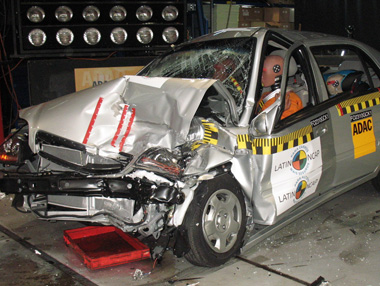
SAFE: The FIA has done immense work in the safety department
DEATH in Formula One is possible.  It has happened before and without wanting to sound callous, it will probably happen again at some stage.  However, it has now been 17 years since that horrific weekend at Imola, when both Roland Ratzenberger and Ayrton Senna were killed.  The last fatality at any Grand Prix event was Marshal Graham Beveridge; killed by flying debris from a serious crash at the 2001 Australian Grand Prix in Melbourne.  The introduction of the HANS (Head and Neck Safety) system in 2003 has restricted the potential possibility for fatal neck and head injuries.  Ironically, the HANS device came in after successful testing in American racing.  Professor Sid Watkins, Dr. Gary Hartstein and the FIA can take immense satisfaction for the work they have done in recent years.  Who can forget Robert Kubica’s aeroplane shunt in the 2007 Canadian Grand Prix, which would have probably been a fatal shunt ten years earlier, saw Kubica only suffer a sprained ankle and that is down to HANS and the vigorous safety cells and crash tests each car has to pass in pre-season.  1993 IndyCar champion Nigel Mansell praised Formula One’s safety record and told BBC Radio 5 Live, that IndyCars could learn from the premier competition in motorsport; “In Indy racing, there is simply nowhere to go.  When an accident happens, you are into the wall in a split second.  This is why Formula 1 does an exemplary job.  The tarmac runs off so the driver has time to decelerate the car.”

THE COCKPITS: SHOULD THEY BE CLOSED?
NO IS the simple answer to this.  Dan Wheldon’s death will understandably trigger this debate again, which was raised in 2009 when Henry Surtees died in an F2 race at Brands Hatch after being struck by debris, then Felipe Massa received life-threatening injuries in a similar, freakish incident during qualifying for the 2009 Hungarian Grand Prix.  There is talk of a canopy being installed around the driver and yes, it would be better for a safety issue.  However, there is no guarantee of this being the breakthrough to prevent incidents like those that have happened in the past.  Remember, it was the impact with the wall and the resultant fire that was Dan Wheldon’s downfall on Sunday, not a result of the flying debris.  Like I’ve said, motorsport is dangerous, but I think a real element would be taken away if the cockpits became closed within the driver area.  It isn’t a regular occurrence and any action like this would be seen by me as a desperate action.  IndyCar need to look at better racetracks, safer barriers at these tracks and the structure strength of the cars, rather than changing cockpit levels.

HOW IT HAS AFFECTED ME?
PEOPLE who know me will understand the love of motor racing I have.  I don’t follow American racing, but of course, I want the Brits to do really well in any motorsport they take part in.  First indication of potential trouble came when I saw Jonathan Legard’s status on Twitter, about a big IndyCar accident.  Curious, I checked out YouTube to see how big it was and I wished I hadn’t.  When I saw the crash, it felt like my heart stopped beating and you don’t want to hear the words that muttered out of my mouth when I witnessed it online for the first time.  When I saw another of Legard’s tweets in the evening, which said that Dan Wheldon’s condition was serious, with no word on injuries, I knew the situation looked very bleak and sadly, the news came through just before midnight of his death.
      Yesterday, I kept seeing the crash on news broadcasts and I felt there was no need for that, especially for Dan’s devastated family.  In this situation, I would stick to images and videos of the wrecked cars and driver reactions.  It made me sick watching it everytime.  All day at Uni yesterday, it was a talking point with a lot of the journalism students and I just didn’t want to be there.  It was on my mind all day and maybe some will say; ‘Why does it affect you?’  Well it does and I can’t help that.  I had to show the crash to one of my friend’s yesterday afternoon and seeing it again made me feel like, well rubbish in the politest term possible.  As Dan was British, plus he grew up in my hometown of Milton Keynes, it made it even worse to think about.  Thankfully, I don’t remember Ayrton Senna’s death vividly, so this is the first real motorsport tragedy I have seen and it puts perspectives into life.  We still have the basics, can move around and look forward to a potential promising future.  I won’t stop watching motor racing, such as Formula One, but I will certainly appreciate the risks far more than I did and actually, I will probably feel more different when watching the next event on TV because I fully understand the risks and consequences of what might happen if it goes horribly wrong.

Motorsport is dangerous and Sunday’s tragedy in Las Vegas is a reminder for everyone; drivers, fans, marshals, racing organisations etc to not take anything for granted.  It is a wake-up for the whole community and safety must continue to advance in all forms, so these sorts of tragedies such as Dan Wheldon’s accident can be prevented more in future.

Dan Wheldon – 22 June 1978 – 17 October 2011, RIP

Wednesday, 8 June 2011

F1's day of shame - The Indianapolis 2005 tyre debacle


AS THE FIA and the Grand Prix teams clash over whether we should end up going to race in Bahrain this season, I will share the darkest day the sport shared in recent times, when politics overcame sport and turned one of the greatest shows in sport into an utter farce.  The 2005 United States Grand Prix at Indianapolis was the day when Formula One rejected America and many fans walked away in disgust.  Here are the events of a dark weekend in its colourful 61-year history.
     Formula One arrived in Indianapolis, the capital of the motor racing world for the ninth round of the 2005 world championship.  After another dramatic event in Montreal, many were gripped by the intense title battle between young guns Fernando Alonso and Kimi Raikkonen.  Alonso had a handy championship lead for Renault, but Raikkonen’s victory in the Canadian Grand Prix seven days earlier had put pressure on Fernando, who crashed in Montreal.  Any talk of championship potential quickly whittled away when free practice began in America.
CHAIN: Dark events took place after Ralf Schumacher's crash
     The weekend looked like it might turn into a bleak one when Toyota test driver Ricardo Zonta spun off the track into the turn four gravel trap, with a right-rear puncture.  Surely, this was just a dodgy set of tyres?  No, it wasn’t.  Moments later, fellow Toyota driver Ralf Schumacher crashed heavily in the turn 13 banked oval, also due to a right-rear tyre failure.  Ironically, it was at the same place where Ralf had crashed his Williams in the 2004 event, which forced him to miss six races of the previous campaign.  Incredibly, he got out of his battered chassis unharmed, but clearly had been shaken up, and missed the rest of the weekend.  With Ralf okay, attention soon turned to how the accident had been caused.  Speculation began to rise that the Michelin tyres might not be able to handle the newly resurfaced track on the turn 13 banked oval.
      On Saturday morning, Michelin wrote to the FIA, insisting that they did not have total guarantee that the tyres would be able to handle the resurfaced area, unless a speed restriction, such as a chicane was put into place.  Meetings were held throughout the weekend between the FIA, team bosses and drivers to discuss the possible solutions that could occur.  As Michelin were supplying seven of the ten teams; Toyota, McLaren, Sauber, Renault, Red Bull, BAR and Williams, it was clear that this was a dire situation.  Michelin flew over tyre constructions that had been used in May’s Spanish Grand Prix, but they also couldn’t hold up to the turn 13 corner, especially over a full Grand Prix distance.  As all drivers in 2005 were required to complete qualifying and the race on just a single set of tyres, this was a big problem.  It is believed that the Michelin teams offered the chance to handicap themselves, such as grid penalties, fines for tyre changes and even no points for teams and drivers, just so the fans could see a race spectacle.  They all pushed for a temporary chicane to be installed in turn 13 by raceday.
     Come race morning, and the chicane had not been built overnight.  FIA president Max Mosley insisted that a chicane couldn’t be built, as if a crash occurred on a temporary part of road and injury occurred, an American judge wouldn’t care less about the background and would throw the book at the accused.  As ITV (UK), Speed TV (USA), Ten (Australia) and other worldwide broadcasters went on the air to start their race build-up, no-one knew whether a race would take place.
      The Michelin teams were furious and until more meetings were held, insisted they would not leave the pits on raceday.  Minardi, a Bridgestone shod-team joined the party, and accusations soon pointed in Ferrari’s direction.  There were claims that Ferrari felt a significant disadvantage would be handed to them, for having suitable tyres.  Bridgestone, only represented by Ferrari, Minardi and Jordan bought a conservative race tyre to Indianapolis, as the Japanese manufacturer understood the risks of potential high tyre wear through the resurfaced turn 13.  With twenty minutes to go, before the scheduled 1pm race start, the Michelin teams were given permission to go out to the grid.  On the grid, team bosses were still holding discussions, which still suggested that things weren’t right.  Even FOM president Bernie Ecclestone didn't seem to know much about what was going on when ITV commentator Martin Brundle pressed him for answers on the grid.  After all, with many worldwide sponsors in presence, a huge television audience to please and an expectant crowd at the Indianapolis Motor Speedway, Formula One was under pressure to deliver.
      No-one quite knew what was going to happen as the cars set off on the formation lap, with drivers warming up in a normal procedure.  Toyota had taken their first pole position through Jarno Trulli, with Raikkonen alongside him.  Alonso had only managed sixth in qualifying, behind Jenson Button, team-mate Giancarlo Fisichella and the first Ferrari of Michael Schumacher.  As the cars approached the final corner, Alonso was told by his race engineer the plan for this event; “straight into the pits mate.”  Pole man Trulli led the teams with Michelin tyres into the pits.  All the Michelin-shod teams were pulling out of the event.  A shocked Schumacher led team-mate Rubens Barrichello around onto an empty grid, with only two Jordan’s and two Minardi’s also lining up at the back of the grid.  As Schumacher led the six-car farce into turn one, the Michelin teams stood back and watched.
      The drivers all wanted to race, and were just as disappointed.  Ron Dennis had to restrain Kimi Raikkonen from racing, Jenson Button looked as white as a sheep in the pits, Mark Webber disappeared into his motorhome and didn’t appear for the rest of the afternoon and Juan Pablo Montoya broke down in tears, gutted at not being able to race in an event close to his heart (he won the Indianapolis 500 in 2000.)  Other drivers like Felipe Massa didn’t hang around and headed straight for the airport, probably contemplating the following morning’s dismal media headlines.  It was a disappointing and shameful conclusion to events.  As soon as the Michelin teams headed for the pits, I myself turned off my TV and went off to do some exam revision.  Being a massive F1 fan myself, I was devastated, angry, hurt and ashamed to even be associated with a sport where political rows could overtake a sporting spectacle.  It took the majority of the rest of the 2005 season for me to forgive Formula One and its higher forces for this shoddy debacle. 
      For the record, Schumacher went onto win his only race of that season, and all six cars finished.  Tiago Montiero became the first Portuguese driver to finish on the podium for Jordan.  Many fans didn’t stay around to watch, leaving the circuit in disgust and throwing beer bottles and other pieces of litter onto the circuit.  Those actions shouldn’t happen, but their frustration could be shared by millions across the world.   
      Michelin accepted responsibility and agreed to refund all fans who attended the 2005 United States Grand Prix.  They also purchased 15,000 free tickets to give away for the following year’s event.  However, their credibility was shattered and they left F1 at the end of the 2006 season.  F1’s reputation in America suffered too.  The sport returned to Indianapolis for two more seasons, but poor attendances led to its demise from the calendar at the end of its contract in 2007.  It will return to a new circuit in Texas next summer.
      Formula One has had many scarred days in its past.  Few will forget the tragic events of Imola 1994, nor the team orders scandal in Austria 2002, but Indianapolis 2005 will stand out as the day politics and bickering beat sport, in a biggest tyre debacle of the decade. 
      Let’s hope the sport doesn’t go to Bahrain this October, otherwise we could be set for another dark day in its history.

Thursday, 16 September 2010

2010 Italian Grand Prix - The Conclusions


In this piece, I will be assessing ten key features from each Grand Prix weekend from the 2010 FIA Formula 1 World Championship.  Sunday’s Italian Grand Prix turned the world championship battle on its head once again, as the two outsiders Fernando Alonso and Jenson Button charged back into the title race.  Here is a round-up of round fourteen, as the curtain comes down on the European season.

Mark Webber – Does He Have the Title Advantage?
Mark Webber knew that the Italian Grand Prix was going to be a weak one for Red Bull Racing and himself.  It was always going to be damage limitation for the Aussie, but his frustration after the race couldn’t be hidden.  Webber has a nightmare couple of days of practice, stopping twice with electrical and fuel pressure problems, so to qualify 4th on Saturday was an admirable effort.  All that hard work went to waste with another disastrous start, which had him back in 9th on the first lap.  Aggressive passes on Michael Schumacher, Robert Kubica and Nico Hulkenberg showed Webber’s strong instinct to overtake.  However, 6th place, on a day when Lewis Hamilton damaged his prospects severely, wasn’t what Mark was hoping for.  Nevertheless, with the Red Bull expected to be the strongest chassis in the last five races, he now has the title advantage.

Lewis Hamilton – Are His Championship Chances Shattered Like His Steering?
Lewis Hamilton had to score big at Monza, knowing that this was the last circuit that his McLaren was going to have a clear advantage over Red Bull this season.  Consequently, a radically improved Ferrari was not in the gameplan, and nor was Saturday’s qualifying session, leaving him in a frustrated 5th.  Hamilton had taken the traditional Monza low-spec downforce setting, without the f-duct.  However, Jenson Button had gambled on a different route and got it right.  Annoyed going to the grid, Hamilton pulled off a 2007-spec move on Felipe Massa into the second chicane.  He stuck his nosecone in an area where the Brazilian was always going to make unintentional contact with him, and the clash of wheels bent Hamilton’s right-front steering arm, sending the Brit into the gravel and out on the first lap.  For Hamilton, the Italian Grand Prix was an utter shambles, and his championship chances have taken a significant and potentially knockout blow.

Fernando Alonso – A Crucial Weekend Pays Off
For Fernando Alonso, Italy expected him to deliver and he duly delivered, as a crucial weekend in his fading title bid paid off, with a handsome and popular win.  Alonso’s pole position lap in qualifying was immense and the total commitment presented him with a great opportunity to dominate from the front, squandered by a poor start and allowing Jenson Button into the lead.  Button’s unusual Monza high-downforce spec meant that it was impossible for Alonso to pass until the pitstops.  Fortunately, McLaren pitted Jenson first, allowing Ferrari and Fernando to steal a tactical initiative.  One lap later, Alonso pitted and to the tifosi’s delight, came out ahead and went onto win.  With Ferrari being a one-man team, don’t discount Alonso from the final reckoning just yet, though he can’t afford to make any more silly errors.

Ferrari Escape Team Orders Disciplinary – Was The FIA Right?
Before the weekend begun, Ferrari was already breathing a sigh of relief, after they escaped any further punishment for the team orders debacle in Germany.  It was a difficult call for the FIA, and despite deserving further sanctions, at least we should know come Bahrain next year that team orders are prohibited, whether the fans like it or not.  Personally, I’m not a fan of team orders, but it is better if they are open for teams to use, rather than teams sneak around using it.

Nico Hulkenberg – Beginning To Show His Future Potential
He struggled to get to grips with Formula One at the start of his rookie season, but Nico Hulkenberg is now beginning to really show his future potential, and now has the measure of his Williams team-mate Rubens Barrichello.  Eighth on the grid was a fantastic effort, as Hulkenberg made the Q3 shootout session for the fourth successive race.  An excellent start saw last year’s GP2 champion zoom upto 6th and then, he did well to jump Robert Kubica at the stops.  His defensive tactics against Mark Webber had to be questioned, especially by his consistent use of using the escape route down the first two chicanes.  Nevertheless, 7th place was a good result, and I think he is now only going to get better, now that the ‘Hulk’ has settled into the sport.

Timo Glock – An Unlucky Figure throughout the Weekend
Virgin Racing had the right to be very happy with their weekend, especially as they won the battle of the new teams.  Jarno Trulli’s late demise, with a gearbox problem allowed Timo Glock to take the honours, holding off Heikki Kovalainen in a race-long duel for position.  However, Glock was out of luck at the start of the weekend, so his result to win the new teams scrap should be highly credited.  He was victim to a blatant block by Vitaly Petrov at the beginning of Q1, meaning he would be beaten by the off-form Vitantonio Liuzzi from Force India.  Then, a five-place grid penalty followed for a gearbox change, meaning Glock started plum last.  Therefore, his race effort was a very valid performance.

Michael Schumacher – Will He Stay or Go?
BBC pundit Eddie Jordan started the rumours flying that the managers of Timo Glock and Adrian Sutil had been in and out of the Mercedes motorhome during the weekend.  It means that the pressure is intensifying on Michael Schumacher’s future.  Ross Brawn has already said that there will be a manager’s role for Schumacher in the future, but is that short-term or a longer vision?  At Monza, Schumacher qualified a disappointing 12th, at least half a second behind Nico Rosberg all weekend.  Despite another strong start, he finished a lonely 9th, on a track where he has excelled so much down the years.  Schumacher didn’t look his usual bouncy self either all weekend, maybe the speculation is starting to get to the seven-time world champion a bit.

13 Races, 8 DNF’s – The Sobering Statistic of Bruno Senna
Bruno Senna is the most unreliable driver in 2010, certainly in the statistics of finishing races.  He failed to finish once again at Monza, making it eight retirements in thirteen races.  Even Sakon Yamamoto has finished almost as many races this season!  Some of these DNF’s have not been Senna’s fault, largely because the Hispania lacks both speed and reliability.  However, statistics don’t lie and at the end of the day, Senna has largely disappointed in his rookie campaign.  Had it not been for money, I wonder if Karun Chandok should be back in the sport and not commentating for BBC Radio 5 Live.

The End of the European Leg – Time To Reflect
Monza brought the curtain down on a dramatic European season, consisting of nine races.  Mark Webber has nearly won 50% of the European races this season (Spain, Monaco, Britain and Hungary) and heads for the five remaining flyaway races in the lead of the championship.  Jenson Button is the only one of the five title contenders to have not sprayed the bubbly on the top step of the podium in Europe.  Despite all the new races being added, with India joining the party in 2011, Formula One must never forget its traditional routes of races in Europe.  Although the likes of Imola and Magny-Cours have disappeared in recent seasons, it’s nice to see races like Monte Carlo, Monza, Spa and Silverstone still with long-term contracts, and very much at the heartbeat of the Grand Prix circus.

Two Weeks Until F1 Returns To the Gaming World – Codemasters Big Gamble
There is less a fortnight away now from the return of Formula 1 to the gaming world.  Codemasters, the makers of GRID and Colin McRae DIRT are launching F1 2010, due for release on September 24th.  It’s a big gamble, but I have every confidence it will pay off.  There will be an in-depth review of the game after the Singapore Grand Prix in two weeks time.

Friday, 10 September 2010

No Extra Punishment For Maranello


Ferrari has escaped any further punishment from the FIA for their role in the team orders debacle at July’s German Grand Prix.  After a meeting at Paris on Wednesday afternoon, in which the Italian team was asked to explain its actions infront of the World Motor Sport Council, it has been decided that there wasn’t enough evidence to prove that the team hadn’t breached the regulations to a severe point.

On Lap 48 of the 67-lap encounter, Brazilian Felipe Massa slowed down to allow his team-mate Fernando Alonso past at Hockenheim.  Massa had been told on the team radio by his race engineer Rob Smedley the lap before that “Fernando is faster than you.”  

After the incident, Smedley’s transmission spoke out trouble for Ferrari infront of millions of worldwide television watchers.
“Good lad, just keep it up now, sorry!”

Alonso went onto win the race, but Massa’s expressions on the podium after the race suggested the bitter taste in the Brazilian’s mouth and in our mouths too.  Ferrari insisted that Felipe let Alonso through by his own accord.  They also used the case that Massa was given a similar coded message at the Australian Grand Prix in March, yet then, there was no switch of position, with Massa ending up 3rd and Alonso in 4th.

After the race, stewards at the Hockenheim meeting fined Ferrari the maximum possible fine of $100,000 for breach of two regulations:
39.1: Team orders which interfere with a race result are prohibited.
151. C: any fraudulent conduct or any act prejudicial to the interests of any competition or to the interests of motorsport generally" can be punished.

The WMSC upheld the fine and has also agreed to have a look into removing the rather ridiculous team order regulation, put in place when Rubens Barrichello let Michael Schumacher through to win the 2002 Austrian Grand Prix on the very last corner of the race. 

Ferrari can now gear up for their home race, Sunday’s Italian Grand Prix with Alonso sitting 41 points behind McLaren’s Lewis Hamilton in the drivers title battle, and Ferrari 80 points shy of Red Bull Racing in the constructors championship.  However, most will hope that the Maranello team won’t win either championship, in the aftermath of this latest escapade to hinder Formula One’s image, which has been fairly clean in 2010.

Sunday, 16 May 2010

2010 Monaco Grand Prix - Marvellous Mark is the King of the Streets


Seven days after his untouchable performance in Barcelona, Mark Webber produced another invincible drive to be the toast of Monaco’s glamorous principality.  He coasted home around the demanding streets of Monte Carlo to lead home a Red Bull Racing 1-2, and with it, and equal share for the lead of the drivers’ championship.

As Webber was back-flipping into the swimming pool at Red Bull’s hospitality lounge, doused in the victory champagne, a bigger storm involving an old Formula One rivalry is sadly, the talk of the town.  Though not racing on the track anymore, the bitterness is still felt between Damon Hill and Michael Schumacher, nearly sixteen years after that infamous collision in Adelaide, which decided the 1994 World Championship.  Tonight, Schumacher and his Mercedes team have every right to be aggrieved with the FIA stewards, which Hill was on the panel for this weekend, as what looked to be wonderful piece of opportunism in the dying stages on Fernando Alonso has been rewarded with a 20-second penalty and a relegation to 12th place in the final classification. 


All the drama began with four laps to go, when a daft overtaking attempt by the experienced Jarno Trulli ended with his Lotus embedded on Karun Chandok’s Hispania at the tight La Rascasse hairpin, the scene of Schumacher’s famous roadblock during qualifying for the 2006 event.  The Safety Car was sent out and came in on the last lap, but Schumacher spotted an opportunity and a loophole in the new FIA 2010 Safety Car regulations.  Exiting the hairpin, Alonso got a slide on his evil-handling Ferrari and Michael drew alongside, completing his overtaking move into the final Anthony Noades bend.  However, onboard footage definitely sees the Spaniard ahead of the Mercedes as he crosses the ‘white line’ overtaking zone.  Ferrari claims that this regulation is nullified on the final lap, whilst Mercedes and Ross Brawn disagree venomously and have served an intention to appeal.  This issue will drag all the way to Istanbul in a fortnight’s time.

It is a shame that this controversy takes the gloss on another perfect weekend from Webber, who led every tour of the 78-lap spectacular.  Despite four Safety Cars, he was in total command throughout.  Team-mate Sebastian Vettel was outclassed again by the more experienced Aussie, but his pass on front-row starter Robert Kubica at the start was all needed to secure a fabulous 1-2 for the Austrian registered team, based in Milton Keynes.  Vettel and Webber share the lead in the drivers’ championship, as Alonso battled to an (as it stands) 6th place finish, from a pitlane start.  Previous championship leader and 2009 winner Jenson Button had a nightmare weekend, only qualifying 8th, dropping to 11th on the first lap, then was out on lap three, with a cooked engine, caused by some cooling device not removed by his McLaren team before the installation lap.  Unsurprisingly, he was far from impressed with this fundamental error.

On a track where he normally delivers, Lewis Hamilton could only manage 5th, exactly where he started, as McLaren has a poor time of things, managing tyre temperature.  Despite losing second off the line to Vettel, Kubica capped a fine weekend off with his second podium of 2010, completing a Renault grand slam of the rostrum for the first time since the 1997 Luxembourg Grand Prix.  Felipe Massa had a better weekend, finishing a solid 4th for Ferrari, with Nico Rosberg, Adrian Sutil, Vitantonio Liuzzi and Sebastian Buemi benefiting from Schumacher’s demotion to all score valuable points.  In Liuzzi’s case, it was a reminder of his talent, as he is under severe pressure to hang onto his seat at Force India and for Buemi, his first score of a troubled campaign.

Attrition was high in Monaco, with only half the starters finishing.  Amongst the DNF’s were all six of the three new teams, and both Williams cars of Nico Hulkenberg and Rubens Barrichello, retiring through spectacular shunts which deployed two Safety Cars and leaves the Grove team with a race against time to rebuild both chassis for Istanbul in a fortnight’s time.


It is a shame when fantastic and brave overtaking is not rewarded, especially in a sport that craves for it under the new regulations, and Damon Hill’s position and integrity must come under question, as his interference must have something to do with Michael Schumacher’s downfall, considering their previous biased history.  However, for Mark Webber and Red Bull Racing, it was the ultimate tour de force, and their dominance here could well be a fair reflection on how the rest of the season will shape up.  Ferrari and McLaren’s message is clear, ‘Catch us if you can!’

Thursday, 18 February 2010

Toyota - A Damaged and Ruined Reputation

This blog was first published on February 5th at http://happydude88.livejournal.com/


Japanese car manufacturer is facing a crisis that could finish them off as a car manufacturer. In recent days, many would have heard the news stories regarding the accelerator problems which have led to several popular models being recalled. With a damaged and dented reputation from this latest problem to hit the car industry business, has Toyota lost all creditability to operate successfully on the global market?

The company has been engulfed with complaints from many concerned drivers, but has told its many worried consumers to keep driving on without the fear. How can you though, when you hear what has been going on? It was revealed that 180,865 Toyota models will be recalled in Britain and 8 million worldwide by The Times newspaper on Wednesday. The accelerator issue has been freshened today by further reports of dodgy brakes on other models that haven't yet been asked for intensive looks.

Okay, it has admitted its faults, but in America, many people Stateside are furious that Toyota knew about this problem ages ago, yet decided against investigating it. Well now, the naive Japanese are paying the penalty in the biggest possible way. It isn't a simple fix of the fault; this is now a problem that has left the company on the back foot in the worst possible fashion. They won't be in the driving seat for car production sales for a good while now.

Toyota have had a very tough and trying 18 months. Car production sales have slumped worldwide, largely down to the recession and the scrappage scheme promoted by the government has produced dismal results. Couple with that is the failure to compete in motorsport, with Toyota announcing their departure from the FIA Formula 1 World Championship in November. This was little surprise following nine years of spectacular underachievement on such a large budget. Now with this to deal with, the reputation of a company that has been at the forefront of worldwide manufacturing for nearly three decades is under severe scrutiny.

The seven models being called back are the Corolla, Aygo, Avensis, Yaris, iQ, Aygo, Auris and Verso models. Toyota has complained about getting terrible press, but frankly they deserve it. There have been 26 incidents in Europe alone and at least 18 people have been killed in America, thanks to the accelerating fault. So, how can the media ignore this blatant mechanical problem? It’s impossible to hide away from such press coverage. It must be said the French manufacturer PSA, who own Peugeot and Citroen have recalled over 6,000 models with a similar problem, though these were also being dealt with at a Toyota plant in the Czech Republic. Therefore, PSA isn't so entirely to blame.

The square of the blame must lie with the production workers, but largely at the Toyota management, for dismissing something that has been going on for months, then only acting when they realised of such a problem was hurting their name. Sadly, it has taken deaths and near-misses to highlight this course of action, which in honesty, bonkers. The advice from the company is keep driving if you haven't experienced a problem. My advice is entirely opposite. If I was a Toyota driver, hand your car in, life is more important than a flashy model. Toyota is now a damaged brand and its global reputation ruined. Can they come back from this, I severely doubt it. We could be saying farewell to the recession's biggest casualty very soon on a technicality.