HappyDude88's Search

About Me

My photo
Hello, this is Siwri88, better known to some as Simon. Currently work as a picture researcher and product editor with a leading publishing company that works with trading cards and sticker albums on a variety of licenses in sport and entertainment. Freelance Journalist and writing a book in my spare time. Achieved a 2:1 studying BA Hons Journalism at the University of Northampton (2009-2012). Enjoy reading!
Showing posts with label France. Show all posts

Thursday, 27 October 2011

Rugby World Cup 2011 review

THE seventh IRB Rugby World Cup concluded with the right result at the weekend; a victory for the tournament hosts.  New Zealand ended 24 years of hurt, misery and underachievement at rugby’s top level with an 8-7 triumph in the final against France on Sunday at Eden Park.  It was a successful campaign for the All Blacks, but just how good was the 2011 showpiece. . .

Good, but not great
ALTHOUGH there were some shock results and the second-rate teams did better in restricting the heavy landslide scores that are normally associated in the pool stages, the quality of rugby in 2011 had decreased on 2007.  The 07 tournament saw plenty of memorable matches, terrific tries and some sensational scalps.  It didn’t happen this time around, for a variety of reasons.  Teams seemed to focus more on defensive, rather than attacking rugby.  This meant a lack of try-scoring activity, especially in the knockout stages and aside from Tonga’s pool win over France and Ireland humbling Australia, the expected results took their course without too much distress.  There were close scrapes along the way; as Wales pushed the world champions South Africa all the way, Canada beat Tonga and gave France a match and both Romania and Georgia came within an inch of upsetting Scotland, but the 2011 edition will not be remembered for the underdog’s success.

A nation reborn
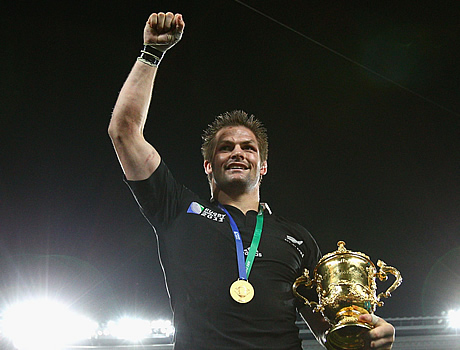
EXAMPLE: Captain McCaw led New Zealand's road to glory
NEW Zealand’s success in the final completes a proper story, at a time where depression is in the news a lot.  The country has had to deal with a horrible year, which has including a mining disaster and the devastating earthquake in Christchurch back in February.  Finally, the rugby team have managed to put smiles on the Kiwi public, which has had a lot of trauma to put up with this year.  By far, this isn’t the greatest All Blacks side ever put together, but what it does have is not just the abundance to turn on the style, but hold on when it needed to.  Consistently, they played the best rugby over the six weeks, delivered when it counted and got the ultimate prize at the end, a deserved reward for a nation that can feel reborn on its success.

What went wrong for England?
EVERYTHING pretty much went wrong for England; their time in New Zealand was a disaster.  The players have to take the blame for some average performances.  The first half nightmare in the quarter-final against France finally sealed their fate.  Martin Johnson will probably pay for the lack of performance, with his job.  The media didn’t help the team either, with some unsavoury headlines about late night antics involving Mike Tindall.  The team were allowed to enjoy themselves, but maybe they did it too much.  Words fail me with what Manu Tuliagi was thinking when he decided to jump off a ferry even after elimination.  Johnny Wilkinson looked well past his best, Matt Stevens is a liability and indiscipline cost the team on the pitch too, with both Courtney Laws and Dylan Armitage serving suspensions after being reported.  The RFU has to produce an urgent review into the failings of the side and on the evidence of this tournament; England will do well to retain the Six Nations title next spring.

Other disappointments
SCOTLAND had a challenging pool and didn’t get any luck against England and Argentina when they needed it the most.  However, they only scored four tries in four matches and didn’t make the quarter-finals for the first time in RWC history.  Another disappointment was Fiji, who laboured past Namibia, then were simply dreadful against Wales, South Africa and Samoa.  They were expected to challenge seriously for a quarter-final berth, but it never materialised.  Defending champions South Africa looked like a side that was past its best and Peter de Villers has quit off the back of failing to retain the trophy.  Finally, despite reaching the last four, Australia never looked convincing either.  The Aussies have a promising crop of young players and were also desperately unlucky with injuries throughout, but they didn’t hit the heights they looked capable of from the Tri Nations series.  Perhaps this tournament was a bit too soon for the current young generation.  However, the Aussies must continue to invest in this development, as it might make them favourites to regain the trophy in four years time.

Redemption for France
FRENCH rugby looked to be in yet another crisis, especially after that shocking defeat to Tonga in the pool stages.  They scraped into the quarter-finals, but while the rugby experts continue to write them off, I never did that.  They saved their best performance for the final and came within an inch of causing their own upset and clinching the golden prize for the first time.  Three weeks ago, the French deserved to fly home in standard class to a chorus of boos at Charles de Gaulle airport in Paris.  Now, they return to their homeland as heroes.  Rugby can be a fickle game at times!

Argentina perform at the highest level
AT LAST, Argentina has got into the Four Nations, formerly known as the Tri Nations next year.  I’m sure South Africa, Australia and New Zealand will appreciate the extra competition, if not the daunting trip to Buenos Aires.  Unfortunately, I do feel this decision has come four years too late.  The Pumas may have not looked at their best, as they did in 2007, but a run to the quarter-finals, giving the All Blacks their most challenging encounter until the final showed that progress has been sustained at least.  The story of the South Americans is once again, among the success stories of a Rugby World Cup.

Improvements from the ‘B’ teams
DELIRUM: Canada surprised Tonga in the pool stages
NAMIBIA aside, there was some great performances from the lower-ranked sides.  Canada beat Tonga and pushed France all the way, Samoa came within an inch of shocking South Africa and even though they didn’t win any matches, the flamboyant Japanese side won many fans in New Zealand.  So did debutants Russia, whose defending was pretty abysmal, but didn’t mind giving it a go and scored tries in all of their four pool matches, including 22 points against Australia.  There was the occasional thrashing, but the days of regular landslide scores in the pool stages of the Rugby World Cup is a thing of the past.

The Welsh journey
TURNED: The Welsh dream ended with this cruel red card for Warburton
NEW Zealand might be world champions, but the story of the Rugby World Cup is the rebirth of Welsh rugby.  Warren Gatland’s side returned with a fourth placed finish and had it not been for a diabolical decision to send off Captain Sam Warburton in the semi-final against France, it could have been even better.  The youngsters in the Welsh pack are incredibly talented and they showed that in abundance.  The likes of Faletau, Halfpenny and Warburton also brought the best out of the experienced players such as Shane Williams.  Wales have now given themselves a massive platform to build on and start February’s Six Nations as overwhelming favourites.  Previously the laughing stock of Northern Hemisphere rugby, they have to be taken seriously now as leading lights in world rugby.

So there you have it, six weeks of cracking rugby is over.  The atmosphere was electric and New Zealand lived up to the billing, being absolutely sensational hosts of the premier competition in world rugby.  The action might not have lived upto the standard of 2007, but there are still many fond memories for fans to take away, especially for the hosts, who can once again claim to be, world champions.

Sunday, 23 October 2011

Rugby World Cup Final 2011 - The All Blacks end the barren run

CELEBRATION: The wait is finally over for New Zealand

THEY have waited 24 years and had to deal with a serious of near-misses and underachieving teams.  However, good things do come to those who wait and New Zealand can claim to be world champions for the first time since 1987.  Infront of a passionate and willing home crowd, they edged out France this morning 8-7 to win the Rugby World Cup final and claim the Webb Ellis Trophy for the second time.  It was a closely fought and intense final, even if it lacked clear try-scoring opportunities and free flowing rugby.  It was a penalty early in the second half from fly-half Stephen Donald that ultimately proved to be the difference.
      Going into the final showpiece and many fans and rugby experts had already written France off.  They had lost embarrassingly to Tonga three weeks ago in the pool stages and have struggled as a unit to gel properly Down Under.  Meanwhile, the All Blacks were quietly confident after their semi-final demolition of Australia last weekend.  However, this new crop of stars was wary of the potential for an upset; as France had knocked them out sensationally of two tournaments in the past; 1999 and 2007.  They were also the last side to beat New Zealand in rugby internationals at Eden Park, Auckland – way back in 1994.
      The opening stages promised much for the Northern Hemisphere side, but just like in the earlier pool match between these sides, it was the Kiwis who brokethrough first.  Veteran prop Tony Woodcock, who had been part of the side that experienced that quarter-final heartbreak in Cardiff four years ago, charged through a gap in the French defence from a well-worked lineout.  Within 12 minutes, the favourites were infront and the fears of the potential demolition people had forecasted before kick-off might have been realised.  Luckily for France, Piri Weepu had a dreadful night with the boot; missing with all three of his early kicks, including the conversion for Woodcock’s try. 
     Meanwhile, fly-half’s in the match kept getting injured left, right and centre.  France’s no.10, Morgan Parra was forced out of the game, thanks to a head injury.  Moments later, Donald, who wasn’t even in New Zealand’s RWC squad at the start of the competition, got his chance when Aaron Cruden was carried off the pitch by the New Zealand physio with what looked like a serious knee injury.  First choice fly-half’s Dan Carter and Colin Slade had already been sidelined during the tournament by injury.  Early after the restart and Donald kicked a simple penalty over the posts to install an eight point lead.
      However, France kept battling and produced their best performance of the tournament by a long distance.  They ended up setting up a nervous last half-hour for the hosts, producing the best piece of rugby in the match which resulted in a try for the captain, Thierry Dusatoir.  However, Francois Trinh-Duc missed a long-range penalty in the last ten minutes and the hosts grimly held on for a famous and deserved victory.
     For France, it was a disappointing end to a tremendous effort, which not only won the respect of the crowd in Eden Park, but won them back both pride and redemption after their nightmarish string of performances in the pool stages.  Unlike their defeats in the finals of 1987 and 1999, they can hold their heads up high at giving it everything and pushing the favourites all the way.
DELIVERED: Richie McCaw and his team came through for a nation
     It was left to Prime Minister John Key to hand the golden trophy to New Zealand captain and one of the best flankers to have ever played the game, Richie McCaw.  McCaw joins the likes of Francois Pienaar, John Eales and Martin Johnson who have had the honour of lifting aloft the Webb Ellis Trophy, alongside colourful fireworks, pyrotechnics and an electric singing performance from the voice of this World Cup, Hayley Westerna.  For New Zealand the rugby team, they were the best side in the six weeks of competition and this time, they delivered for a public who craved another rugby success.  For New Zealand the nation, it is a fitting triumph for a country that had to deal with the River Pike mining tragedy and the devastating earthquake in Christchurch back in the spring.  Now, they have something to smile about.
      So, thank you New Zealand for putting on a spectacular show and congratulations to the All Blacks, fitting winners of the 2011 IRB Rugby World Cup.

Wednesday, 12 October 2011

Rugby World Cup 2011 - Sorry England go home

QUARTER-FINAL weekend at the 2011 Rugby World Cup provided some great stories, some emotional heartbreak and some graceful and emotional goodbyes.  For England, they don’t fit into any of these categories.
     The death knell in their torrid time in New Zealand came to a painful conclusion at Eden Park on Saturday.  Their worst performance in the competition since the inaugural 1987 tournament was sealed by a 19-12 defeat at the hands of France.  Actually, the scoreline reflects quite positively on England, but if anyone had watched the game, they would have seen that the French were completely on top for 90 per cent of the encounter.  After a flying opening, the English failed to score a point and paid for a number of issues with their basic game.  Some woeful tackling, poor discipline and iffy handling came together to give the French a 16-0 half-time lead.  
DECISIVE: Maxime Medard's try ended England's sorry adventure
     The dangerous Vincent Clerc and Maxime Medard both crossed the try line as for the first time in this tournament; France looked like a decent side, which I had sadly predicted previously.  Matt Dawson; scrum-half in the 2003 winning England team summed it up on BBC Radio 5 Live; “England were blown away in the first half and probably got a proper telling off.  They came out with a little more pace and precision, but they made too many mistakes with knock-ons, penalties and turnovers.”  Ben Foden and Mark Cueto highlighted a slight improvement from England in the second half with tries, but the damage had already been done.  Martin Johnson has refused to answer questions about his future as head coach, but this tournament has been a flopping disaster.  The RFU has insisted it will hold a review into the shambles of this Rugby World Cup.  I hope Johnson keeps his job, but unfortunately, coaches are judged on World Cup success, not autumn internationals and Six Nations championships.  His future is looking very bleak.  To finish matters off, Manu Tuliagi, who had been one of the bright sparks in this dreary campaign, was arrested by police after deciding on Sunday night to jump off a ferry!  It cost him £3,000 for a stupid, daft and foolish piece of behaviour and sadly, if players do this, the media has every right to crucify them.  England have arrived home, a far sorrier and unruly bunch than it was when they left these shores at the end of August.
     Whilst England headed for the airport, Welsh fans were beginning to move from Wellington to Auckland for a World Cup semi-final.  Since that agonising opening weekend defeat to South Africa, the Welsh have been getting better and better.  They are a team that is gelling together at just the right, decisive moment.  Their first semi-final since 1987 was sealed by a very impressive 22-10 triumph against Ireland in what was the best quarter-final of the weekend.  Shane Williams put Wales infront after just two minutes and the Irish resistance got blown away by second half tries from Mike Phillips and Jonathan Davies.  At the start of the second half, Keith Earls had pushed Ireland onto level terms with his sixth try of the competition.  However, as the game wore on, the Irish began to run out of legs and the young, fresher Welsh squad prevailed.  It marks the end for a golden Irish generation, with the likes of Ronan O’Gara, Paul O’Connell and Brian O’Driscoll surely set for retirement now.  Ireland gave it their all, but it wasn’t enough on the day.  Although the final result was devastating for them, they made their mark in this competition by shocking Australia in the pool stages, so they shouldn’t be too disheartened.  Wales go from strength to strength and will fancy their chances against the unpredictable French on Saturday of making a Rugby World Cup final for the first time.
PACKING: JP Pietersen reflects on South Africa's painful defeat
     Sunday’s second semi-final will be between old rivals, Australia and New Zealand.  The Wallabies somehow managed to send the defending champions South Africa packing on Sunday morning.  They won 11-9 in a game full of bruising tackles and competitive build-up play, but lacked clinical scoring opportunities.  The only try of the match came early on, courtesy of Australia skipper James Horwill.  Afterwards, a heroic rearguard action by the Australians was enough to restrict the Springboks to kicking attempts.  Fly-half Morne Steyn sent over two penalties and a drop goal, which did have his side 9-8 in the lead with eight minutes remaining.  However, winger James O’Connor responded for Australia, with a brilliant penalty kick from near his own half to seal the victory for the Wallabies.  The Springboks will be wondering how they managed to have so much possession, yet lose the match, equalling their worst performance in RWC history, which was back in 2003.  It means that still no-one has ever managed to retain the Webb Ellis Trophy.  Coach Peter de Villers hailed an ‘incredible journey,’ but made an emotional goodbye to the job he loved in the post-match press conference.  Like Johnson, his failure to bring the big trophy home will be sadly what he will be remembered for in South Africa.
     As expected, New Zealand saw off a brave Argentina outfit, although the final 33-10 scoreline did flatter them.  Nerves looked to have got the better of the All Blacks, infront of an expected crowd and they trailed early on through Julio Farias Cabello’s try.  Gradually though, the Pumas resistance was worn away by the cup favourites.  Seven penalties from Piri Weepu showed that there is life after the much missed Dan Carter before tries in the last quarter from Kieran Read and Brad Thorn made the game safe.  Felipe Contepomi bids farewell to the rugby stage, after three World Cups where he showed that he was one of the best players to have graced the game in modern times.  Argentina were rightly praised by Graeme Henry, the New Zealand coach for the tough encounter he got and the South Americans can look forward to joining the former Tri-Nations series alongside South Africa, New Zealand and Australia in the newly named Four Nations next summer.
     So, four sides now remain after an intense quarter-final weekend.  All English fans will be gutted by this shameful early exit, but I urge them now to back Wales all the way!  Let’s see what France, Australia and New Zealand have to say about it in what is bound to be an even tenser semi-final weekend coming up.

QUARTER-FINAL RESULTS: Ireland 10-22 Wales, England 12-19 France, South Africa 9-11 Australia, New Zealand 33-10 Argentina

SEMI FINALS
Wales v France, Auckland – Saturday 15 October (9am) live on ITV1 and ITV1 HD
Australia v New Zealand, Auckland – Sunday 16 October (9am) live on ITV1 and ITV1 HD

Wednesday, 5 October 2011

Rugby World Cup 2011 - Scottish hearts broken by Ashton

THE pool stages at the 2011 IRB Rugby World Cup are over and so are the hopes of twelve teams who were dreaming of reaching the final.  Quarter-final weekend will ultimately see eight of the top nine sides in the IRB rankings do battle; Ireland, England, South Africa, New Zealand, Wales, Argentina, Australia and France.  The team missing out is Scotland, who lost their proud record of having at least made the last eight of every Rugby World Cup competition. 
CRUSHED: Ashton finally put the knell in Scotland's hopes
    For a while on Saturday morning, it looked like the impossible might become possible, as Dan Parks kicked Scotland into a 12-3 lead against England in Auckland.  However, the English dug in throughout another scrappy performance from our boys.  Once again, Johnny Wilkinson had a shocking day with his kicking and surely, Martin Johnson has to consider picking Toby Flood as his no.1 choice at fly-half.  In the end, it was Chris Ashton who once again managed to bail out England.  Trailing 9-12 with three minutes remaining, Ashton finished off the one flowing move England were able to put together in the entire match.  It makes him the leading try scorer in the tournament and earnt us a 16-12 triumph.  It comes at a cost; with a dangerous tackle on Chris Patterson, Dylan Armitage was cited and since been banned from this weekend’s quarter-finals.  Scotland has been unlucky at the tournament, but when you fail to score any tries against Argentina, Georgia and England, I’m afraid it has to be an early flight home.
UPSET: Tonga celebrate a historic victory over the dismal French
     It could be worse, as you could be French at the moment.  They may be in the last eight again, but at the height of a national embarrassment.  They were dominated by a resolute and magnificent Tonga in Wellington and fell to a 19-14 defeat; one of the biggest upsets in Rugby World Cup history.  Only a late try from Francois Clerc was even enough for Les Bleus to secure the losing bonus point.  The French have looked atrocious from their opening match, but knowing them, they have a performance in them, so England shouldn’t take them too lightly.  For Tonga, victory meant like winning the World Cup to them.  It secures them an automatic place for the 2015 finals, at Canada’s expense.  However they will be regretting the loss to the Canadians, otherwise they would be deservedly in the last eight.  Unless they progress on Saturday, France’s rugby players deserve similar treatment to their football counterparts in the 2010 football World Cup; fly home in standard class!
     New Zealand received a hammer blow as arguably, the best player in the world at the moment, Dan Carter was ruled out of the tournament.  He looked in agony and limped away in tears after an Achilles tendon ruptured finished the 29-year’s old participation in his home tournament.  You wonder whether this is his last attempt at the World Cup, after injury ruined his 2007 campaign too.  The All-Blacks didn’t need him against Canada though, cruising to a comprehensive 79-15 victory, scoring twelve tries in the process.  Four of these came from Zac Guildford, while Miles Muliana returned from injury to cross once in his 99th test for the hosts.  We’ll see how much Carter’s absence will now affect the New Zealand squad and also, the fans. 
    Wales banished their nightmare of Nantes 2007 in their revenge rematch against Fiji.  Samoa’s luckless and narrow defeat to world champions South Africa on Friday meant a bonus point was only required for the Welsh to progress.  The potential banana skin turned into a no contest encounter, with the Welsh cantering to 66-0 annihilation in Hamilton.  Welsh centre Jamie Roberts scored two tries in this emphatic performance.  The Welsh have looked very impressive in the pool stages, and can look forward to a very intriguing quarter-final showdown with Ireland on Saturday.  Fiji; quarter-finalists themselves four years ago, have had a dismal tournament.  No wonder; they even let Namibia score over 20 points!
     In the final pool match of this World Cup, one more quarter-final spot was up for grabs.  Ireland sealed it and it turned into a mismatch against Italy.  Once Brian O’Driscoll crossed the Italian try line in the opening stages of the second half in Dunedin, there was little doubt who was going to be the winning team.  On his birthday, Keith Earles touched down twice, as Ireland scored 27 unanswered points in the second half.  The Emerald Isle eventually won 36-6 and deservedly ended top of Pool C, leaving Australia with a much harder route now to the final. 
     Quarter-final weekend looks a very tasty one and at least three of the games look too close to call.  The final gets closer and with the hard-working minnows dispatched, the real action starts this weekend!  Good luck to the remaining teams left fighting it out for Rugby World Cup glory in 2011!
THE FINAL POOL RESULTS: Georgia 25-9 Romania, South Africa 13-5 Samoa, Australia 68-22 Russia, France 14-19 Tonga, England 16-12 Scotland, Argentina 25-7 Georgia, New Zealand 79-15 Canada, Wales 66-0 Fiji, Ireland 36-6 Italy

CLOSER: Just eight teams can still dream of lifting the trophy in 2011
THIS WEEKEND’S QUARTER-FINALS
Ireland v Wales, Saturday 8 October, from Wellington, 6am UK time, live on ITV1 and ITV1 HD,
England v France, Saturday 8 October, from Auckland, 8.30am UK time, live on ITV1 and ITV1 HD,
South Africa v Australia, Sunday 9 October, from Wellington, 6am UK time, live on ITV1 and ITV1 HD
New Zealand v Argentina, Sunday 9 October, from Auckland, 6am UK time, live on ITV1 and ITV1 HD

Tuesday, 27 September 2011

Rugby World Cup 2011 - Favourites begin to show their class

WITH the pool stages at the 2011 Rugby World Cup coming to a close, the quarter-final line-up begins to take rapid shape.  In the last week, we’ve seen evidence that the cup favourites have taken their game up a notch and some more landslide results as a consequence.  Although to the neutral, this can be seen as disappointing in light to a true contest, the underdogs know that barring a disaster, it’s four games and then an early flight home, whilst the heavyweights play out the latter stages. 
RETURN: Cueto made a successful comeback, with a hat-trick
     Having scathingly criticised England for their opening two performances, Martin Johnson’s men finally arrived at this Rugby World Cup with a ten try whitewash of minnows Romania in Dunedin.  The 67-3 scoreline didn’t flatter the English either, with signs that their A game has now been brought to the pitch.  Mark Cueto marked his return to the test side, with a devastating hat-trick in the first 30 minutes.  The flamboyant Chris Ashton also crossed for his own hat-trick, as Romania simply couldn’t cope with the onslaught.  To not concede a try and only three points in total also underlines that the defensive work in training is beginning to pay off.  Let’s not forget that Romania is a lower-ranked side, but the performance was much better than the one witnessed in beating Georgia six days earlier.  Only against sterner opposition, like Saturday’s crunch encounter with Scotland in Auckland can we truly assess where England are at in comparison to the other favourites.
TORMENT: Scotland have to look on, as the Pumas celebrate
       Sadly for the Scots, it will now take a miracle to qualify for the quarter-finals.  In conditions more akin to rallycross, they were narrowly beaten 13-12 by Argentina in Wellington.  It was a game of few chances and that was always going to be the case between two well-matched sides.  The crucial, game breaking moment came with nine minutes remaining.  Dan Parks had come off the bench to kick Scotland 12-6 ahead.  The Pumas response was absolutely scintillating.  Lucas Gonzalo Amorosino weaved his way past three Scottish tackles, before diving over for the pivotal try; one of the best individual ones of the World Cup so far.  Stalwart Felipe Contepomi, playing in his last World Cup kicked over the conversion.  In the dying stages, Contepomi looked blatantly offside during the final Scottish attack.  Rather than wait for the certain penalty, Parks attempted the drop goal which wasn’t even close.  The advantage went and with it, so did Scotland’s hopes in cruel fashion.  They now must beat England, score four or more tries and prevent Johnson’s side from gaining any points.  It has to be considered as a long shot.
      If they don’t underestimate Georgia, Argentina’s prize for escaping Pool B will be an exhilarating quarter-final clash with the favourites and the hosts.  New Zealand dispatched France with consummate ease in their Pool A decider at the weekend.  In fact, they were so clinical; the bonus point was wrapped up shortly after the interval.  Israel Dagg was the star man for the All-Blacks, crossing for another two tries.  They won the match 37-17 and by five tries to two; one of those being an intercepted try for the French.  Dan Carter looked back to his best and it was a celebration for Richie McCaw, who was playing in his 100th test match.  As for France, they will have to seriously improve if they want to advance past the quarter-finals.  However, knowing the French, they have the capabilities to turn in a performance of magic at some point.  England still has to be prepared for the quarter-final bruiser that awaits them.
       In the battle of the Pacific Islanders, Samoa beat a desperately poor Fiji outfit 27-7.  However, they failed to score a crucial bonus point in the match, when it was there for the taking.  Although they will give South Africa a physical and bone-rattling test on Friday, expect the South Africans to finish their hopes off and progress as Pool D winners.  Wales looked impressive again, especially in the second half of their 81-7 destruction of a very tired Namibia yesterday.  Namibia’s tournament has been forgettable, but they did play four games in sixteen days, which is a big ask for a second-rate, amateur team. 
      Pool C is the one pool that looks very interesting going into the final weekend.  Australia had been expected to coast past the USA and did so on Friday morning, dispatching the Americans 67-5.  Adam Ashley-Cooper highlighted their clinical approach, with a hat-trick as the Wallabies ran over 11 tries.  The match was overshadowed by what looked to be a horrific injury to Anthony Faingaa in the closing stages.  He went off on a stretcher, with the likelihood of not only his tournament being finished, but the possibility of his rugby career being in severe doubt.         
     Finally, both Canada and Japan may be going home, but they provided those who got up at 4.30am this morning with a cracking match.  In a keenly-fought contest in Napier, a late penalty from Ander Monro was enough to earn a 23-23 draw for the Canadians.  It is only the third draw in RWC history and incredibly, these sides couldn’t be separated in 2007 either, drawing 12-12 on that occasion.  For me, Canada and Japan have given us plenty of memories in the pool stages and look to be the two most improved teams in world rugby.  Hopefully it won’t be long before they can begin to seriously threaten the real rugby elite.  With one more weekend of pool matches remaining, all rugby fans will be looking forward to an intense final weekend, some emotional farewells and then the real fun begins.   
THE WEEK’S RESULTS: Australia 67-5 USA, England 67-3 Romania, New Zealand 37-17 France, Fiji 7-27 Samoa, Ireland 62-12 Russia, Argentina 13-12 Scotland, Wales 81-7 Namibia, Canada 23-23 Japan, Italy 27-10 USA

Thursday, 8 September 2011

My top ten RWC moments


By Simon Wright, (Sporting piece)

My selection of the best; the top ten from the Rugby World Cup.

1. France stun the All Blacks, Rugby World Cup Semi-Final, 1999
FRANCE had stuttered into the semi-finals of the 1999 Rugby World Cup and came in as massive underdogs against formidable New Zealand at Twickenham.  Many pundits before the match thought it would be no contest, with the All Blacks predicted to score more than 50 points against their opponents.  It went to form in the first half, with Jonah Lomu looking as formidable as ever.  However, Les Bleus ripped the best side in rugby apart in a devastating 30 minute spell in the second half, scoring three tries and scoring 31 unanswered points to produce the biggest ever upset in the whole of Rugby World Cup history.  The final scoreline; 43-31.  The rugby world was shaken by what France did on this day; undoubtedly the best ever match in the game of rugby union, let alone World Cup history.

2. Johnny drops England home, Rugby World Cup Final, 2003
TELSTRA stadium was the setting for the 2003 final between the hosts Australia and the favourites, England.  Australia made the dream start, as Lote Tuqiri scored a try after only five minutes.  Johnny Wilkinson’s reliable boot pushed England into the lead, before they ripped up pre-match critics of ‘boring’ rugby, by producing a great teamwork try for Jason Robinson.  At 14-5 up at half-time, silly errors from Clive Woodward’s side in the second half allowed the Wallabies back into the match.  Elton Flatley kicked the match into extra-time under intense pressure.  With the scores at 17-17, the prospect of sudden death loomed when a final surge from England allowed Wilkinson his moment.  At the fourth attempt of asking, he hit a sweet drop goal to ensure victory for a Northern Hemisphere side for the first time in this prestigious final.  England’s first major sporting success since 1966 was sealed by the golden boot of Johnny.

3. ‘We did it for 43 million South Africans!’  Rugby World Cup Final, 1995
HAVING been released from exile in sporting competitions after Apartheid, South Africa staged a colourful and spectacular Rugby World Cup in 1995.  They came into the tournament ranked tenth in the world, but by beating defending champions Australia in the opening match, they set out their stall.  Chester Williams became a national hero for his four tries against Samoa in the quarter-finals and the late Ruben Kruger dived over to win the swamp of a semi over France.  In the final, the Springboks had a plan to stop Jonah Lomu and New Zealand’s formidable frontline.  It wasn’t a great match, but the spectacle made up for it and it was the right result, as Joel Stransky kicked the winning points with a brilliant drop goal in extra-time.  The hosts had won the Webb Ellis Trophy, with delighted captain Francois Pienaar getting the cup from President Nelson Mandela, who was wearing a Springbok rugby top!  Afterwards, Pienaar claimed that his team had won it for the incredible support the country had shown throughout, but not just lucky enough to be in Ellis Park on the day, but for the 43million South Africans worldwide.

4. Lomu destroys England, Rugby World Cup Semi-Final, 1995
HE DESTROYED Wales, Ireland and Scotland in the preliminary stages and Jonah Lomu simply dismantled a shell-shocked England in the 1995 semi-finals.  His first try, which saw him shake off the attentions of Tony Underwood and Rob Andrew, before trampling all over Mike Catt to reach the try line.  For me, it is the greatest try in Rugby World Cup history.  He scored four in the match and Will Carling, England captain later admitted he didn’t ever imagine conceding four tries in the first fifteen minutes as worst case scenario.  The final 45-29 scoreline flattered England, as they were simply outclassed by the powerful All Blacks and the fearsome Lomu.

5. Gordon Hamilton’s Try, Rugby World Cup Quarter-Final, 1991
WITH skipper Nick-Farr Jones injured and watching from the stands, Australia looked on the ropes at Lansdowne Road in a quarter-final with Ireland.  In the last ten minutes, the Irish sensed an opportunity and Gordon Hamilton, not a prominent try-scorer, produced the greatest moment in Irish Rugby World Cup history.  The ground erupted in joy as the underdogs had just taken the lead.  Unfortunately for Ireland, Michael Lynagh scored a late try which took the favourites through and broke the crowd’s hearts.  Nevertheless, Hamilton’s moment of magic has remained in Irish folklore.

6. Serge Blanco’s last-gasp try, Rugby World Cup Semi-Final, 1987
AUSTRALIA must have fancied their chances of a final with New Zealand in the inaugural tournament, when they came up against the unpredictable French in a pulsating semi-final.  The game ebbed and flowed throughout, with David Campese breaking the all-time rugby point’s record during the match.  Seconds remained, when a mix-up in the Australian backline allowed the French a final chance.  Serge Blanco managed to find the corner to send France into the final, which they ultimately lost.  However, it goes down as the most iconic moment of the 1987 world cup.

7. Hastings blows it, Rugby World Cup Semi-Final, 1991
LET’S face it, England and Scotland don’t like each other and never will.  The 1991 semi-final was always going to be very personal and tight, as England wanted to seek revenge for a Grand Slam nightmare at Murrayfield the year before.  With nine minutes to go, the game was deadlocked at 6-6, when Gavin Hastings, a trusty penalty kicker, had an easy chance to put Scotland infront.  Amazingly, he sliced the kick and it sailed wide.  Even the English couldn’t quite believe what Hastings had just done.  Minutes later, Rob Andrew’s drop goal took England through to a final with Australia and Gavin Hastings was left to ponder what might have been.

8. England’s revenge at Table Mountain, Rugby World Cup Quarter-Final, 1995
THEY lost a narrow final on home soil in 1991, so England were desperate to settle the scores in a quarter-final at Table Mountain against Australia four years later.  The Aussies defeat to South Africa in the pool stages had given them a harder route towards the final, but with a team full of talent such as John Eales, Michael Lynagh, George Gregan, Tim Horan and David Campese, the Wallabies were still expected to go through.  The game didn’t disappoint and extra-time beckoned when Rob Andrew kicked a stunning drop goal to win the quarter-final.  English fans overjoyed, Australian fans desolate and for the likes of Lynagh and Horan; the end of an era as both legendary players retired from rugby after this devastating defeat for the holders.

9. Super Shocking Saturday, Rugby World Cup Quarter-Finals, 2007
ON PAPER, Australia were expected to steamroller England and New Zealand should comfortably put the French away, but when was rugby ever played on a piece of paper!  On ‘Super Saturday,’ Johnny Wilkinson’s boot once again did for Australia in a heroic English display in Marseille.  Following an embarrassing defeat to South Africa in the pool stages, English rugby had been seen as a game and a team in steep decline, so this must have made Australia look very poor.  Hours later, Yannick Jauzion crossed the line in Cardiff to seal a sensational 20-18 win for France over New Zealand.  The favourites by a mile had choked again.  They had gone out at the quarter-final stage on this ‘Shocking Saturday,’ for the first time in history and Coach Graeme Henry lost his job.

10. Argentina’s mammoth breakthrough, Rugby World Cup, 2007
OPENING night nerves really showed up on hosts France in 2007.  It was a match where they never looked strong enough and believed they could win.  As a nation toiled, Argentina rejoiced in its biggest moment in RWC history and their momentum continued.  The Pumas had been knocking on the door of the elite nations for a while, and they finished off Ireland’s shambolic tournament in the final Pool D match to top the pool.  The South Americans overcame a stiff Scotland challenge in the last eight and only an error-strewn performance against eventual winners South Africa in the last four blunted their hopes.  Nevertheless, this was a tournament where Argentina made a mammoth breakthrough.

WHETHER you are supporting the All-Black Haka, the Emerald Isle of Ireland, the English Rose, the stunning Springboks, the Welsh Dragon, the hard-hitting Pacific Island nations or the Walloping Wallabies, RWC 2011 promises to be another fantastic spectacle.

To New Zealand, South Africa, England, Australia, France, Argentina, Ireland, Wales, Scotland, Fiji, Italy, Tonga, Samoa, Japan, Canada, USA, Romania, Georgia, Namibia and Russia, I wish you all a great tournament over the next six weeks and I’d like to unofficially declare the battle for the 2011 Rugby World Cup officially open!!

Monday, 13 June 2011

McNish's lucky escape


SCOTTISH racing driver Allan McNish was lucky to escape unharmed from a serious accident which marred this weekend’s Le Mans 24 Hours race in France.  The Le Mans event is the pinnacle of the sportscar calendar, but it nearly ended in tragedy which would have bought echoes of the 1955 disaster, when spectators were killed by a Mercedes car crashing into the crowd.
     McNish, a former Toyota Formula One driver in 2002 and twice a winner of the Le Mans 24 Hours, was driving one of the favourite Audi cars, alongside Rinaldo Capello and Danish legend Tom Kristensten.  Just over an hour into the event and McNish was challenging for third place, when he clipped a backmarker car.  Allan, 41, was turned around by the Ferrari GT entry of Pierre Thiriet and Francois Jakubowski, driven by Frenchman Anthony Beltoise.  It was a minimal connection, but the sequence of events afterwards was frightening.  Fans favourite McNish had no control as his prototype careered across the gravel trap, appearing not to lose any speed whatsoever.  At approximately 120mph, he smashed into the tyre barriers, shredding wheels, debris and other pieces of carbon fibre all over the place.  Stewards and photographers, hoping to have a quiet day or take the stunning landscape shot, were suddenly running for their lives.  Although his car was a complete write-off, McNish was helped out of the cockpit relatively unharmed, with just a bruised shin and a shaking. 
     Inside the pits and the Audi mechanics looked like they’d seen a ghost, some close to tears as they feared the worst.  He was given the all-clear by the Audi team doctor and trackside staff at the La Sarthe circuit.  McNish admitted he was fortunate to walkaway afterwards;
“I have to say a big thank you to the designers of Audi.  They’ve produced a car that can have an impact that is enormous and the driver pops the door and gets out perfectly well.  Considering the impact, the speed and everything else, I think we all got away quite fortunate.”
     Audi had an emotional weekend, as Mike Rockenfeller suffered a 200mph crash on the Mulsanne Straight on Saturday evening.  He was kept in hospital overnight as a precaution, but is thought to be like McNish, relatively unharmed.  It ended on a happy note for the German manufacturer, as their other car, driven by Marcel Fassler, Benoit Treluyer and Andre Lotterer beat the leading Peugeot of Pedro Lamy, Sebastian Bourdais and Simon Pagenaud by just 15 seconds.  Britain’s best finisher was Anthony Davidson.  Davidson, also in a Peugeot finished fourth with fellow former F1 racers Marc Gene and Alexander Wurz. 
     However, the 2011 Le Mans 24 Hours will only be remembered for Allan McNish’s lucky escape.

Friday, 6 May 2011

F1 classic races - Turkey


IN A new series, I will be looking back at six classic races every weekend from the country about to stage an event in the 2011 FIA Formula One World Championship.  As Turkey has only held seven races before and not all of them have been classics, here is a varied selection of events from events no longer on the F1 calendar, plus two races from Turkey between 1991 and 2010.  Enjoy the archive!

1991 – France
WINNER: Nigel Mansell (Williams Renault), 2nd: Alain Prost (Ferrari), 3rd: Ayrton Senna (McLaren Honda)
RICCARDO Patrese started from pole position for the first French Grand Prix to be staged on the new Magny-Cours circuit, but he made one of the worst starts of his career, and never recovered from it here.  The battle for victory was between Alain Prost, on home soil in an uncompetitive Ferrari and Nigel Mansell’s Williams.  Mansell had a slower tyre stop, but managed to catch and pass Prost twice, eventually scoring a long first overdue victory of 1991.  Ayrton Senna was a distant third, holding off a similar hard challenge from Jean Alesi, with Patrese a disappointing and lapped fifth.

1997 – Argentina
WINNER: Jacques Villeneuve (Williams Renault), 2nd: Eddie Irvine (Ferrari), 3rd: Ralf Schumacher (Jordan Peugeot)
FORTUNE and a more competitive chassis saw Jacques Villeneuve win an absolutely barnstorming Argentine Grand Prix, but he had to work really hard all day.  His main rival for the championship in 1997, Michael Schumacher took himself out of the event on the first corner.  The German tangled with the Stewart of Rubens Barrichello, who also picked up severe damage.  Initially, it was Olivier Panis who was threatening Villeneuve, before engine trouble hit his Prost.  Eventually, the Canadian, who was battling a stomach bug all weekend, had to resist stern pressure from Eddie Irvine.  Although he chased him home hard, Irvine never really got close enough to make a sufficient overtaking attempt, and finished a close 0.9secs behind.  Jordan’s Ralf Schumacher, in only his third ever F1 outing scored a podium finish.  However, he achieved this at the cost of a fruitful relationship with his team, knocking off Giancarlo Fisichella and starting a civil war between the pair.

1999 – Austria
WINNER: Eddie Irvine (Ferrari), 2nd: David Coulthard (McLaren Mercedes), 3rd: Mika Hakkinen (McLaren Mercedes)
AUSTRIA 1999 was David Coulthard’s worst nightmare.  Not only did the Scot run into his team-mate Mika Hakkinen on the first lap, he allowed Ferrari to score an unlikely victory.  McLaren had been a full second quicker than the opposition in qualifying, missing Michael Schumacher, who was starting his recovery from a broken leg at Silverstone a fortnight earlier.  However, Coulthard tried an ambitious lunge on Hakkinen, which ended in contact at the second corner.  The Flying Finn recovered from a spin and 21st at the end of the opening lap, to finish an incredible third.  Coulthard sped 14 second clear at one point, but Eddie Irvine went longer on strategy, and with some blistering Schumacher-esque laps, overtook the Scot for his second win of the season and it threw the world title race wide open again.  Coulthard’s and Hakkinen’s expressions spoke volumes on the rostrum afterwards.

2005 - Bahrain
WINNER: Fernando Alonso (Renault), 2nd: Jarno Trulli (Toyota), 3rd: Kimi Raikkonen (McLaren Mercedes)
NEVER mind motorsport, but tennis was dangerous to Juan Pablo Montoya.  A freak accident left the Colombian with a fractured shoulder and out of the Bahrain event.  He wasn’t missed by the McLaren team, as super sub Pedro de la Rosa set fastest lap and finished a stunning fifth in an action-packed event.  It was one of the hottest races ever in history, and Michael Schumacher’s hydraulics couldn’t take the heat.  They gave up on his new Ferrari after 12 laps.  With Rubens Barrichello only 9th after gearbox troubles, Ferrari’s gamble on saving their 2005 season with a new car had backfired spectacularly.  The path was clear for Fernando Alonso to record back-to-back victories, with Jarno Trulli’s Toyota finishing second for the second successive race.  Kimi Raikkonen earnt his first podium of the season, to highlight McLaren’s impressive pace in the desert.

2006 – Turkey
NOTCH: Massa led Schumacher all the way to glory in 2006
WINNER: Felipe Massa (Ferrari), 2nd: Fernando Alonso (Renault), 3rd: Michael Schumacher (Ferrari)
THIS was the weekend when Felipe Massa really came good and went up a level in his F1 career.  Massa took pole position and his maiden Grand Prix victory in a nail-biting climax.  The start was just as chaotic, as Giancarlo Fisichella spun infront of the pack and caused mayhem.  Kimi Raikkonen, Scott Speed and Nick Heidfeld all suffered significant damage, with Raikkonen eliminated after a pitstop for checks.  As Massa led from the front, the Safety Car was deployed after Vitantonio Liuzzi spun his Toro Rosso and stalled on the exit of Turn One.  Championship rivals Fernando Alonso and Michael Schumacher swapped places in the pits, as Schumacher was held up, having to queue up for Massa to be serviced first.  In the dying stages, the retiring German did all he could to pass Alonso, but like at Imola in 2005, he couldn’t find a way through and had to settle for third.  As Schumacher couldn’t find a way through, Massa was allowed to win his first event in Formula One.

2010 - Turkey
RIVALRY: Began after this Red Bull collision last season
WINNER: Lewis Hamilton (McLaren Mercedes), 2nd: Jenson Button (McLaren Mercedes), 3rd: Mark Webber (Red Bull Racing Renault)
RED Bull Racing totally shot themselves in the foot last season, when under pressure from McLaren.  Mark Webber began from pole position and led the first 40 laps.  A slow pitstop dropped Lewis Hamilton behind Sebastian Vettel, but Hamilton and Jenson Button stayed right on the tails of the Red Bulls throughout.  On Lap 41, Vettel, with a higher engine setting, went to overtake Webber.  The Aussie left minimal room and Sebastian made his way past.  However, he began to deviate right before a car length’s room was given and they collided.  Vettel span into retirement, whilst Webber had to pit for a new front wing, surviving for a podium finish.  The McLaren’s of Hamilton and Button had a similar dice later, which saw the duo swap the lead.  However, they kept it clean to secure a 1-2 for the British team; Hamilton’s first win of 2010.  Although most experts thought Vettel was to blame for the Red Bull clash, the management seemed to shoulder the blame onto Webber.  This began a fractious summer for the pair and the Milton Keynes based team.

Wednesday, 22 December 2010

2010: A year in sport


IT HAS been an extraordinary year in sport, which saw some pleasant surprises, favourites fall flat on their faces and intriguing battles that went down to the wire.

UNLUCKY: Andy Murray came so close, yet so far in the Australian Open
The year began with a hard luck story for Andy Murray.  The Scot performed brilliantly to reach the final of the Australian Open, including a quarter-final success over Rafael Nadal.  Sadly, it ended in heartache, as Roger Federer swept him aside in straight sets in the final.  For both, this was to be their highlight of 2010.  In rugby union, France overpowered the feeble competition from the Northern Hemisphere to win a poor Six Nations championship.  They sealed the Grand Slam with victory over inconsistent England in the final match of the championship in Paris.  The New Orleans Saints completed a famous win in the NFL, defeating huge favourites Indianapolis Colts 31-17 to win Superbowl XLIV.  The Winter Olympics were held in the cold chill of Vancouver in Canada.  The games were overshadowed by poor weather, dismal organisation and the tragic death of a male Georgian competitor in the Luge competition on the eve of the event.  However, there was gold success for Britain, as Amy Williams showed she was the Queen of Speed.  She clinched gold in the women’s skeleton, Britain’s first solo gold in the Winter Olympics for over 40 years.  Manchester United beat Aston Villa 2-1 to win the first silverware of the football season.  They came from behind to lift the Carling Cup at Wembley, but that was Sir Alex Ferguson’s only taste of silverware in 2010 for the Red Devils.

SHOCK: Imperial Commander was the surprise winner of the Gold Cup
The F1 season began with an absolute stinker in Bahrain.  Fernando Alonso inherited victory on his Ferrari debut, after Sebastian Vettel encountered technical problems on his Red Bull.  Little did we know then of the later drama in the Grand Prix season.  It was dubbed the greatest horse racing showdown battle, but it never materialised at the Cheltenham Gold Cup.  Imperial Commander was the shock winner, taking full advantage of a shock fall for the pre-race favourite Kauto Star and the lack of fitness from his stablemate, Denman.  If Cheltenham upset the odds, Phil Micklelson’s victory by three shots in the US Masters at Augusta wasn’t so much of a surprise.  Tony McCoy may have guided Denman to runner-up in the Gold Cup, but he went one better at the Grand National, riding Don’t Push It to glory and finally, winning the world’s greatest steeplechase event at the 15th attempt of asking.  This success helped him land the coveted title of 2010 BBC Sports Personality of the Year.  In Jerez, Jorge Lorenzo passed countryman Dani Pedrosa on the last lap to win a thrilling Spanish MotoGP and set the tone for the motorcycling season to come.

GLORY: Chelsea lift the Barclays Premiership title in a double-winning year
As damaging allegations about former world champion John Higgins came to light, Australian Neil Robertson kept his nerve to win the World Snooker Championship at the Crucible.  Chelsea thrashed Wigan Athletic 8-0 on the final day of the Premiership season to clinch their third title in six years.  A week later, Carlo Ancelotti guided his side to a historic league/cup double, as Didier Drogba’s brilliant free-kick was good enough to defeat a brave and debt-ridden Portsmouth side 1-0 at Wembley in the FA Cup final.  There was more success for Australia on the streets of Monaco, as Mark Webber took the leadership of the Formula One world championship, leading home Sebastian Vettel to a Red Bull 1-2 in the principality.  A fortnight later, the two Red Bulls took each other off as Istanbul Park, handing Lewis Hamilton his first win of the season, as he won the Turkish Grand Prix for McLaren.  Blackpool joined Newcastle United and West Brom in the promise land of the Premiership.  The Tangerines sealed their shock promotion to the top flight, beating Cardiff City 3-2 in a pulsating Championship play-off final at Wembley.

CELEBRATION: Paul Collingwood lifts afloat the World 20:20 trophy
Argentine Diego Milito scored twice as Inter Milan beat Bayern Munich 2-0 in the UEFA Champions League final in Madrid, the perfect going away present for departing manager Jose Mourinho, who was heading for Real Madrid.  There was agony for Fulham, as they were cruelly beaten in the inaugural final of the UEFA Europa League, 2-1 by Atletico Madrid.  Diego Forlan scored the winner in the dying stages of extra-time and it was to be Roy Hodgson’s final game in charge of the West London side.  He took over the Liverpool job, after Rafa Benitez was sacked.  Benitez turned up at Inter, but might be sacked again before the year is out.  In cricket, Paul Collingwood captained England to a surprise and fantastic victory in Cricket’s 20:20 World Cup.  6-1 shot with the bookies, Workforce won the Epsom Derby and Rafael Nadal claimed back the world no.1 spot after overcoming Robin Soderling in the final of the French Open at Roland Garros.  Italy’s Francesca Schiavone was the shock winner of the ladies singles in France. 

PAIN: Valentino Rossi is treated after his horror MotoGP crash
Valentino Rossi’s hopes of retaining his MotoGP title were shot, when he broke his leg in a serious practice accident for his home event in Mugello.  A week later, the greatest show on earth kicked off with the 2010 FIFA World Cup beginning in Soccer City.  A colourful opening ceremony was followed by hosts’ South Africa drawing 1-1 in the opener with Mexico.  Siphiwe Tshabalala scored one of the goals of the tournament for the hosts.  Twenty-four hours later, England drew their opening match in Rustenberg against the USA.  The 1-1 draw stood out for a glaring error from goalkeeper Robert Green and millions of ITV HD viewers missing the England goal from Steven Gerrard, enjoying a Hyundai car commercial instead!  There was success for Northern Ireland, when Graeme McDowell won the US Open at Pebble Beach, becoming the first European since Tony Jacklin in 1970 to win the prestigious event.  Meanwhile, Mark Webber was very lucky to walkaway unscathed from a terrifying 196mph shunt with Heikki Kovalainen at the European Grand Prix in Valencia. 

AGONY: Steven Gerrard feels the pain of an early exit for England
England’s World Cup dreams were blown apart in Bloemfontein.  Fabio Capello’s flat Three Lions losing 4-1 to bitter rivals Germany in the last 16.  Despite having a clear goal disallowed, when Frank Lampard’s shot bounced over the line, the younger German side had far more passion and the scoreline didn’t flatter them.  It was another dismal major tournament performance from England, but Capello somehow managed to hang onto his job.  England weren’t the only ones to make an embarrassing exit, as 1998 winners France and defending champions Italy also making desperate early departures.  In the quarter-finals, Ghana got denied a semi-final place by Uruguay in a gripping quarter-final in Soccer City.  Luis Suarez’s blatant handball handed the Africans a last minute penalty in extra-time, which Asamoah Gyan missed.  Suarez’s celebrations left a bitter taste with many fans afterwards.  The final of the World Cup was a bruiser; with English referee Howard Webb dishing out 14 yellow cards.  Spain won the bad-tempered final in Soccer City, with Andreas Iniesta striking the decisive goal in extra-time against a Holland side that seem to be more interested in playing kung-fu.  At Wimbledon, John Isner beat Nicolas Mahut in the longest game ever in tennis.  Their first round match ended in Isner’s favour, 70-68 in the fifth and deciding set.  Watched on by David Beckham amongst others, Andy Murray failed in his quest to become SW19 champion, beaten by the inspirational Rafael Nadal in the semi-finals in straight sets.  Nadal went on to win the final, cruising past the conqueror of Roger Federer and Novak Djokovic, Tomas Berdych in straight sets.  In the women’s game, Serena Williams regained her title, thrashing Russia’s Vera Zvonareva in less than an hour.

WINNER: Mo Farah achieves a brilliant double in Barcelona
South Africa’s Louis Oosthuizen ran away with the Open Championship at St. Andrews, finishing on 16 under par, seven strokes clear of Lee Westwood, who would end the year as the world no.1.  In the Tour de France, Britain’s Mark Cavendish finished with an impressive five stage wins and Bradley Wiggins ended the event in fourth place.  The winner was Spain’s Alberto Contador.  Ferrari received a $100,000 fine for their use of team orders at the German Grand Prix.  Felipe Massa controversially handed a deserved victory over to his team-mate, Fernando Alonso at Hockenheim.  Formula One wasn’t the only sport in the dock in the summer, as cricket was faced with some tough questions, over match-fixing and ball-tampering allegations involving some of Pakistan’s key cricketers.  It made for savoury front page headlines and overshadowed a dominant summer series victory for England.  Happier times came out of the European Athletics Championships, which were very successful for Britain in Barcelona.  Mo Farah starred with two long distance wins in the 5,000m and 10,000m.  Phillips Idowu added to his world championship gold in the men’s triple jump and there was also gold for Jessica Ennis in the heptathlon and Andy Turner in the men’s 110m hurdles.  Britain left the event with 19 medals and puts us in great stead for London 2012.

REGAIN: McDowell played a key role in the Ryder Cup
The Warrington Wolves surprised the odds to defeat the Leeds Rhinos 30-6, to win the Rugby League Carengie Challenge Cup at Wembley.  In Super League, Wigan Warriors overcame Leeds in the final at Old Trafford, to win their first title since 1998.  The Ryder Cup at Celtic Manor turned into a rain-hit affair and a tense battle for supremacy.  In the first ever Monday finish to the tournament, Europe came out on top in Wales, with Graeme McDowell sinking the crucial put to see off America by one point, and regain the trophy for Europe, guided by the fantastic Colin Montgomerie.  After a dismal build-up and the withdrawal of several top-class athletes, the Commonwealth Games went ahead in India very successfully.  The starring role was from Tom Daley, as the young 16-year old won a double diving gold, despite having missed most of the season through injury.  After his closest challenger Dani Pedrosa fractured his knee in a practice crash for the Japanese MotoGP in Motegi, Jorge Lorenzo was practically assured of his first championship, which he buttoned up in Malaysia with a podium finish.

SOAKING: Lewis Hamilton and Jenson Button give the new champ a shower
The closest ever F1 world championship battle went down to the wire in Abu Dhabi.  Four men still had the chance of clinching the jewel in the crown and it was Sebastian Vettel who became the youngest ever Grand Prix champion, with victory in the season finale.  Championship favourite Fernando Alonso was penalised by a poorly timed pitstop and wound up a frustrated 7th, three places lower than what was required.  Mark Webber (8th) and Lewis Hamilton (2nd) were the other men in with a shout at the finale.  Hamilton may have missed out, but Dario Franchitti’s domination of the American scene continued, winning the Indy 500 for the second time in his career and the IndyCars title in the season finale in California, overhauling long-time leader Will Power in the final reckoning.  David Haye retained his world heavyweight championship title, after a comfortable stoppage of the woeful Audley Harrison in Manchester.  In the pick of the autumn rugby internationals, England beat Australia at Twickenham and Scotland stunned the world champions South Africa and the Ashes is currently tied at 1-1, after Australia levelled the series with an easy rout of England in the third test in Perth.    

That was 2010, a spectacular year and 2011 is bound to promise more of the same.