HappyDude88's Search

About Me

My photo
Hello, this is Siwri88, better known to some as Simon. Currently work as a picture researcher and product editor with a leading publishing company that works with trading cards and sticker albums on a variety of licenses in sport and entertainment. Freelance Journalist and writing a book in my spare time. Achieved a 2:1 studying BA Hons Journalism at the University of Northampton (2009-2012). Enjoy reading!
Showing posts with label 2002. Show all posts

Friday, 8 July 2011

TV classics - The Bill

By Jason Wright (Entertainment Expert)

ITV started the eighties with a bit of a drama crisis.  Popular programmes Minder and The Sweeney had been consigned to the history books, so it fell to Thames Television to produce a selection of one-offs to try and launch a new show.  They all failed bar one.  1983 saw the airing of a police drama called Woodentop and ITV were for once impressed.  They commissioned for it to return the following year as The Bill.

     The Bill’s humble beginnings were a basic half-hour show, dealing with general issues in the fictional Sun Hill branch of the Metropolitan Police.  Although not cutting edge as many drama shows that ITV showed at the time, it paid off and soon translated into a twice weekly show.  Eventually, the episodes grew into an hour and it was also very lucky to be one of the few shows to survive on ITV after Thames lost its regional broadcasting franchise.
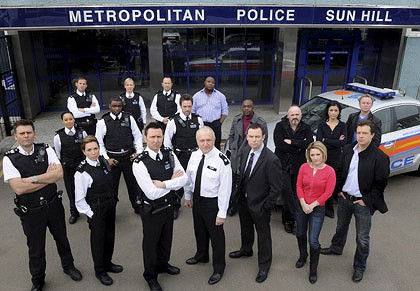
BEAT: The coppers outside Sun Hill police station
     Some of the most popular figures to grace Sun Hill were either usually around for a long time or memorable for deadly deeds.  Characters such as June Ackland (Trudie Goodwin), Bob Cryer (Eric Richard) and Tony Stamp (Graham Cole) were often at the height of the gripping storylines that the show was common for.  In the late nineties/early Noughties, the dodgiest copper was no doubt Don Beech (Billy Murray), who set up a secret second life by running a corrupt business and when unmasked, resulted in the death of a fellow officer.  He soon disappeared to Australia but was eventually tracked down and justice was done.
     The turn of the 21st century saw The Bill make the move into the dark side.  It had covered typical crime stories but now it felt it was ready to tackle more extreme plots.  This was best represented in 2002 with a constant vendetta battle with gangs in the area.  First, veteran Derek Conway (Ben Roberts) was killed when his car was blown up in a petrol attack.  Then the same people responsible for this crime came back weeks later in a petrol bomb attack that exposed Des Taviner (Paul Usher) as a corrupt cop.  Sun Hill erupted in a fireball and the lives of another six officers were lost.
     As the years passed, darker storylines were introduced and several characters paid with their insurances, and most of the recruits were killed off soap stars including Lucy Speed, Ali Bastian and Todd Carty.  Although two live episodes in 2003 and 2005 respectively garnered much praise, the new attitude alienated viewers and ratings declined very sharply.  Surprisingly, ITV didn’t even seem to care about it.
     Eventually, ITV did announce that autumn 2009 would bring a major shakeup, reducing the programme to once a week and move it into the post-watershed slot at 9pm.  Granted, most of the issues raised now were certainly not suited to the 8pm slot but what ITV didn’t get right was the new style of it all.  The new dramatic format took the edge away that it had been famous for and also the famous theme tune was ditched by something that seemed to written more for a funeral.
     Truly the decline of The Bill was now indeed complete.  As ratings shredded even further, ITV had engineered its own downfall so it decided to engineer its death and the police drama quietly slipped away in August 2010.  It was a sad but rather timely demise for a show that had gotten ahead of its time.
     The Bill though did change the conception of drama programmes on ITV.  It made the risks that worked first but then, the repetitive uses of these meant the public got bored and criticised it for its lack of faith.  It will though be always remembered for the quality it delivered.

Sunday, 15 May 2011

£3million fine for Network Rail

NETWORK RAIL has been fined £3million and been forced to pay legal costs of £150,000 following the Potters Bar rail disaster.
AVOIDABLE: Seven died after the tragic crash in May 2002
     Seven people, six passengers and one individual walking along the platform were killed when a lunchtime service from London to Kings Lynn crashed into the Potters Bar station in Hertfordshire.  The decision to fine Network Rail, taken on Friday at St. Albans Crown Court, ends the fight for justice for the families, who have waited nine years to gain some form of justice.
     At the hearing, Judge Andrew Bright described the accident as ‘catastrophic’ and the problems with faulty points at Potters Bar ‘could and should have been spotted sooner,’ before the tragic accident occurred on May 10, 2002.  Network Rail, who deal with the public railway system nowadays, have accepted the fine and apologised again to those who lost relatives and friends in the crash.
    Railtrack, which ran the railways at the time of the Potters Bar rail disaster were seen by many to be responsible for the accident.  The judge said that the running of the railways at the time, which had seen accident at Southall, Paddington and Hatfield in quick succession before Potters Bars that Railtrack’s procedures were ‘seriously inadequate.’  Also held accountable was maintenance company Jarvis.  Jarvis, now in administration, were responsible for the faulty point lines at Potters Bar.  In March, the Office of Rail Regulation, which bought about this prosecution against Network Rail decide to drop charges against Jarvis, as they felt it was out of the public interest.
     After Friday’s hearing, Ian Prosser, director of rail safety for the ORR made a statement to reporters.  He said; “Safety on Britain’s railways has improved significantly over the last nine years and statistics show we have on of the safest railways in Europe.  However, there can be no room for complacency and the safety culture of the rail industry can be significantly strengthened.”
     The recklessness of the Railtrack years seems to be a thing of the past.  Since Potters Bar, Network Rail, which is a private limited company, but gets most of its funds through public spending have taken great strides in improving the railway system.  That is something the families affected by Potters Bar have been happy to accept.  Unfortunately, it came at the cost of seven people’s innocent lives, in a tragedy as proven by Friday’s verdict, as an avoidable accident. 

Tuesday, 22 February 2011

Ronaldo calls it quits


AFTER a series of serious injuries, Brazilian football superstar Ronaldo has announced his retirement from football at the age of 34.  At a press conference in Brazil, the ex-Barcelona, PSV Eindhoven and AC Milan striker was in tears, as he admitted to giving up the games he loves due to lack of consistent fitness.

The announcement came after his current club; Corinthians were knocked out of the Copa Libertadores last weekend.  He leaves the game as the most successful goalscorer in FIFA World Cup history and a winner of the prestigious World Player of the Year on three separate occasions.  Although recent years have seen a dramatic fall from grace and younger readers may not know Ronaldo that well, his talents at his peak were awe-inspiring.  On his own, he could beat teams’ hands-down and the 2002 World Cup finals in the Far East was a prime example of this.  Since he made his professional debut in 1993, the Brazilian has gone on to score over 400 goals and has the distinction of having represented both Milan clubs and Spanish sides Barcelona and Real Madrid.  Sadly, he never made it to apply his trade in the Premiership, but Serie A and La Liga saw a striker when at his best, destroy opponents and leave them dazzled.

Ronaldo first made his name with Cruziero in 1993, and after scoring 12 goals in just 14 appearances, was a shock inclusion in the Brazilian squad for the 1994 World Cup finals in the USA.  Although he got a winners medal, he never played in the tournament.  However, the experience he gained from going and learning from other deadly finishers Bebeto and Romario would turn out to be valuable.  After the finals, Romario advised Ronaldo to make the move into European football and his first destination was Dutch side PSV Eindhoven.  Despite the first of many knee injuries, Ronaldo was top scorer in his first season in the Eredevisie in 1995 and attracted the attention of both Barcelona and Inter Milan.

WINNER: Ronaldo scores the penalty that wins the 1997 Cup Winners Cup
He moved to Barcelona in 1996, tutored under the guidance of Sir Bobby Robson.  Ronaldo scored the winning penalty that beat PSG to win the 1997 European Cup Winners Cup for his new side, top scored in La Liga and won the FIFA World Player of the year award for the first time.  A year later, after contract negotiations stalled with Barca, Inter Milan forked out £19million for Ronaldo and it would turn out to be money well spent.  He scored 59 goals in 99 games for Inter, including netting in the 1998 UEFA Cup final.  However, 1998 was to be a dark year for Ronaldo personally, as form and injuries began to take its toll.

After scoring four times in the 1998 FIFA World Cup, Ronaldo suffered a series of dangerous epileptic fits in the lead-up to Brazil’s final showdown with France.  After some farcical confusion over the Brazilian team sheet, he played, but looked like he’d just rolled out of the bed hungover.  France won 3-0 and Ronaldo’s mysterious lack of performance was blamed for Brazil’s shambolic final.  Less than a year later, he ruptured a knee tendon playing for Inter in Serie A against Lecce and three more surgeries were required in the next three years.  He only just regained fitness in time for his glory hour, the 2002 World Cup.

TARGET: Ronaldo turned the 2002 World Cup into his own
Ronaldo saw the 2002 World Cup as the chance to seek redemption for the shambles of 98.  It was his tournament.  He scored eight goals, finding the net in every game except the quarter-final against England and scored both goals in the 2-0 final win over Germany in Yokohama.  Had it not been for Ronaldo’s goal scoring abilities, Brazil won’t have won their fifth trophy.  He won the World Player of the Year in 2002 and secured a world record transfer from Inter Milan to Real Madrid for £39million.

At Madrid, Ronaldo was loved and won the La Liga title in his first season at the Bernabeau.  He scored twice on his debut and scored one of the finest ever hat-tricks in football to knock Manchester United out of the UEFA Champions League in 2003.  Injuries hampered his form at Madrid, but an impressive 83 goals in 127 games is an incredible strike rate.  He fell out of favour with Fabio Capello due to her excessive weight issues and was sold to AC Milan in January 2007.  Before then, Ronaldo appeared in one more World Cup finals and although his body was starting to adapt to the constant injuries he picked up, Ronaldo broke Gerd Muller’s 32-year record and became the top scorer in FIFA World Cup history, when he got the opener in Brazil’s 3-0 last 16 win against Ghana.  He ended up scoring 15 goals at the World Cup, 62 for Brazil in total before retiring from international football after Brazil’s quarter-final exit, at the hands of arch-enemy France.

END GAME: His final club move was to play for Corinthians
Once again, injuries would ruin his experience at the San Siro.  Ronaldo only featured 20 times for AC Milan and eventually was released at the end of the 2007/08 campaign.  He returned to Brazil, to see out his career with Corinthians.  The team’s cup exit has bought this retirement decision forward.  In an interview with a Brazilian newspaper last October, Ronaldo had already decided to retire at the end of the Brazilian season, once his contract expired.

Although he never managed to win the UEFA Champions League, Ronaldo won pretty much everything else in his career and despite become a pale shadow of his previous in recent seasons, he was the greatest player in the world at the turn of the millennium.  His legacy on the game and for Brazilian football can never be forgotten.

Wednesday, 10 November 2010

Prosecutions over Potters Bar rail tragedy


NETWORK RAIL and former maintenance company Jarvis Rail faced unlimited fines over the Potters Bar rail crash.  The tragedy, which occurred in May 2002, left seven people dead and many more seriously injured.  Today, an enquiry into the disaster ruled that the two companies in the dock were found guilty of breaches in Health & Safety Law regulations.  The ORR (Office of Rail Regulation) also said that it will be launching criminal proceedings against Jarvis Rail and Network Rail.

The verdict will please the victims of the dead and the TSSA which represents the union of people in regards to transport and travel.  An inquest was held earlier this year, which came back with seven counts of accidental death, which angered families.  The director of rail safety in the ORR Ian Prosser said; “there is enough evidence in the public interest,” to prosecute Network Rail and Jarvis under health and safety regulations.

DERAILED: The aftermath of the train following the crash
A previous health and safety executive report into the tragedy blamed negligent maintenance for the point’s failure which led to the train being derailed on May 10 2002.  Six people on the train and one passenger at the station were killed in the crash.  Railtrack was in control of the British rail system, before Network Rail took over the running in the autumn of 2002.  Since the incident, Network Rail has carried out the required safety recommendations made by the crash report. 

In response to the charges today, Network Rail added this in a statement; “The railway today is almost unrecognisable since the days of Railtrack and the Potters Bar tragedy of 2002.”  Jarvis Rail, the contractor who was responsible for maintenance on the Potters Bar network went into administration earlier this year.   

Monday, 4 October 2010

Braking Problems Put BMW On The Backfoot


German car giant BMW has announced a worldwide recall of 345,000 of its cars due to a braking problem.  Some Rolls-Royce cars, which are also made by the company, have also been recalled, though it is thought to be more on a precautionary basis.

A BMW spokesman has insisted that there have been no customer complaints and no injuries had been reported.  They have taken this step to ensure that there is no disastrous repeat of the problems that Toyota suffered with its faulty accelerators at the start of the year.  BMW, who pulled out of Formula 1 racing at the end of the 2009 season and are currently mulling over returns to both sportscar racing and touring cars in Germany are recalling nearly 200,000 cars in the US and 10,522 models in the UK.

The models affected involve the BMW 5, 6 & 7 Series vehicles from 2002-2010 models.  The diagnosis with the brakes is that a leak has been spotted in the power braking system.  As news came through of the recall on Friday afternoon, shares in BMW dropped by nearly 3% on the stock exchange, though that doesn’t come to great surprise. 

Any BMW owner who is worried about their car should call the BMW customer service number on 0800 325600.

Let’s hope that BMW’s quick action will prevent other manufacturers from running into similar issues in the future.