This year, the legendary Brazilian racing driver Ayrton Senna would have celebrated his 50th birthday. Sadly, he isn’t around to cherish this amazing anniversary – sixteen years after he tragically perished at the wheel of the Williams FW16 in the 1994 San Marino Grand Prix. However, this opportunity gives me the chance to produce my memories of Ayrton Senna: The Man, and Ayrton Senna: The Genius behind the Wheel of a Racing Car. Forget Juan Manuel Fangio and Michael Schumacher: In my opinion, Senna was the greatest ever human being to drive in Formula One.
Senna was very successful in the junior formulae in Brazil and in England. He had begun karting at the tender age of four. For him, racing was in his blood and so to, was his will and desire to win. To him, second place wasn’t acceptable; he felt it was first of the losers. He underlined that ruthless streak early on in his career, in the tense and exciting duel with Britain’s Martin Brundle for the 1983 British Formula 3 Championship. Senna dominated the first half of the season, Brundle the second half and it left Ayrton to pull off some crazy overtaking attempts that often ended in accidents. Eventually, he overcame Brundle in the season finale at Thurxton, and Formula One beckoned.

Despite testing for McLaren and Williams in the winter of 1983, Senna opted to sign on for the Toleman team, an unfamiliar name to many in the sport. Immediately, Senna made an impression, despite his inferior equipment. He came so close to winning his maiden race that season too. In Monaco, Senna made full advantage of the awful weather conditions, to charge through from 12th on the grid. He pulled off some stupendous overtaking moves, with the confidence that suggested he would be a champion in future waiting. Only the insistence of race leader Alain Prost got the race red-flagged, though the half points would eventually cost him the 1984 championship. Senna insisted that he would have won if the race had run just one more lap. The determination to succeed was firmly there. Podiums at Brands Hatch and Estoril followed, but Senna knew that Toleman was not a long-term stay. He went to Lotus for the next three seasons, convinced that this might be the team that could deliver him the world championship.
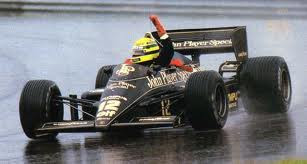
In only his second race for the famous British marquee, Senna won in Portugal – in very similar conditions to those of Monaco 1984. Second placed Michele Alboreto was the only driver not to be lapped, in a clinical and masterful performance in the wet. Not only did Senna edge himself into a great wet weather runner, he developed a close association with the Japanese manufacturer Honda in his time at Lotus, and also the amazing skill he had to pull off a flying lap when the chips were down. Eight pole positions went his way in 1985, and this skill remained in Senna’s book all the way through to his untimely death. Although Schumacher has beaten this statistic now, it took him twelve years to do it after Ayrton’s death. Sixty-five pole positions in 161 races, over 33% is one of the most impressive ratios I’ve ever seen. In his three years with Lotus, Senna achieved 3rd place in the 1987 championship and six wins, including a maiden triumph on the streets of Monte Carlo. However, the British team was on a steady rate of decline and Ayrton elected to jump ship, taking Honda with him to McLaren.

Frustrated by seeing the more superior Williams of Nelson Piquet and Nigel Mansell often get the better of him, despite his undoubted talent, Senna was convinced the switch to McLaren would finally give him the success it craved. There, he was partnered with the Frenchman, Alain Prost, the golden boy of McLaren at the time. Fireworks would explode between the pair, though not initially. The 1988 McLaren Honda was the most dominant car in Grand Prix history, winning 15 of the season’s 16 races. If Jean-Louis Schelesser hadn’t rammed Senna in the closing stages at Monza, it could well have been a clean sweep. Senna won eight races, to Prost’s seven – though the ‘Professor’s’ consistency meant he went on to score more championship points. However, on a countback system, which the sport used at the time, Senna knew that victory in the 1988 Japanese Grand Prix would be enough for his first championship.

The start was a disaster, Senna squandering pole position, and dropping to 14th by Turn 1, giving Prost a colossal advantage. Very quickly, Senna showed the superiority of his McLaren, and charged through the pack. By Lap 16, he was fourth and eleven laps later, was challenging for the lead. When Prost was trapped in backmarkers, Senna seized his opportunity and squeezed past his team-mate on the start-finish straight. It was a clinical piece of overtaking, and a drive that thoroughly deserved to win the championship. Prost was very gracious in defeat, admitting that Senna had been the better driver during the campaign. Apart from a moment in Portugal, when Ayrton had nearly put Alain into the pit wall, their battle had been clean and a joy to watch in 1988. Sadly, the next two years bought politics and accusations to the heartfelt of the game.
Race two of 1989 was the San Marino Grand Prix at Imola. Prost and Senna had entered a gentlemanly agreement, that the man who approached the breaking point for the Tosa hairpin first, would go onto win the race. Senna took pole position and led on the first lap. However, when his good friend Gerhard Berger crashed at Tamburello and his Ferrari burst into flames, the race required a restart. Prost made the better start, and led approaching Tosa. Senna, presuming that the agreement only meant on one attempt, stole the lead into the hairpin and drove into the distance. Perhaps a gentle misunderstanding, but Prost, who finished over a minute adrift, refused to talk to Senna again.
1989 was not a lucky year for the Brazilian, losing certain victories in USA, Canada and Italy due to mechanical problems, whilst he was taken out in Portugal by the already disqualified Mansell. Once again, Suzuka would be the deciding factor in the championship battle, this time with Prost the overwhelming favourite. Senna had to win, to stand any chance of taking the fight to Adelaide. He lost the lead with a poor start, and harassed Prost all afternoon, with little chance of getting ahead. On Lap 47, he closed up and made his move into the final chicane. Prost, knowing that Senna had to win turned into the corner and the accident was inevitable. The two McLaren’s interlocked wheels and slid to a halt. Prost unbuckled his belts and walked away, but Senna kept his engine running and restarted. However, he needed outside assistance from the marshals to get going again. Despite needing to pit for a new nosecone, catching and overtaking the Benetton of Alessandro Nannini, Senna won and was promptly disqualified, for the outside assistance offence. Prost was champion. Ayrton was furious, almost refusing to race in Australia, threatening to walkaway from the sport he loved, believing that a conspiracy had been set-up against him, by Prost and the unpopular FISA president, Jean-Marie Balestre. More allegations and accusations followed, and Senna’s super license was revoked. Had he driven Formula One for the last time?
The following March, he was back, having apologised for his actions and won the season opener in Phoenix. Once more, the fight for supremacy was between Senna’s McLaren Honda and Prost, who had swapped seats with Berger and moved to McLaren’s arch-enemies, Ferrari. For the third successive year, Japan was the deciding point for the championship saga. This time, it was Prost who needed to win to keep his title dream alive. Senna took his customary pole position, but bitterly complained all weekend that pole position was on the dirtier side of the grid. He campaigned for it to be changed, and Prost actually agreed. The officials granted Senna’s request, but Balestre refused to back down. Consequently, Senna vowed that if Prost turned into Turn One first, he would regret it.
Twenty-four hours later and Senna sprinted away, but Prost got the better start and took the immediate advantage. Senna looked for a gap on the inside of the first corner that was simply always going to disappear. The result was catastrophic. The McLaren and Ferrari disappeared into a cloud dust, the pair clambered out of their battered motorcars, neither talking to the other but the outcome of the 1990 FIA Formula One World Championship had been decided in a matter of seconds. Replays clearly put the blame fair and square at the Brazilian’s door, though he defended his actions long after the event. It was a second title for Senna, but bittersweet and distasteful in the circumstances. Only at the same event a year later, with Balestre gone and replaced by Max Mosley did Senna admit that he deliberately ran Prost off the road in 1990. He will and desire to win couldn’t be faulted, but in attempting to knock another car out on purpose was a hideous crime, which on a normal UK road would land you with at least a driving ban, and possibly a jail sentence.
In 1991, Senna won his third and last drivers title, for the umpteenth time at Suzuka, the deciding point of most title battles. Prost fell away and was fired by Ferrari before the season’s end, so it left for a renewed rivalry to remerge between Senna and ‘Il Leone,’ Nigel Mansell. Senna won the first four races in 1991, but as the Williams Renault became the stronger package during the campaign, Senna grew frustrated, realising that McLaren were being out developed by a rival for the first time in his stint with the Woking team. Eventually, reliability and a terrible pitstop in Portugal shot Mansell’s 1991 title dream, but not for the worth of trying. He went wheel-to-wheel with Senna, sparks flying at some 200mph down the backstraight of Spain’s Circuit de Catalunya in Barcelona, one of the sport’s most iconic images.

As the Williams team mastered the active suspension and traction control systems, McLaren drifted further behind the game and Senna had to work especially hard for any of his later victories in his career. 1992 was a major disappointment, as Ayrton finished 4th in the final standings, with just three wins, compared to the nine of the dominant Mansell. Honda pulled out of F1 at the end of the season, and Senna questioned whether he should remain in the sport, especially when Prost ‘vetoed’ him not to drive alongside him at Williams in 1993. Senna was incensed with this, but pot, kettle, black spring to mind when he did the same thing in 1986, to deprive Derek Warwick of a Lotus drive. One of his greatest victories came in Monaco 1992, when he managed to hold off a hard-charging Mansell, who clambered all over the back of his McLaren in the last five laps.
However, he had saved the best for last on a damp, dull Easter weekend in 1993. The venue was Donington Park for the European Grand Prix. Senna, now in a McLaren Ford had qualified 4th and made a bad start, squeezed out by the uncompromising Michael Schumacher on the rundown to Redgate. Undeterred, he out-accelerated the young German on the exit, and then swept past the fast-starting Karl Wendlinger in his Sauber around the outside of the Craner Curves. Next target were the dominant Williams and just three corners later, he went inside Damon Hill to move into second. He tore into Prost’s early advantage and finally, outbraked his chief rival into the Melbourne Loop. He had gone from 5th to 1st by the end of the first lap, definitely the greatest lap in Grand Prix history. Senna won the race from Hill by nearly a full lap.

For 1994, Senna got his dream move to the almost unbeatable Williams Renault squad. With Prost having retired, and Mansell conquering the IndyCars scene in America, this was Senna’s chance to add to his forty-one victories. Sadly, the partnership that promised so much never came to fruition. Senna didn’t like the handling of the FW16, and had a miserable first two races. He spun off and stalled his engine in Brazil, chasing down Schumacher’s Benetton, then was tipped off by an over-ambitious Mika Hakkinen into the first corner of the Pacific Grand Prix. Arriving at Imola, Senna had no points, Schumacher twenty. Autosport magazine claimed he was a man under pressure. He didn’t show it though, focused on his goal to bring Williams back to the top, after an unconvincing start. He blitzed the entire field in San Marino, setting the quickest times in every single session. However, accidents to his countryman Rubens Barrichello and the death of Austrian driver Roland Ratzenberger in qualifying deeply affected Senna. Deep down, he didn’t have the passion to race. Some say he was not on the best of terms with his family, due to his burdening relationship with Adriane Galisteu. Others suggest he believed that Schumacher and Benetton were cheating their way to success, by using the now banned electronic aids. Either way, he put those issues aside, dropped his crash helmet and went out to race. A startline accident put the race under caution behind the Safety Car. On the restart, Senna charged away, determined to pull away from the pest that was Schumacher. On Lap 7, he entered the flat-out Tamburello bend when his Williams refused to turn into the corner. The rest they say is history….
Ayrton Senna may have not endeared himself to everyone. However, his skill behind the wheel of a racing car cannot be questioned, nor could his charitable work he put in for many local Brazilian and worldwide charities. His speed, desire and commitment to win were immense, even if some of his tactics had to be questioned. A devote Christian, Senna believed that God would save him on the racetrack. His death brought shock to the whole world – and the funeral that followed brought Brazil to a complete standstill. Chillingly, he had predicted that the new regulations for the 1994 season would bring serious accidents, possibly even bring the horrible fatality that he feared could happen. On May 1st 1994, the world lost a famous icon, and although Williams found replacement drivers easy to come by, Formula 1 will never see the likes of him.
Ayrton Senna is a legend who leaves an endearing legacy to many, and is a sporting legend that will never be forgotten.
21st March 1960 - 1st May 1994


