HappyDude88's Search

About Me

My photo
Hello, this is Siwri88, better known to some as Simon. Currently work as a picture researcher and product editor with a leading publishing company that works with trading cards and sticker albums on a variety of licenses in sport and entertainment. Freelance Journalist and writing a book in my spare time. Achieved a 2:1 studying BA Hons Journalism at the University of Northampton (2009-2012). Enjoy reading!

Friday, 8 July 2011

The end for the News of the World

By Simon Wright (News and personal piece)


CLOSURE: The final edition of the paper will be on Sunday
AFTER 168 years of exposing celebrities, shaming politicians and campaigning for better human rights, this Sunday will see the final ever edition of the News of the World.  Rupert Murdoch has taken the controversial decision to axe the newspaper, in a desperate bid to bury the phone hacking scandal which has dominated news headlines across the world this week.  Some 200 journalists have lost their jobs as a result of the decision taken by News International at its Wapping headquarters, but chief executive of the company, Rebekah Brooks – who was editor of the paper during the scandal, has remarkably held onto her job.  This morning, Andy Coulson – another former editor of the tabloid paper and former press aide in David Cameron’s coalition government was arrested for his role in the phone hacking, as well as allegations into payment to members of the Metropolitan Police.
     The News of the World has come under significant fire for the phone hacking of famous celebrities and politicians already this year.  Film star Sienna Miller, former deputy Prime Minister John Prescott, PR guru Max Clifford and TalkSport radio host Andy Gray were amongst the victims.  Some of these disputes were being settled with significant compensation packages.  However, the twisted events of the last week have led to the downfall of the biggest selling newspaper in the UK. 
      The trouble started when it emerged that the mobile phone of murdered teenager Milly Dowler in 2002 had been hacked into by rogue journalists.  As the days rolled on, more scandals emerged.  Also targeted were the parents of murdered Soham schoolgirls, Holly Wells and Jessica Chapman and victims of the 7/7 terrorist attacks in London – on the eve of the sixth anniversary.  The final death knell was when it emerged that some families of servicemen who fought for the country in Afghanistan, but never came home also had their phones and voicemails listened into.  Police have confirmed that they have had 4,000 complaints of mobile phones being targeted and the scandal is likely to cost News International £120million.  Media regulator OFCOM is investigating News International’s other businesses, including fellow newspapers under the branch; The Sun and The Times.  It also throws the proposed takeover of BSkyB into severe doubt, with culture secretary Jeremy Hunt forced to delay the go-ahead for the bid until September at the earliest.
QUESTIONS: Murdoch has decided to keep his chief executive
     Murdoch was reeling yesterday.  For a man who loves making news, he looked scared as he desperately tried to escape questions from pressing journalists on a golf course in Idaho, USA.  It seems though that under fire Brooks will keep her job as chief executive of the organisation, despite the cost of many other innocent positions.  Labour leader Ed Miliband, who has criticised David Cameron for his handling of the situation all week, is furious that Brooks still has a job, despite her knowledge of such illegal journalism practices.  He told the Daily Mirror;
     “It’s clearly people power that has forced this decision.  It’s the result of the revulsion that people felt at what happened at the News of the World.  The one person who seems to be staying in her job in chief executive Rebekah Brooks who was the editor at the time Milly Dowler’s phone was hacked.  I don’t think News International can hope to start to move on while she remains in place.” 
     The lawyer for the Dowler family, Mark Lewis is also saddened that those responsible are still in higher positions; “It’s sad that people will end up losing their jobs, but those responsible are still there.”  Current chairman of News International James Murdoch was interviewed by ITN’s political editor Tom Bradby last night.  He gave his full backing to Brooks and insisted he had no choice to announce the pulling of the plug for the paper;
     “The good things the News of the World does has been sullied by behaviour that was wrong.  Indeed, if recent allegations are true, it was inhuman and has no place in our company.  The News of the World is in the business of holding others to account, but it failed when it came to itself.”
     Celebrities have used Twitter to express their views on the newspaper’s axing today.  Singer George Michael said; "Today is a fantastic day for Britain.  These beliefs are in no way an excuse for any of my behaviour in recent times.  I was happy to do my time, because I was so ashamed.  But... I believe every individual, whether privileged or the average citizen, deserves the law.  And many of us rich or poor have been denied it by News International.  You gotta have faith in Karma.  Today it's very real. And I hope the families of Milly Dowler and all the others who died...."
     Former editor of the Daily Mirror Piers Morgan lamented the move, although he did slam their actions; “Shocked and saddened by closure of the News of the World.  Scandals of past week indefensible, but has been a great British newspaper."
     Founded in October 1843, the News of the World has an annual circulation of 3million readers today, despite the powers of 24-hour rolling news, social networking sites and the radical growth of the internet.  It is famous for its hard-hitting interviews and massive investigations that send celebrities into a pit of shame.  Some of its most famous moments included the undercover sting that exposed Sven-Goran Eriksson into agreeing to take over as Aston Villa manager in January 2006.  Eriksson, contracted to England at the time announced his departure after the 2006 World Cup finals just days following the ‘fake sheikh’ investigation.  It has also revealed Prince Harry’s experimentation with drink and drugs in 2002 and the spot-fixing involving Pakistan cricketers during last summer’s test series in England.  Unsurprisingly, the News of the World has also had to fight many libel cases.  England footballers Ashley Cole and Wayne Rooney have received damages out of court for sleazy stories that made the front page headlines, whilst former FIA president Max Mosley used an invasion of privacy into allegations regarding his private life in March 2008.  Mosley won £60,000 in damages, but lost the battle to change privacy laws in the UK only two months ago.  The News of the World has been underneath Rupert Murdoch’s News International banner since 1969.

MY VIEW
My symphony is with those affected by the disgusting practices
Although the celebrity phone hacking scandal is totally the wrong way to go, the cynics would say that to be famous, you are going to get negative headlines and therefore, these sort of practices.  However, once bereaved families are targeted, it becomes totally indefensible and inexcusable.  The practices are sick and I can’t believe that some rogue journalists would stoop so low to get a story.  Clearly there was no news in the world!  I am very saddened by the whole issue and of course, I have every symphony with the families of Milly Dowler, Holly Wells and Jessica Chapman, the 7/7 victims and families who have lost their loved ones at war.  For their families to basically go through the whole nightmare in the public eye once again is really sad. 
     I am not saddened by the closure of the News of the World.  Frankly, I felt the paper was full of unproven gossip and garbage.  I already boycotted The Sun anyways, due my anger over their coverage of the 1989 Hillsborough football stadium disaster.  Who I do feel sorry for are the innocent journalists, who have lost their jobs through no fault of their own.  However, Rebekah Brooks keeps hers.  It is unbelievable that she can still be backed by News International, especially after being the editor while Milly Dowler’s phone was being hacked into.  How can she sleep at night!  If she had any decent piece of soul in her body then she should do the honourable thing and resign.
     I do hope the BSkyB takeover doesn’t go through either.  Murdoch did introduce the concept of 24-hour rolling news into the UK and has revolutionised English football with the Sky Sports Premiership deal.  Great things for sure, but I don’t think it would be in the audience’s interest for a rogue media organisation to own BSkyB, no matter how viable and profitable it is. 
     Will people miss the News of the World?  Honestly, I don’t think so.  The Today newspaper was the last major paper to get the chop and that was owned by Murdoch in November 1995.  No-one remembers it today.  Rumours are already flying around that The Sun on Sunday will be launched, so it will probably just be same stories, and similar angles with different name.
     If there is a winner this week, it has to be Ed Miliband.  The Labour leader has really managed to show some steel and determination to push for change in the British press industry this week.  Miliband has put David Cameron under pressure and for me; the Prime Minister has not been convincing enough.  If Andy Coulson is charged by police, it puts David Cameron in a very difficult and stressful position.
     Ultimately, one of the main losers will be those studying journalism at colleges and universities.  The Press Complaints Commission code needs a total rework and the new restrictions and ratifications that will come into force will just make the job for journalists even tougher.  Fewer jobs will be around and if any budding journalism student had commonsense, don’t work for Rupert Murdoch!  He doesn’t care about people’s feelings; he’s only after money and that’s all he’s ever thought about.  So, he is the male version of Janine Malloy from EastEnders then!
     It has been a sad and damaging week for the British press industry.  The phone hacking scandal has dragged the reputation of many names in media through the mud and there are many losers in this.  The story won’t go away and is going to drag on for the rest of the year, especially with enquiries and investigations likely to continue.  If News International can ditch a newspaper and think it will solve the problems, they are seriously mistaken!
One more message; RESIGN REBEKAH! YOU’RE A DISGRACE! 

TV classics - The National Lottery


By Jason Wright (Entertainment Expert)

IN 1993, the growingly-unpopular John Major Conservative government made one of their few successful moves in office by passing an act to commission Britain a lottery draw.  Camelot Group was awarded the license and The National Lottery was launched.
     Playing the lottery was dead easy, providing the player was 16 years or over.  They needed to select six numbers from a block of 49 for just £1 to be entered into the upcoming draw.  It could be played at virtually any retailer in the country like Tesco, ASDA, WHSmith, Woolworths as well as in post offices and selected petrol stations.  Matching all six numbers would make the player a chance to become a millionaire.
PLAY: 'It could be you!'
     On November 19, 1994, over 20 million people tuned in to BBC1 to see the first ever National Lottery draw with Noel Edmonds overseeing the proceedings.  A jackpot of £6 million was shared between seven people leaving Camelot red-faced that none of them got an exact million pound winning.  Following this spectacular launch, the coming weeks saw The National Lottery Live broadcast from a different location every week with Anthea Turner and Gordon Kennedy hosting.
     In April 1995, it made the permanent switch to broadcasting from the Television Centre with Turner still presenting, though often sharing the now solo role with Bob Monkhouse and Dale Winton amongst others.  It was also at this time when Alan Dedicoat would begin to describe the draw as it happens and the fortune teller Mystic Meg would give physiological predictions on the draw.  Perhaps the most infamous moment in the Lottery’s history came on November 30, 1996 when the draw machine Guinevere, failed to start.  The draw was delayed for around an hour to fix the fault and avoid leaving millions of people demanding refunds.
     1998 saw the start of the transition of the Lottery draw being morphed into a format with a typical Saturday gameshow.  First came Big Ticket with Patrick Kielty and Anthea Turner which although proved to be entertaining, it never really warmed to the public.  Next was Winning Lines with Simon Mayo and then Phillip Schofield in later years.  Other shows given the lottery treatment included Jet Set, In It to Win It, 1 vs. 100 and Who Dares Wins.  As more and more games were churned out, the main lottery became a twice weekly draw with a Wednesday draw and was also joined by sister draws to give viewers more chances to win.  Thunderball debuted in 1999 and the appalling Lottery Extra which got ditched in 2006 (about 6 years too late to be precise!) with the more pleasing Dream Number.
     In May 2006, a protest by the activist group Fathers 4 Justice resulted in the lottery draw being taken off air for several minutes and somehow, managing to finish in time before the Eurovision Song Contest, as that was being held on the same night at its traditional 8pm start time.  This resulted in the BBC taking the inept decision from September 2006 to move the lottery draws to a specially constructed studio inside Lottery HQ.  This was increase security whilst the quizzes were now all pre-recorded and intercut with the draws, still being broadcast live.
     Throughout the years, popularity within the game has declined significantly, resulting in the jackpot prize being much lower than its peak in the nineties.  It is expected because not much progress or improvement can be made in this game unlike many others.  However, the impact that The National Lottery has made on the nation has been quite spectacular and will continue to be played week after week for many more years to come.

TV classics - The Bill

By Jason Wright (Entertainment Expert)

ITV started the eighties with a bit of a drama crisis.  Popular programmes Minder and The Sweeney had been consigned to the history books, so it fell to Thames Television to produce a selection of one-offs to try and launch a new show.  They all failed bar one.  1983 saw the airing of a police drama called Woodentop and ITV were for once impressed.  They commissioned for it to return the following year as The Bill.

     The Bill’s humble beginnings were a basic half-hour show, dealing with general issues in the fictional Sun Hill branch of the Metropolitan Police.  Although not cutting edge as many drama shows that ITV showed at the time, it paid off and soon translated into a twice weekly show.  Eventually, the episodes grew into an hour and it was also very lucky to be one of the few shows to survive on ITV after Thames lost its regional broadcasting franchise.
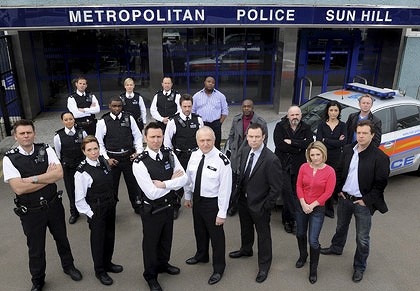
BEAT: The coppers outside Sun Hill police station
     Some of the most popular figures to grace Sun Hill were either usually around for a long time or memorable for deadly deeds.  Characters such as June Ackland (Trudie Goodwin), Bob Cryer (Eric Richard) and Tony Stamp (Graham Cole) were often at the height of the gripping storylines that the show was common for.  In the late nineties/early Noughties, the dodgiest copper was no doubt Don Beech (Billy Murray), who set up a secret second life by running a corrupt business and when unmasked, resulted in the death of a fellow officer.  He soon disappeared to Australia but was eventually tracked down and justice was done.
     The turn of the 21st century saw The Bill make the move into the dark side.  It had covered typical crime stories but now it felt it was ready to tackle more extreme plots.  This was best represented in 2002 with a constant vendetta battle with gangs in the area.  First, veteran Derek Conway (Ben Roberts) was killed when his car was blown up in a petrol attack.  Then the same people responsible for this crime came back weeks later in a petrol bomb attack that exposed Des Taviner (Paul Usher) as a corrupt cop.  Sun Hill erupted in a fireball and the lives of another six officers were lost.
     As the years passed, darker storylines were introduced and several characters paid with their insurances, and most of the recruits were killed off soap stars including Lucy Speed, Ali Bastian and Todd Carty.  Although two live episodes in 2003 and 2005 respectively garnered much praise, the new attitude alienated viewers and ratings declined very sharply.  Surprisingly, ITV didn’t even seem to care about it.
     Eventually, ITV did announce that autumn 2009 would bring a major shakeup, reducing the programme to once a week and move it into the post-watershed slot at 9pm.  Granted, most of the issues raised now were certainly not suited to the 8pm slot but what ITV didn’t get right was the new style of it all.  The new dramatic format took the edge away that it had been famous for and also the famous theme tune was ditched by something that seemed to written more for a funeral.
     Truly the decline of The Bill was now indeed complete.  As ratings shredded even further, ITV had engineered its own downfall so it decided to engineer its death and the police drama quietly slipped away in August 2010.  It was a sad but rather timely demise for a show that had gotten ahead of its time.
     The Bill though did change the conception of drama programmes on ITV.  It made the risks that worked first but then, the repetitive uses of these meant the public got bored and criticised it for its lack of faith.  It will though be always remembered for the quality it delivered.

Thursday, 7 July 2011

F1 classic races - Germany


THIS BLOG HAS BEEN DONE EARLIER THAN THE SCHEDULED DATE OF THE GERMAN GRAND PRIX, DUE TO MY IMPENDING WORK PLACEMENT IN LONDON NEXT WEEK!

IN A new series, I will be looking back at six classic races every weekend from the country about to stage an event in the 2011 FIA Formula One World Championship.  This is my selection, of races staged under the German Grand Prix between 1991 and 2010.  Enjoy the archive!

1994
WINNER: Gerhard Berger (Ferrari), 2nd: Olivier Panis (Ligier Renault), 3rd: Eric Bernard (Ligier Renault)
FERRARI’s victory drought of nearly four years came to an end in the 1994 German Grand Prix, but it won’t be remembered for Gerhard Berger’s dominant victory from pole position.  Instead, it will be remembered for the frightening refuelling fire involving Benetton’s youngster Jos Verstappen.  Verstappen was in fifth place when he came in for a scheduled pitstop.  A fuel filter had been removed and petrol escaped from the refuelling rig, before the Benetton went up in flames.  Amazingly, Verstappen escaped with only minor burns, as did several of his team’s mechanics.  This race would also be remembered for a massive pile-up at the start of the race.  Ten cars were wiped out including Johnny Herbert, Mika Hakkinen, Mark Blundell, Michele Alboreto and Eddie Irvine.  Hakkinen was blamed and earnt a one-race ban for his troubles.  Damon Hill failed to capitalise on a rare engine failure for Michael Schumacher by clouting Ukyo Katayama at the third chicane on the first lap and winding up out of the points.  The high attrition rate allowed the uncompetitive Ligier Renaults of Olivier Panis and Eric Bernard to finish on the podium.  Oh and did I ever forget to mention that Gerhard Berger won this race for Ferrari!

1997
WINNER: Gerhard Berger (Benetton Renault), 2nd: Michael Schumacher (Ferrari), 3rd: Mika Hakkinen (McLaren Mercedes)
IT WAS one of the greatest comebacks in sport.  Gerhard Berger came back from a sinus infection and the tragic death of his father in an aeroplane crash to record his final victory in F1 for Benetton.  He began in pole position and made an unfancied two-stop strategy work.  However, he did earn some fortune, as Giancarlo Fisichella’s Jordan suffered a puncture whilst leading.  Fisichella retired cruelly with suspension damage which allowed the home favourite Michael Schumacher to finish second.  Neither Williams finished; Heinz-Harald Frentzen after a first lap collision with Eddie Irvine and Jacques Villeneuve spun off whilst trying to pass Jarno Trulli’s Prost.

1999
WINNER: Eddie Irvine (Ferrari), 2nd: Mika Salo (Ferrari), 3rd: Heinz-Harald Frentzen (Jordan Mugen Honda
MCLAREN should have secured a 1-2 at the home of Mercedes-Benz, but they blew it, as they did traditionally in 1999 and Ferrari took the maximum points instead.  David Coulthard touched Mika Salo’s Ferrari early on and damaged his front wing.  Later, a stop-go penalty for cutting the chicane whilst passing Olivier Panis compromised DC further and he finished a distant fifth.  World champion Mika Hakkinen was cruising to another victory when a refuelling rig problem at his sole pitstop dropped him to fourth.  A lap later, he passed Heinz-Harald Frentzen, but suffered a 200mph tyre blow-out entering the stadium.  He careered headfirst into the tyres, but escaped unharmed.  Salo drove brilliantly all weekend, but handed certain victory over to team-mate and championship contender Eddie Irvine.  Frentzen completed the podium procedure and there was another notable drive from Ralf Schumacher, coming through from 11th on the grid to a fourth place finish.

2000
WINNER: Rubens Barrichello (Ferrari), 2nd: Mika Hakkinen (McLaren Mercedes), 3rd: David Coulthard (McLaren Mercedes)
RUBENS Barrichello charged through from 18th on the grid to win his maiden Grand Prix in an event full of crashes, overtaking and even a lunatic running across the track during the race.  The 2000 race started spectacularly when home favourite Michael Schumacher tangled with Giancarlo Fisichella, sending both into the barriers at the first corner.  Like in 1999, the McLaren’s of Mika Hakkinen and David Coulthard dominated the early stages before the disgruntled Mercedes employee walked across the road just after half-distance.  The Safety Car came out and Hakkinen was preferred over Coulthard by McLaren, leaving DC stranded back in sixth.  Another Safety Car was deployed after Jean Alesi and Pedro Diniz collided and this was followed by the rain.  Hakkinen and Jarno Trulli elected to pit for wet tyres, but Barrichello stayed out on dry weather tyres and as only the stadium section was damp, it turned out to be an inspired gamble.  The emotion on the Brazilian’s face as he broke down on the podium with his national flag showed how much it meant to him.  The two McLaren’s survived to finish second and third and Jenson Button starred in the Williams.  Having been forced to start at the back of the grid, Button finished an inspired fourth, his best result of a sensational rookie season.

2003
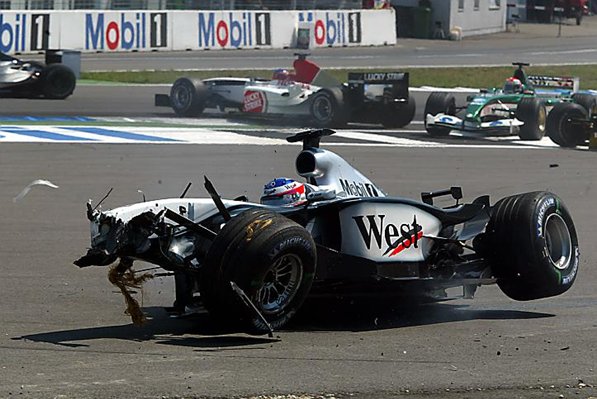
WRECK: Raikkonen's car in tatters, seconds into the 2003 race
WINNER: Juan Pablo Montoya (Williams BMW), 2nd: David Coulthard (McLaren Mercedes), 3rd: Jarno Trulli (Renault)
THE weekend was dominated by BMW Williams at ‘Hotenheim!’  Their drivers, Juan Pablo Montoya and Ralf Schumacher were quickest in every single session, but Ralf was out seconds into the start of the race.  He wandered across the circuit on the rundown to turn one and squeezed Rubens Barrichello between him and Kimi Raikkonen.  The result was the three cars made contact, with Raikkonen’s McLaren connecting hard with the tyre barriers.  All three drivers; championship contenders were eliminated on the spot.  With Ralf out of the way, Montoya was left to win as he pleased, by over a minute.  There was a battle royal for second spot between Jarno Trulli, Michael Schumacher, Fernando Alonso and David Coulthard throughout the race.  Schumacher and Coulthard both passed Trulli, but fate dealt Michael a rare blow, as he picked up a puncture with just three laps to go.  He limped back to the pits and salvaged seventh place.  Coulthard finished second; his first podium since Australia and Trulli, despite being laid by a flu bug all weekend, came third for his first rostrum since Nurburgring 1999.  The result moved Williams to the top of the constructor’s championship and Montoya to within six points of Schumacher.

2009 – Held at the Nurburgring
WINNER: Mark Webber (Red Bull Racing Renault), 2nd: Sebastian Vettel (Red Bull Racing Renault), 3rd: Felipe Massa (Ferrari)
HAVING fought back from a leg breaking shunt in pre-season, Mark Webber finally ended years of bad luck and misfortune to win his first Formula One Grand Prix.  Webber started on pole position, but his aggressive defence on Rubens Barrichello in the rundown to turn one earnt Webber a drive-through penalty.  Despite this, he put in the drive of his life; at times lapping over one second quicker than his nearest challengers.  The cooler track temperatures, coupled with a three-stop strategy and a faulty fuel rig turned a possible podium for Barrichello into a very frustrated sixth place result.  Afterwards, he launched an extraordinary attack on his team for making him ‘lose the race.’  Sebastian Vettel was outshone by Webber on his home ground all weekend, but completed a Red Bull 1-2, whilst Felipe Massa made a welcome return to the podium for Ferrari.  Force India lost the possibility of their first points in the sport, when contact with Kimi Raikkonen left Adrian Sutil without a front wing.  Sutil was left back in 16th at the end, when fifth place was possible at the finish.

F1 classic races - Britain


IN A new series, I will be looking back at six classic races every weekend from the country about to stage an event in the 2011 FIA Formula One World Championship.  This is my selection, of races held at Silverstone between 1991 and 2010.  Enjoy the archive!

1994
HOME: Success for Hill amidst controversy in 1994
WINNER: Damon Hill (Williams Renault), 2nd: Jean Alesi (Ferrari), 3rd: Mika Hakkinen (McLaren Peugeot)
MICHAEL Schumacher was coasting away with the 1994 championship, but lost his head at Silverstone, which turned the season on its head.  Having been beaten to pole by 0.003secs, Schumacher overtook Damon Hill’s Williams on the formation lap, not once – but twice!  Although he leapfrogged Hill at the first round of pitstops, Schumacher was shown the black flag on lap 22.  The Benetton team challenged the decision, with the German ignoring the order to come in and serve a five-second stop-go penalty for another seven laps.  Hill won the race, whilst Schumacher was disqualified afterwards and banned for two races for his transgression.  Mika Hakkinen earnt a much-needed podium for the McLaren team, despite a last lap run-in with Rubens Barrichello, but team-mate Martin Brundle’s Peugeot engine erupted in a ball of flame when the lights turned to green, leaving the Brit furious and stunned.

1995
WINNER: Johnny Herbert (Benetton Renault), 2nd: Jean Alesi (Ferrari), 3rd: David Coulthard (Williams Renault)
THE championship contenders clashed, which allowed the popular and usually unlucky Johnny Herbert to register his first ever Grand Prix win.  Damon Hill was on pole again, and led the early exchanges, but Benetton once again outdid Williams on strategy and had Michael Schumacher infront.  On lap 46, Hill, desperately wanting to take advantage of fresher tyres, made a desperate dive up the inside into the Priory bend and took the pair off into the gravel.  Hill insisted it was a racing incident, whilst the champion pointed the blame squarely at Damon’s door.  Herbert inherited the lead, but lost it to David Coulthard.  However, the Scot got a pitlane speeding penalty and dropped to third, so Herbert got his lead back and won the event.  Rubens Barrichello had a lucky escape when his Jordan nearly flipped the gravel trap after late contact with the McLaren of Mark Blundell.

1998
WINNER: Michael Schumacher (Ferrari), 2nd: Mika Hakkinen (McLaren Mercedes), 3rd: Eddie Irvine (Ferrari)
FORTY laps into the 1998 race and Michael Schumacher’s chances can’t have looked great.  On a wet day, his Ferrari was no match for the dominant McLaren’s of Mika Hakkinen and David Coulthard.  However, Coulthard spun off on a puddle whilst lapping the Benetton of Giancarlo Fisichella.  With the rain level intensifying, Hakkinen spun off at Bridge and did some front wing damage to his car.  The Safety Car was deployed and Mika’s 40 second lead was washed away.  On lap 51, he ran wide at Becketts and Schumacher powered past, opening up a 20 second lead.  However, rather than a time penalty, he was wrongly given a ten second stop-go penalty with three laps to go.  The offence was for passing Alexander Wurz under waved yellows whilst Jos Verstappen’s Stewart was recovered.  On the last lap, Schumacher entered the pitlane to serve his penalty, crossing the startline in the process.  He effectively won the race in the pitlane.  McLaren appealed the result, but lost in the Court of Appeal, meaning Schumacher made it three wins in a row.  

1999
WRECKED: Schumacher's title hopes after his 1999 failure
WINNER: David Coulthard (McLaren Mercedes), 2nd: Eddie Irvine (Ferrari), 3rd: Ralf Schumacher (Williams Supertec)
DAVID Coulthard’s first triumph at Silverstone was overshadowed by the accident that ruined Michael Schumacher’s title chances.  Schumacher made a bad start from the front row of the grid and dropped behind Coulthard and team-mate Eddie Irvine.  As red flags were waving due to the stalled cars of Jacques Villeneuve and Alex Zanardi, Schumacher went to overtake Irvine on the Hangar Straight when he suffered a rear brake failure and pitched off the road at Stowe gravel trap, hitting the tyre barriers head-first.  Despite attempting to exit the cockpit on his own, the German realised his leg was trapped in the wreckage and had to be treated by marshals with a broken tibia and fibula in his right leg.  On the restart, Mika Hakkinen led away, but lost a wheel and was forced to retire with a faulty wheel hub.  Irvine overshot his pit box on his first stop, handing the lead and the race to an overjoyed Coulthard.  Considering he didn’t know the well-being of his brother, Ralf Schumacher raced brilliantly to a podium result for the Williams team and Damon Hill led a lap and finished a fighting fifth on his final British Grand Prix appearance.

2003
WINNER: Rubens Barrichello (Ferrari), 2nd: Juan Pablo Montoya (Williams BMW), 3rd: Kimi Raikkonen (McLaren Mercedes)
RUBENS Barrichello won a crazy race in 2003, after pulling off some stunning overtaking manoeuvres.  He started from pole, but slipped to eighth on lap 11 as crazed religious lunatic Neil Horan ran onto the Hangar Straight and started waving signs about the bible as the cars were doing almost 200mph.  The Safety Car was sent out and the scramble saw the likes of Juan Pablo Montoya, Michael Schumacher and Fernando Alonso tumbling down the order.  Barrichello produced amazing passes on Ralf Schumacher, Trulli and Kimi Raikkonen and was a great winner of a great race which was full of overtaking.  Raikkonen ran wide at Stowe with 11 laps to go, gifting Montoya second place.  Michael Schumacher fought back from 14th place to fourth to maintain his title advantage.  By use of a lucky strategy, 2002 CART champion Cristiano da Matta did a great job to lead the race for 17 laps, before finishing seventh.

2008
WINNER: Lewis Hamilton (McLaren Mercedes), 2nd: Nick Heidfeld (BMW Sauber), 3rd: Rubens Barrichello (Honda)
UNDER pressure from two dismal performances in Canada and France, Lewis Hamilton arrived at Silverstone in desperate need for a result.  He produced a mesmerizing drive to win by an entire minute, lapping at times, some seven seconds a lap faster than anyone else.  His team-mate Heikki Kovalainen claimed his first ever pole position, but was all at sea on raceday and finished a lapped fifth.  Hamilton was under pressure from Kimi Raikkonen early on, but Ferrari made the decision to keep Kimi on old tyres and the move backfired.  Raikkonen dropped down to 11th, before recovering to fourth.  Renault made a similar mistake with Fernando Alonso, which left the Spaniard down in sixth.  At the height of a tropical downpour, Nelson Piquet and Robert Kubica were caught out and lost possible podium finishes.  With championship leader Felipe Massa having a dire day, spinning five times and ending up last, this allowed the BMW Sauber of Nick Heidfeld and Honda’s Rubens Barrichello to take the final two podium positions.  Barrichello’s came from 16th on the grid, when the Honda team took a gamble on extreme wet weather tyres and started lapping 15 seconds quicker than the midfield.  However, the 2008 British Grand Prix belonged to McLaren and Lewis Hamilton who showed he was the new ‘rain master.’

Wednesday, 6 July 2011

TV classics - Dream Team

IN OCTOBER 1997, Sky One and Hewland International came together to produce a football drama that no-one can live upto.  For ten years, viewers were gripped by ‘Dream Team,’ a series focusing on the events of a fictional club in the West Midlands, Harchester United.  For the first time ever, viewers got to see the makings of a football club and what really happens behind the cameras.  The show ended in June 2007, after 419 episodes full of murder, explosions, shootings, affairs, gambling addictions, pregnancy, battles for controls, match-fixing, bribery and murder trials.  Yep, Dream Team pretty much covered every base possible.  You wouldn’t want to be around this football club, because ten years of drama at Harchester United feels like the drama of an average family in their lifetime put together!
LOGO: HUFC emblem
     Dream Team began on Tuesday 15 October 1997, initially making two 30 minute episodes every Tuesday and Thursday.  The first series focused on the youth team, but for the following nine series, attention switched to the senior squad.  From series four (2000) onwards, the show moved into a successful one-hour Sunday evening slot.  At the height of its peak, Dream Team was Sky One’s most watched programme, with nearly two million (good figures) for a Sky show tuning into the series four finale, which culminated in the murder of unpopular chairman Prashant Dattani (Ramon Tinkram).
      The match action was used with permission from the FA Premier League and use of the Sky Sports archives, with a lot of the filming taking place at Millwall’s New Den ground.  The show proved the fronting ground for a lot of talented actors and actresses.  Jamie Lomas and Ricky Whittle became Hollyoaks icons, Rob Kazinsky likewise in EastEnders.  Duncan Pow is a hit with the Holby City fans, Stefan Dennis was the owner for a season in his break from playing evil Paul Robinson in Neighbours and Chucky Venice went into a similar show; Footballers Wives, after his Dream Team experience.  There were also a series of guest appearances from familiar football faces including Dennis Wise, Andy Gray, Harry Redknapp, Neil Warnock, Richard Keys and Alan Curbishley.
     The football might have been reality, but the off-field sagas that gripped the show were spectacular enough.  In series five, Harchester's first-team squad was travelling to the airport for the UEFA Cup final against AC Milan when it crashed off the M1.  Three first-team squad members were killed.  The following year, goalkeeper Jamie Parker (Jim Alexander) held the first-team hostage in 'The Siege,' in some of Dream Team's finest and grittiest scenes to be filmed.  After a tense stand-off with police, Parker was eventually gunned down to his death.
      The two most popular characters in the history of Dream Team were Lynda Block and Karl Fletcher.  Played by Alison King (now better known for playing Carla Connor in Coronation Street) and Terry Kiely, they were stalwarts in the show from its early beginnings.  Kiely’s character, Karl Fletcher was in the show from the first series and became instantly known for his ‘playboy’ lifestyle.  His character was a goal machine, helping Harchester to FA Cup success in 1998.  After an unhappy stint in Spain, playing for Real Mallorca, Fletch returned to Harchester and was accused of the murder of Dattani at the start of series five.  At the resulting trial, he was found guilty of his murder, before Lynda came clean at the last moment to reveal it was her who had struck the final blow.  Rather than be angry with her, Fletch and Lynda went onto have a steamy affair, but Sam Irving (Stefan Dennis) found out and called off the nuptials between him and Lynda at the altar.  With Lynda in jail, serving time for Dattani’s murder, Fletch went onto marry physiotherapist Abi O’Leary (Rachel Brady), and looked set to settle down at long last.  However, a crippling tax bill and a power struggle against manager Patrick Doyle (Shaun Scott) led to Fletch departing at the end of the sixth series for Saudi Arabia, in a bid to solve his money troubles.  He eventually divorced Abi, after she had a fling with French footballer Marcel Sabatier.  In series eight, Fletch returned to Harchester unexpectedly, but was struggling for fitness and was never deranged manager Don Barker’s favourite person.  In a showdown for supremacy, Barker murdered Fletcher in the changing room against a coat rail in the penultimate episode of series eight. 
     Lynda Block arrived in series two, as the wife of Chairman Jerry Block.  She got bored with Jerry quickly, and was soon having a sizzling affair with Latino player-manager Luis Amor Rodriguez (Martin Crunes) in one of Dream Team’s greatest ever storylines.  When Jerry’s dodgy dealings were exposed in series three, Lynda took over as chairwoman, but broke up with Luis when he went to play in Argentina for Boca Juniors.  So, Lynda continued her likings in Harchester managers, and went onto bed Ray Wyatt (Mark Moraghan), destroying his marriage.  However, series four was a power struggle for Lynda, with regular run-ins with the unpopular Dattani and a financial crisis that in the end saw her lose control of the club.  To compound matters, her affair with Ray was exposed to the press and sleazy local journalist Paul Hankin.  The resulting stress caused her to lose the baby she and Ray had been expecting.  In the final episode, Lynda’s patience finally snapped and she killed Dattani and ended up in jail at the end of the following series.  Series five was more of the same, with Lynda serving her time in prison after the breakup of her potential marriage to Sam Irving, as she was carrying on with Fletch.  She was released on a technicality three years later, on the day of Harchester’s darkest moment.
     The match-fixing scandal in the 2003-2004 campaign, caused by controversial chief executive Pilar Hernandez (Marem Hernandez) and bitter ex-player Stuart Naysmith (Terence Maynard) led to a chain of events which ultimately conspired to the death of the HUFC squad in Cardiff.  UEFA relegated Harchester United to the Coca Cola Championship and sweeping changes for the pre-season saw the feisty Don Barker (Jon Morrison) come in as the club’s new manager.  From the outset, Barker did things his own way and wouldn’t take any prisoners.  Clyde Connolly (Timothy Smith) couldn’t take it and jumped off the stadium after a Champions League match and Barker eventually lost his job over a sex scandal.  Having taken a position as West Ham’s director of football, Barker’s ultimate aim was to finish off Harchester.  He killed Fletch, revealed the secret of an affair between Ryan Naysmith (Ricky Whittle) and Chelsea Wright (Karen Ferrari) which drove nutty Viv Wright (Phillip Brodie) into a fit before the Championship playoff final.  After Harchester beat West Ham 1-0 to secure their place back in the Premiership, Barker wasn’t going to take it lying down.  So, he drove his cordoned off BMW, with petrol cans and Fletch’s body in the boot into the Harchester team coach.  The coach exploded, killing all but three of the first-team squad.
     Sadly, despite a new look and new characters, the glory days of Dream Team had come to an end.  Storylines either got boring or more sensationalised and in April 2006, it was decided that the show would be axed after a tenth and final series.  The tenth series focused on a storyline which evolved around the ‘Dragonslayer,’ a mysterious individual, exposing the secrets of the club.  The show bowed out with the offices of the Dragons Lair, Harchester’s ground going up in flames thanks to a dropped cigarette.  It was a disappointing conclusion, as no-one knew whether the ground exploded, killing thousands or Harchester won the Premier League title on the last day of the season.
     Dream Team certainly had its day and was quality football drama.  It has every right to be called a ‘TV Classic,’ especially if you liked the match action, attractive women and dramatic cliff-hangers.  Although a campaign for the ten series on DVD to be released has failed, the fictional legacy of Harchester United remains in the blood of many fans of the show.  There may be no revival, but the memories will remain forever.

More information on Harchester United can be found at http://www.harchester.net/ and http://www.harchester.tv/, where the latter continues the story where the TV drama ended for approximately another season and a half.

Tuesday, 5 July 2011

Wimbledon 2011: Changing of the guard


THE 2011 Wimbledon championships were another great spectacle of tennis.  Fans were treated to many epic matches, some stunning surprises and a real changing of the guard over the past fortnight.  We now have two brand new Wimbledon champions.
NEW: A dominant year for Novak Djokovic continued at SW19
     Novak Djokovic is now the men’s world no.1 and rightly so.  He has only lost one match in this entire year, which was a belting semi-final against Roger Federer at Roland Garros.  On Sunday, the Serbian achieved his ultimate dream by beating the former no.1 and defending champion Rafael Nadal in four sets.  On an overcast day on Centre Court, Djokovic smashed his way to a 6-4, 6-1, 1-6, 6-4 victory, continuing an incredible run of form, which he has had since leading his country to Davis Cup glory last year.  Having been a fierce critic of his in the last couple of years, I’m delighted to see Djokovic’s hard work and dedication of the game finally pay off.  His form in the second set was incredible, one of the best sets I’ve ever seen played at SW19.  He dismantled Nadal and made the grass court expert look very average.  Nadal wasn’t at his best, there’s no doubt about that in a final that won’t go down as a classic, but it was a fascinating scrap all the way through.  He will be back next year; the Spaniard wondering how he can bring Djokovic down, as Novak has now won their last five head-to-head battles.
     Once again, Nadal crushed the Grand Slam dreams of Andy Murray, as he beat the fiery Scot in four sets in the semi-finals.  Murray played some brilliant tennis in the first set, winning 7-5.  Unfortunately, he missed an easy forehand chance at 2-1 (15-30) on Nadal’s serve in the second set.  He then proceeded to lose the next seven service games; something you just can’t do in any Grand Slam semi-final.  Murray will be disappointed; he was in great form going into these championships, with victory at Queen’s Club and a best-ever run to the semis at the French Open.  At Wimbledon, he played some stunning shots to beat Ivan Ljubicic, destroyed Richard Gasquet in round four and turned the quarter-final against Feliciano Lopez into no more than a training exercise.  There isn’t much else Murray can do, apart from get a bit more luck on his side.  I still believe he will win a Grand Slam in the future, but the dream of a British champion at Wimbledon is fading fast.
      For the second year running, Roger Federer exited the tournament at the quarter-final stage.  Federer was eliminated in the match of the tournament; as he threw away a two-set lead to lose in five to Jo-Wilfred Tsonga.  Tsonga, who pushed Murray all the way in the Queen’s club final and has reached the Australian Open final in the past, played some sensational tennis and although Federer didn’t’ play badly, he didn’t get another break point after the first set, which shows how well the Frenchman played.  Roger is now 29 and like Murray, certainly has the ability to win Grand Slams, but Pete Sampras record of seven men’s singles titles at Wimbledon looks safe for now.  The Nadal threat and the emergence of Djokovic has made things very tough now for Federer on the ATP tour.  On his day, he still can dismantle anyone, but I do think that the Swiss genius has had his best years.
      Two other former Grand Slam winners who exited early from SW19 and need to seriously consider their futures are Lleyton Hewitt and Andy Roddick.  Hewitt, the 2002 champion here, has slipped outside the top 100 and lost in round two, from two sets up against no.5 seed Robin Soderling.  No-one can criticise Lleyton Hewitt’s determination.  It is still there in abundance, but he isn’t getting any younger and might want to consider his next move, especially as Australian tennis is now in safe hands.  The emergence of 17-year old qualifier Bernard Tomic was one of the stories of the championships.  Tomic knocked out former semi-finalist Xavier Malisse and Soderling on his way to a battling four set quarter-final loss by training partner Djokovic.  I would mark Bernard Tomic down as a star of the future.  As for Roddick, he made another whimpering exit on the first week, going down in straight sets to Lopez on Centre Court.  He missed Roland Garros recently with a shoulder problem and has no chance of making the top five anymore.  In fact, Mardy Fish is now American no.1 and his quarter-final run at Wimbledon is just going to push him infront of Roddick further.  Maybe it’s time for Andy to hang up the racquet, because he will never win a Grand Slam again and I’m so sure of that, someone can hit me round the back of the head with a shoe if he does! 
NERVE: Petra Kvitova held hers to become a surprising champion
      It might have been the return of the Williams sisters that caught the attention in the women’s game, but we have a new champion instead, from the Czech Republic.  Does that sound familiar?  20-year year Petra Kvitova, the eighth seed at Wimbledon became the first left-hander to win the women’s dish since her compatriot Martina Navratilova won her ninth and final singles title in 1990.  With Navratilova and fellow former Czech champion Jana Novotna in the Royal Box watching on, Kvitova produced a performance of power and class to beat the 2004 champion Maria Sharapova in straight sets, 6-3, 6-4.  Sharapova made too many errors in a final where breaks of serve were the order of the day.  However, it was Kvitova who held her nerve longest to become the youngest winner here since Sharapova herself seven years ago.  As for the Williams sisters, both exited at the fourth round this year.  Venus Williams lost in straight sets to her conqueror from last year, Tsvetana Pironkova and Serena suffered a similar fate at the hands of 2007 finalist Marion Bartoli.  For the game, it was a real bonus to see the Williams sisters come back and actually not waltz into the final.  Both have suffered injury problems in the last twelve months and for Serena, it was even more critical than injury and they will be back, because the hunger of the game doesn’t seem to have diminished from either of them.  Like Federer though, I do think their best days have gone.  
AMAZING: Run of form which shows Lisicki's true potential
     Finally, for me, the fairytale of the championships was the form of German wildcard Sabine Lisicki.  Lisicki missed the whole of 2010 with a career threatening ankle injury, after breaking into the world’s top 20 a year earlier.  She produced one of the individual performances of the championships to send the French Open champion and many people’s favourite for glory, Li Na in the second round.  Lisicki’s emotion on Centre Court afterwards had to be felt, after what she has been through.  She also knocked out Bartoli in the last eight, before coming up fractionally short against Sharapova in the last four.  If she avoids injury problems again, I think Lisicki has all the class and ability to become world no.1. 
     The balance of power has shifted in both the men’s and women’s game.  Novak Djokovic has many Grand Slam victories to come and messers Nadal, Federer and Murray have a lot of work to do to stop the force of Djokovic.  In the women’s, the talents of Lisicki, Kvitova and Pironkova, combined with Sharapova’s return to formidable form means the days of underachieving from Jelena Jankovic  and the Williams sisters domination is well and truly over.  Both genders have prosperous futures and overall, it was a great 125th championship.

Many congratulations to Petra Kvitova and Novak Djokovic on their glory at Wimbledon in 2011.

Monday, 4 July 2011

Italy MotoGP 2011: Lorenzo fights back in Mugello


YAMAHA’s revival in this MotoGP season continued with Jorge Lorenzo’s sensational victory in the Italian Grand Prix yesterday.  Lorenzo rode the race perfectly, biding his time on the Mugello circuit to record his second win of the season and narrow the gap on runaway championship leader Casey Stoner.  His cause was helped by Andrea Dovizioso finding a way past Stoner on the last lap to snatch second place.
     The writing looked on the wall again when Stoner cruised to pole position in a damp Saturday qualifying session.  It looked like those fears were going to be answered as he led the group of 16 riders into the first bend.  Lorenzo rocketed up from fifth on the grid into second, then got involved in a private scrap with Dovizioso, who on his home circuit, was having his best ride of a consistent season so far.
      Further back, Nicky Hayden ruined his chances of a strong finish when he went into the gravel trap on the second lap and there were more woes for Britain’s Cal Crutchlow.  Having started seventh, the rookie, still clearly in pain as he continues to recover from the broken collarbone he suffered at Silverstone slipped to tenth, before retiring for the second weekend running, once again with tyre troubles.
PERFECTION: Lorenzo overpowered the Honda's in Mugello
     Tyre problems also hampered Stoner’s challenge.  The Australian began to run out of grip on his front tyres and Lorenzo, having finally overhauled Dovizioso was ready to pounce, which he did with seven laps to go.  This was a battle of who could look after their tyres the best, and it was the world champion who easily won this duel.  Stoner was powerless to resist Dovizioso, who made a brave and aggressive pass on the last lap, which nearly had his team-mate running into the back of him.  To show Honda is a great team unit, Stoner congratulated Dovizioso afterwards in the paddock, which was good to see – something he won’t have done in his Ducati days.
      With Valentino Rossi struggling, the partisan Italian crowd was left for Dovizioso to provide the podium celebrations.  He was elated with his second spot, one step higher than what he achieved in the corresponding event last season.  It also keeps him in a comfortable third in the standings.  However, he was no match for Lorenzo, who cruised home to record his first dry win of the season.  Behind Stoner, Marco Simoncelli and Assen race winner Ben Spies had a private and intense scrape for fourth spot, which Spies won, bullying his way past on the last corner.  Once again, Simoncelli missed out on the maiden podium he was chasing, but at least he managed to stay on his bike this time around!
     After a great battle with Alvaro Bautista and Hector Barbera, Rossi fought hard to sixth spot on his stomping ground, which was the maximum he was going to achieve here.  Barbera got his best result of the season in seventh, whilst Bautista faded badly to 13th, another sufferer of the softer Bridgestone tyres.  Finally, Dani Pedrosa made his long-awaited return to the paddock, but clearly wasn’t 100 per cent fit all weekend.  After a shocking start, which saw him second last at the end of the first circuit, he did well to come back to eighth.  Although his championship bid is in tatters, Pedrosa can play a major part in the destiny of where the title may go, depending on his fitness levels.
      After four races in five weeks, the teams will be relieved of a week off, before the next battle at the formidable Sachensring circuit in Germany.  However, Jorge Lorenzo proved here in Mugello that this title scrap in the 2011 MotoGP season isn’t a write-off and is still alive and kicking.

Friday, 1 July 2011

Video games - An addictive, but not excessive hobbie

By Simon Wright (Personal piece)


AS I sit in my place in Northampton, counting down the days until I go home to Milton Keynes for the best part of two months, I think a bit more about one of my hobbies that I have enjoyed and have entertained me for a long time, the video game.  However, before anyone jumps to any conclusions, it’s only an addictive trait of mine – I’m not one of those freaks who drink gallons of coffee, stare into the TV screen excessively and do permanent damage to my eyesight.  If you have that life, then that’s fine, but it must cost an absolute fortune in prescription glasses, so I hope it’s worth it!
     I remember my first console machine, which was the Sega Mega Drive.  Playing classic games like Sonic the Hedgehog, NFL 93, running rings around American football teams with the Miami Dolphins and the early FIFA games, which let’s face it, were terrible, as the players looked like mushrooms and the football was a paper ball, when you could make a better version in nursery!  Nevertheless, the Mega Drive was a great breakthrough in gaming technology and ultimately, Sega’s best attempt at a console.  The Dreamcast was an utter disaster and as for Sega Saturn, I don’t have any words to describe that are nicer than rubbish!
     My view of gaming changed in 1997, through one of the most powerful slogans I can remember and one of the best TV commercials I ever saw.  The ‘Double Life’ Playstation ad really spoke to me.  Sony had created a monster as far as I was concerned and what I mean by that, that’s a monster of beauty.  I mean, who couldn’t be appealed by ‘Do Not Underestimate the Power of PlayStation.’  I certainly didn’t and through the PlayStation and PlayStation 2 – I was blessed with Sony games for the next 12 years.  I have every single Formula One title, got appealed by Crash Bash, drove like a maniac on Crazy Taxi and The Simpsons Road Rage, became a legend on the WRC rally games and of course, the football battle between FIFA and ProEvo, which in those days, FIFA was winning hands down.
     What were my favourite PlayStation memories?  It’s difficult to choose actually, though I remember one of my friends commentating on some football game which I think involved Ronaldo (the chubby Brazilian that is!) and Barry Davies, the legendary BBC voice actually telling him to shut up!  Whether it was an error with the game or the console, I don’t know, but quite impressive I thought!  Then, there was Murray Walker, who’s excitement was crystal clear on the early Formula 1 games, with terms shouted out like; HE’S JUST HIT DAMON HILL! OR FISI-C-H-ELLA, Martin, it looked like he hit the wall there.  I like Murray’s dedication, even for your finish.  Say, if you had finished 19th, he’d mention it.  “19th; Shinji Nakano (Another Japanese idiot who had no credentials btw) – well his team boss won’t be happy with that result!”
SMART: My clever collection of XBox 360 games in my flat
     Ultimately, the PlayStation 3 never quite appealed to me, but the Xbox 360 did.  I often would trial the Xbox in Zaavi (an entertainment store before it went bust during the recession.)  I got a taste for the new type of gaming; the better graphics, the more virtual reality experience and I wanted a machine to myself.  In 2009, my brother and I got one of the Arcade versions and I bought a newer, 4GB elite version for myself last summer to go into my room whilst at University.  My greatest achievement on the Xbox has to be either winning the FA Cup on World Class difficulty with the legendary Coventry City (hope Farida’s still proud haha!) on FIFA 11 and winning the 2011 FIA Formula One World Championship with Virgin Racing, the ultimate backmarkers in the sport in real life!  So I guess, this proves I’m a king of racing games.  I’ve even taken the plunge into karaoke and been trying my art at the Lips singing games.  Sadly, I can’t sing but it’s still a laugh to perform classics like ‘Karma Chameleon’ and ‘Tubthumping,’ then also embarrassing songs such as ‘Barbie Girl,’ and ‘Wannabe,’ by the Spice Girls!  Oh dear!
CONTROL: The XBox 360 is the console to have at the moment
     For me, I like to play at least an hour a day if I can, because it means I can escape into the virtual reality world, especially if I have had a bad day.  I can have bad days on the Xbox and not get anything right on the game I’m playing.  For people who know me, they know that I can get really competitive.  I simply hate losing to the computer!  For me, it mocks me when that happens.  Sometimes, I can accept it and move on, especially when the computer beats you fair and square, but it gets frustrating when you batter an opposition with 36 attempts on goal, yet still lose 1-0!  That’s when you do think, Grr!  And don’t get me near a tennis game, because when I play a bad shot, the profanity that comes out of my mouth, because I’m annoyed tells its own story!
     So, as you can see, I love the video game and can have addictive crazes to certain games (The Sims 3, how sad am I!) but, I know when to stop and not carry on.  The most I’ve ever played without taking a serious break ever is around four hours.  Normally, an hour a day (two when I have nothing to do) is enough for me and gives me the satisfaction without becoming excessive.  Plus, it might be gripping, but how can playing the likes of Halo, Call of Duty etc like non-stop for 30 hours straight be entertaining, interesting and healthy!  Those who do that, its your life, but you are wasting away.  Enjoy your gaming in moderation and it will feel better is my tip.  I mean, it’s worked for me for the best part of 15 years, so why shouldn’t it for anyone else.  
     If you say to me ‘I love excessive gaming and it’s my life,’ then your need your brain testing!  Forget scoring an attractive girl if that’s the case, because she can do much better!  Balance is an important asset of life, so don’t go down the excessive gaming route.  I lot of people will just reject you, it’s as simple as that.  Good afternoon and goodbye!  

News Corp sells MySpace to Timberlake


STAR of one of the hit films in 2010, Justin Timberlake now has his own Social Network.  The actor and singer, who featured heavily in the film about the birth of Facebook, now own MySpace, alongside another US advertising agency.
     News Corporation have decided to sell the social networking site, which in recent years, has really struggled to keep up in the social network world, largely thanks to Facebook’s domination and the rise of Twitter.  The deal is thought to be around £22million, but falls well short of the £60million that News Corporation wanted for the company.
     With Timberlake’s help, the new owners are hoping to be able to revive MySpace’s fortunes.  Understandably, Timberlake is delighted and sees some promising opportunities for his new venture;
“I’m excited to help revitalise MySpace by using its social media platform to bring artists and fans together.”
     Under the deal, News Corp will retain a minor five per cent stake in MySpace, and now has holdings in the US firm that has teamed up with Timberlake to thrash out the deal, believed to be Specific Media. 
UNPOPULAR: Can Timberlake turn around the fortunes of MySpace?
     MySpace has been around on computers, phones and various networks since 2003.  News Corp has owned MySpace since 2005 but in the last three years, it has simply failed to cope with the excessive craze people have for Facebook.  I know this personally, having had a MySpace account myself in 2007, but deleted it last year, due to the lack of use of the site.  The early plans for the change in MySpace will be to boost its content of music videos, blogging and original TV shows.
     It is a brave move from Justin Timberlake to enter into the social networking world and he will need to spend a lot of time to eclipse Facebook and turn MySpace into a worthy and strong challenger again in this particular genre.

Pension strike action take place


THOUSANDS of people went on strike yesterday against the coalition government’s controversial public sector reforms over work pensions.  It might not be the end of the industrial action either, with the unions warning of further action if the government don’t back down on their policies.
UNITED: Strike action and peaceful protests were the order of the day
     Yesterday, thousands of schools were shut across England and Wales, with passport control at airports, courts and driving test centres also being significantly affected.  Earlier in the week, around 750,000 people were thought to be striking, with the figure thought to be much lower on the actual day.  600,000 is the estimated amount, with some 20,000 disgruntled workers protesting in the streets of London.  Despite this, the unions insist that it was a success in the biggest day of strike action taken in Britain for five years.
     The other pleasing significance was that in towns and cities across the country, the protests were in good spirit.  Although a small minority of people were arrested in London and Brighton for criminal damage and harming the peace, it was good to see peaceful protests, which sadly didn’t happen with the angry demonstrations following the rise in tuition fees in November and December.  However, the unions will be annoyed by Downing Street’s admission that the disruption of these strikes was ‘minimal.’
     Both have sides to this argument.  The government pointed out to statistics released from the Cabinet Office, which suggested that not even 20 per cent of the civil service workforce went on strike.  In return, the PCS Union, which runs the police and border/immigration department, said that 84 per cent of its staff went onto the picket lines, with the Metropolitan Police being forced to draft people in from other areas.
     Prime Minister David Cameron has described the strikes as ‘wrong,’ and the leader of the opposition, Ed Miliband is in agreement over this.  However, Miliband has accused the government of ‘wreckless behaviour,’ which led to a fiery showdown between the pair in Prime Minister’s Questions on Wednesday morning.  Brendan Barber, General Secretary of the TUC told Sky News that he hoped this sort of action doesn’t have to happen again;
“I’m a firm believer of negotiations and as I’ve said, I hope we’re going to be able to resolve this through negotiations – without the need for further industrial action.”
     It was schools, who were significantly affected by the walkouts yesterday, with nearly 5,000 schools partially closed and another 5,069 totally shut in England.  Three teaching unions staged strike action, which left Education Secretary Michael Gove unimpressed.  He said at the House of Commons that the planned walkout was “unnecessary, premature and disruptive.  This strike, at this time, will not help out schools.”
     It is difficult to judge if there were any winners, if there were any yesterday.  However, don’t be surprised if there’s more action to come and for more disruption, as this is an issue for the government that simply isn’t going to go away.